
 Call us today at 1-888-758-7527

In Praise of UFC Fighter Nate Diaz
This Marty Gallagher essay is a fight-culture appreciation piece, not a generic athlete profile. The subject is UFC fighter Nate Diaz, but the deeper topic is combat character: heart, pain tolerance, defiance, comeback capacity, and the strange code that separates fighters from mere athletes. Gallagher writes about Diaz through the eyes of a lifelong strength athlete, coach, writer, and early supporter of mixed martial arts.
Nate Diaz — Can’t Knock Me Down Ray!
I was an early supporter of the UFC. Back at its inception, the UFC was put together by Rorion Gracie, Royce’s older brother, and businessman Art Davie. I wrote articles praising the MMA concept for Iron Man magazine and Muscle & Fitness, this at a time when powerful voices were trying to ban it. Senator John McCain famously labeled cage fighting “human cockfighting.”
I talked with Rorion quite a bit and interviewed Royce Gracie and Dan Severn for Muscle & Fitness. I met Helio Gracie and attended four UFC fights as part of the press corps. There was so much hyperbole and bullshit connected with the martial arts in the pre-UFC days. When fighters don’t actually fight, all methods are equal. Only by actually fighting are you able to determine which martial methods work and which are fraudulent.
I have watched the UFC evolve over the decades. Real fighting is not just about technique and physicality. In fighting there is pain, and some shrink from pain while others have an innate or learned ability to shrug it off. Still, heart and pain tolerance are not enough. On the other hand, heart and pain tolerance are the combat fighter’s most precious attributes. The other stuff — fight skills, stamina, strength and speed — can all be learned and improved upon.
The Heart and Pain Tolerance of Nate Diaz
The man with the biggest heart and highest pain tolerance in MMA is a skinny fighting grand maestro named Nate Diaz. Diaz puts me in mind of many of my dead-end friends from years gone by. These were the guys you could count on: you could count on them to have your back and you could count on them to start shit. These uber-alphas would fight like wildcats at the drop of a hat. They got a lot of practice because they fought all the time.
Most got beat at home and had uncontrollable tempers. They would act out disproportionally when they felt slighted, embarrassed or threatened. For most boys, the threat of a beating acts as a behavioral governor. For the uber-alpha, future pain is no deterrent for acting out in the present.
True uber-alphas have an ability to take a beating, to get knocked down and get back up, to lose and then come back, to never quit. These men either feel pain to a lesser degree or, psychologically, they have an ability to shrug off physical pain quicker than the rest of us. If you are this type of fighter, the more you get beat up, the more impervious and indifferent you become to the pain. Practice makes perfect I suppose.
Heart and a high pain tolerance make any man a formidable fighter. Few fighters have this. Nate Diaz certainly has it. He blows off pain. He is the modern personification of a certain type of classical fighter. Here is a man who has never been mistaken for a bodybuilder, yet he routinely finds ways to punish muscled-up physical specimens.
Muscles Do Not a Fighter Make
Nate Diaz and BJ Penn both prove a point that serious fight fans already know: muscles and strength do not automatically make a fighter. BJ was another fighter who could look unimpressive standing still and then suddenly become terrifying once the fight started. Gallagher’s point is not that strength is useless. The point is that fighting is a separate and brutal reality. A good physique does not equal a good fighter.
I witnessed an example of this firsthand when, at age 18, I saw a muscle-less hillbilly destroy a giant muscleman in a parking lot street fight.
When the fight commenced, in the parking lot of the Little Tavern, the muscleman immediately tore off his shirt and flexed up like a blowfish attempting to scare off a predator. He told his friends to hold him back because he didn’t want to go to jail for “killing this hick.” They finally squared off. The skinny hillbilly sidestepped the big man’s cliched bull-rush like an expert matador. You could tell this redneck had a lot of street-fight practice.
He hit the onrushing giant with a powerhouse uppercut to the throat and a lightning-fast short overhand right to the jaw-button: lights out. As the giant lay unconscious on the asphalt, the redneck spat and said, “Why you ain’t nothing but a goddamned bodybuilder!” The bodybuilder’s 400-pound bench press didn’t help him much that night.
The Diaz Code
When Nate Diaz first came on the scene, he looked like a guy I used to know who would hang out at the Cue Club pool hall all day before relocating to the Shepard Park strip club from 4 p.m. onward. Diaz reminds me of a certain type of friend or relative: combative types that always got into fights because they wouldn’t control their mouths and they took offense easily. Oh, and they don’t back down.
They all seem to have this samurai code of conduct — take maximum affront at the slightest offense, shoot off your mouth, and never back down. This credo is apparently imprinted in their DNA.
Young boys with short fuses often have a compulsion to backtalk. My younger brother was this type. Tall, naturally athletic, he looked like young Clint Eastwood and had a hair trigger. There was a certain look that would flash across his face right before he launched. His face would freeze, his eyes would visibly widen then narrow into slits, he would turn slightly sideways, his body tensing as he imperceptibly balled up his fists.
When he launched, he went from immobility into total frenzy: punching, kicking, biting. It was instantaneous and complete.
The Ultimate Fighter and the Look of a Fighter
I first saw Nate Diaz on the reality TV show The Ultimate Fighter. It was Season 5 and Nate, tall and scrawny, easily had the worst physique, the most unathletic physique of anyone in the house. The feeling was that the only reason this muscle-less punk with a bad haircut made the show was because his older brother, Nick, was a rising UFC star. Nate looked like a sure-fire candidate to be cannon fodder for the first muscled-up athletes he fought.
Then there was a short clip that most viewers probably missed. A famous UFC champion had come with Dana White to visit the fighters at the Vegas mansion that served as the fighter’s home. As Nate Diaz and the UFC champ passed in a hallway, the champ bumped into Nate. The camera picked up Diaz’s face. The tall, skinny 20-year-old’s face went from blank to that look that I knew so well from my brother. Enraged, a look of pure anger flashed across the man-boy’s face.
He bowed up, fists balled, wild-eyed.
Someone stepped between the two. It left a great impression on me. “Damn! This kid’s got heart!” The scrawny boy was a half-second from unleashing all the hell at his disposal on a UFC champion, a man some 60 pounds heavier. It didn’t matter to him. He wasn’t going to ignore a diss or back down from calling another man out. No matter who that man was.
Can’t Knock Me Down
Heart is an incredible fighter attribute. The ability to take a punch, to get beat down and get up, over and over, was cinematically exemplified in Martin Scorsese’s movie Raging Bull. Robert De Niro played Jake LaMotta, the Nate Diaz of his era. In a title fight against the greatest fighter of the era, Sugar Ray Robinson, LaMotta was being pummeled, cut to ribbons, destroyed, decimated, his face a total bloody mess. Yet LaMotta taunts Sugar Ray: “Can’t knock me down Ray! Can’t knock me down!”
The skinny Diaz kid with the 13-inch biceps won Season 5 of The Ultimate Fighter, beating four opponents, all by submission. He won $100,000 and a UFC contract. He quickly became a fan favorite: Nate Diaz was everyman fighting a never-ending array of athletic supermen.
Looking at Diaz’s original UFC run, what stands out is not an undefeated record. What stands out is that he could lose, bleed, absorb punishment, come back, and remain dangerous. In Gallagher’s 2019 frame, the great Diaz theme was not perfection. It was resilience.
The McGregor Upset and the Masvidal Fight
The high point of Diaz’s UFC career came when Rafael dos Anjos was scheduled to fight UFC superstar Conor McGregor. Dos Anjos was injured in training and Nate Diaz was asked to take the fight on short notice. Despite being a massive underdog, Diaz submitted McGregor in the second round. It was the upset heard round the MMA world. It had the feel of Ali beating Liston or Buster Douglas beating Mike Tyson: incredible, almost inconceivable.
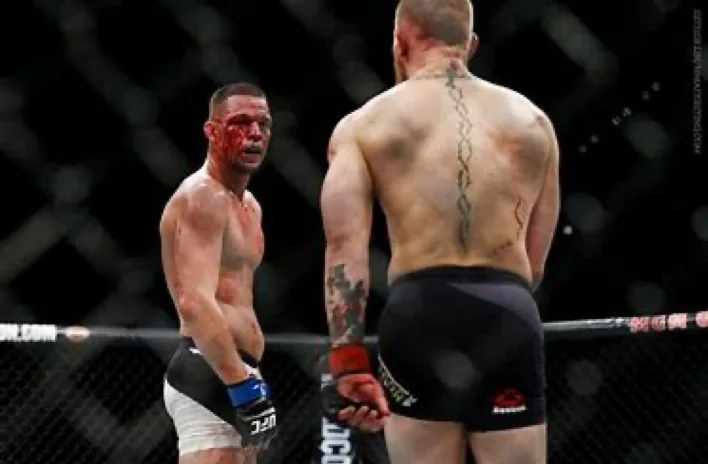
In later years Nate Diaz, then in his 30s, rose again. He beat Anthony Pettis by unanimous decision and set up a super fight with Jorge Masvidal. In an epic slugfest, Diaz was giving as good as he was getting when the fight was stopped by the ringside doctor because of a terrible cut over Nate’s right eye. Naturally, Nate was ready to go into the next round. As he stood there, bloodied and unbowed, he stared through swollen bloody eyes across the Octagon at Masvidal.
All I could think was, “Can’t knock me down Ray! Can’t knock me down!”
Training Takeaway for Strength Athletes and MMA Fans
For strength athletes, the Nate Diaz lesson is not that strength training is unimportant. It is that fight performance is never reducible to biceps, chest size, or a bench press number. Fighters need skill, lungs, timing, toughness, and the kind of nervous system that does not fold when the room turns ugly. A strong body helps, but a strong body without heart is just packaging.
For coaches, gym owners, tactical athletes, and serious trainees building combat-focused spaces, the right tools can support the work, but the work is still the work. A facility built for hard conditioning, grappling drills, bag work, sled work, and fight-style effort can start with practical categories such as Cross Training, Boxing & MMA equipment, MMA training accessories, and push sleds and pull sleds for power, speed, and conditioning work.
Safety note: fight training, heavy conditioning, sparring, grappling, and combat-sport preparation should be scaled to the athlete’s experience, health profile, recovery, and coaching environment. Hard training is useful only when paired with sound judgment.
Frequently Asked Questions
What is Marty Gallagher’s main point about Nate Diaz?
Marty Gallagher’s main point is that Nate Diaz represents a rare combat attribute: the ability to absorb punishment, keep coming forward, and refuse to mentally fold. The article is less about physique and more about heart, pain tolerance, and fighter psychology.
Why does Gallagher compare Nate Diaz to old-school street fighters?
Gallagher sees Diaz as the modern version of a combative, hair-trigger personality he knew growing up: men who took offense quickly, fought often, and never backed down. The comparison is used to explain Diaz’s fighting attitude, not to offer sanitized athlete branding.
Does the article say strength training is useless for fighters?
No. The article argues that strength alone does not make a fighter. In Gallagher’s view, a fighter also needs skill, stamina, pain tolerance, timing, aggression, and heart. Strength can support a fighter, but it cannot replace fight character.
Why was Nate Diaz’s win over Conor McGregor important?
Diaz’s submission win over Conor McGregor became a defining career moment because he took the fight on short notice and entered as a massive underdog. Gallagher frames it as one of those rare fight moments that shocks the sport.
Why does the article reference Raging Bull?
The Raging Bull reference connects Diaz to Jake LaMotta’s image as a fighter who could be battered but not broken. Gallagher uses “Can’t knock me down Ray!” as shorthand for Diaz’s refusal to fold under punishment.
What can strength athletes learn from Nate Diaz?
Strength athletes can learn that performance is not only about measurable power. Conditioning, toughness, composure under pressure, repeated effort, and the ability to keep fighting after setbacks are part of the deeper athletic equation.
About the Author: Marty Gallagher
As an athlete Marty Gallagher is a national and world champion in Olympic lifting and powerlifting. He was a world champion team coach in 1991 and coached Black's Gym to five national team titles. He's also coached some of the strongest men on the planet including Kirk Karwoski when he completed his world record 1,003 lb. squat. Today he teaches the US Secret Service and Tier 1 Spec Ops on how to maximize their strength in minimal time. As a writer since 1978 he’s written for Powerlifting USA, Milo, Flex Magazine, Muscle & Fitness, Prime Fitness, Washington Post, Dragon Door and now IRON COMPANY. He’s also the author of numerous books including Purposeful Primitive, Strong Medicine, Ed Coan’s book “Coan, The Man, the Myth, the Method" and numerous others. Read the Marty Gallagher biography here.
Marty Gallagher is a champion strength athlete, coach, author, and RAW Podcast host known for powerlifting, Olympic lifting, and serious strength training.
