
 Call us today at 1-888-758-7527
Paul Anderson: The Original Strongman and Powerlifting Visionary
Forged Passion and the Georgia Strongman
Paul Anderson was the original American strength phenomenon: Olympic gold medalist, 1955 world weightlifting champion, professional strongman, powerlifting forerunner, rack-lift experimenter, and a man whose best-known feats still cause arguments wherever serious lifters gather.
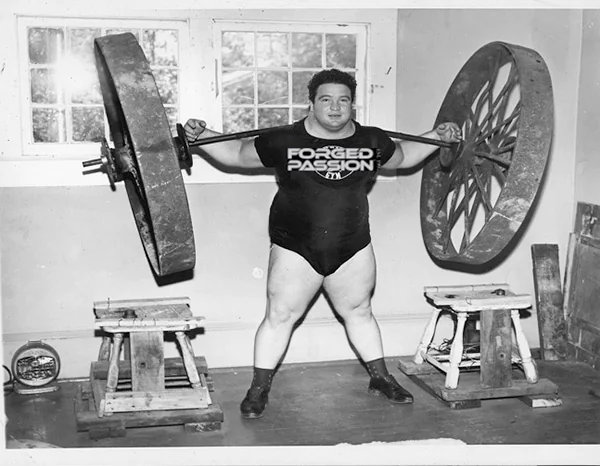
The image above shows Anderson with a makeshift barbell built from wagon wheels across his back. Whether one is looking at a training tool, a public demonstration, or a piece of strength folklore, the lesson is plain: Anderson thought in terms of massive loading, crude implements, short ranges, and relentless progression.
Paul Anderson’s legend is difficult to handle because it sits in two worlds at once. In one world, he was a documented Olympic weightlifter: world champion, national champion, and 1956 Olympic gold medal winner. In the other world, he was Paul Anderson the strongman — a folk hero credited with staggering squats, back lifts, nail-driving stunts, wagon-wheel lifts, and feats that were performed before modern judging, modern powerlifting standards, and modern video verification.
Both worlds matter. One gives us the record. The other gives us the legend.
From Toccoa to the World Stage
Paul Edward Anderson was born on October 17, 1932, in Toccoa, Georgia. He briefly attended Furman University on a football scholarship before turning his full attention toward strength. Like many great lifters, he did not simply “find” the iron; he found a language that fit his body and mind.
Anderson’s early strength was raw and obvious. He was built low to the ground, thick in the trunk, monstrous through the hips and legs, and naturally drawn to the squat. He eventually met Bob Peoples, the legendary Tennessee deadlifter and strength thinker, and that connection helped move Anderson deeper into serious lifting.
Anderson was not a polished Olympic-lifting technician in the modern sense. He was a force of nature who became brutally effective. The squat, the press, heavy supports, partial lifts, overloaded movements, and improvised training all became part of his world. He was a backwoods experimenter before strength science caught up to the idea that overload, position, range of motion, and progressive exposure could be manipulated.
The 1955 World Champion and the Melbourne Gold Medal
In 1955, Anderson won the United States heavyweight championship and then won the world heavyweight title in Munich by an enormous margin. His appearance in the Soviet Union during the Cold War created shock waves. Russian observers famously called him chudo prirody, “a wonder of nature.”
Then came Melbourne in 1956.
Anderson arrived at the Olympic Games ill and far below his best. The heavyweight contest became unexpectedly dramatic. Anderson and Argentina’s Humberto Selvetti tied on total weight lifted. Anderson won the gold medal because he was the lighter man. It was not the easy coronation everyone expected; it was a three-lift survival fight.
That gold medal made Anderson immortal in official sport. After Melbourne, he left amateur Olympic weightlifting, became a professional strongman and speaker, and never again had the same path available to him inside Olympic competition.
Powerlifting Before Powerlifting Had a Name
Anderson’s greatest historical importance may be that he embodied powerlifting before powerlifting had fully separated itself as a formal sport.
Olympic weightlifting in Anderson’s era still included the clean and press, a strength lift. Yet Anderson’s deepest instincts pointed toward what would become powerlifting: the squat, the press, the deadlift, heavy supports, partial movements, and brutally simple progressive overload.
Powerlifting as a formal sport would later organize around the squat, bench press, and deadlift. Anderson was already living in that universe before the universe had a proper name.
He was not merely strong. He was strength-specific. He was obsessed with making the body adapt to progressively heavier loads. He explored leverage, range, supports, and partials with the kind of practical intelligence that old lifters understand instantly.
Crude Racks, Stools, Wagon Wheels, and Heavy Partials
One of Anderson’s most important contributions was not a single piece of equipment but a way of thinking. He understood that a lifter could use partial range of motion to handle poundage far beyond what could be moved through full range. He used stools, crude supports, improvised bars, and primitive loading to create what modern lifters would recognize as rack logic.
The modern powerlifting equipment world is full of power racks, half racks, squat stands, safety arms, calibrated bars, and specialty bars. Anderson’s world was less refined. He trained with what he had. If that meant wagon wheels, stools, barrels, welded contraptions, or crude supports, so be it.
He used heavy partial squats, supports, and progressive lowering strategies to accustom the body to loads that would terrify ordinary trainees. This is the primitive ancestor of rack pulls, pin squats, partial supports, overload walkouts, and top-range strength work.
Anderson did not need a white paper to understand overload. He loaded the bar, got under it, and forced the body to negotiate.
Legendary Feats and the Problem of Old Strength Lore
Anderson’s legendary feats are part of his power, but they must be handled honestly.
Old accounts credit him with a 6,270-pound back lift, huge squats, 900-pound squat repetitions, enormous presses, and jaw-dropping exhibition lifts. Some of those feats were documented as public exhibitions. Others live in the contested zone of old strength history, where witnesses, face-value loading, exhibition conditions, and modern standards do not always line up neatly.
That does not make the legend worthless. It simply means the modern reader must distinguish between three categories:
- Official Olympic lifting record: Anderson’s documented national, world, and Olympic achievements.
- Public strongman feats: exhibition lifts witnessed by crowds, television audiences, or press accounts.
- Old Iron Game lore: stories that may be true, partly true, exaggerated, or impossible to judge by modern standards.
The essential truth remains: Paul Anderson was absurdly strong. Even if a modern historian trims the largest stories, enough remains to leave him standing among the most powerful men ever to touch iron.
Mass, Milk, and the Old-School Strength Formula
Anderson believed size and strength were linked. He was not alone. The old-school strength formula was simple: lift heavy, eat big, rest hard, repeat.
Old accounts place Anderson’s milk intake at almost unbelievable levels, sometimes described as reaching fourteen quarts a day. Whether that exact number was routine, occasional, exaggerated, or symbolic of his mass-building drive, the point is clear: Anderson believed that a man seeking maximum strength needed to feed the machine.
The lesson is not that modern lifters should start drinking gallons of whole milk without thought. Digestion, bodyweight, blood markers, calorie needs, health history, and training goals matter. The useful Anderson lesson is broader: serious strength requires serious fuel. A lifter cannot train like a giant and eat like a bird.
Athleticism Beyond the Barbell
One reason Anderson fascinates strength historians is that he did not fit the lazy stereotype of the slow, stiff strongman.
Old stories credit him with surprising explosiveness: short sprint ability, jumping power, and movement capacity that shocked people who assumed a 300-plus-pound man could only waddle. Some of those athletic stories are difficult to verify, but they align with the bigger point. Anderson was not merely a large man who bore weight. He was a massive athlete.
The strongest men often have more athleticism than the public imagines. Strength, when built onto the right structure, can magnify athletic expression rather than smother it.
The Youth Home and the Larger Legacy
After his competitive lifting career and strongman fame, Anderson’s life turned toward service. In 1961, Paul and Glenda Anderson founded the Paul Anderson Youth Home in Vidalia, Georgia. Anderson used his public-speaking schedule and strength exhibitions to support the home and its mission.
That may be the finest part of the story. Anderson could have remained only a legend of the iron. Instead, he used the platform strength gave him to help young men in trouble.
The Olympic medal matters. The world title matters. The back lift, wagon wheels, squats, presses, and all the disputed numbers matter because they are part of the legend. But the Youth Home gives the legend a moral center.
Paul Anderson was not merely a strongman. He was a man who turned strength into service.
Equipment Notes for Anderson-Style Strength Training
Paul Anderson trained in an era of crude equipment, but the modern lifter does not need to imitate crude equipment to learn from him. The Anderson lesson is overload, progression, patience, and position — not recklessness.
For barbell-centered strength training, lifters and facilities can compare Olympic weightlifting bars, weight plates, and serious loading tools such as American Barbell urethane Olympic grip plates.
For Olympic lifting or high-quality barbell work, a bar such as the Iron Grip Competition Series 20 kg needle-bearing bar can serve a very different role than Anderson’s wagon-wheel contraptions, but the goal remains the same: load the body honestly. IRON COMPANY Olympic spring collars with plastic grips help secure plates during repeat barbell work.
Training space matters too. Heavy squats, rack work, deadlifts, partials, and loaded carries demand flooring suited to the room and the use case. Facilities can compare rubber gym flooring rolls and Regupol natural recycled rubber flooring rolls when building out a serious strength area.
The equipment does not create Paul Anderson. Nothing does. But good equipment gives modern lifters a safer place to pursue Anderson’s central idea: progressive, intelligent, heavy work.
Safety Note for Heavy Partials, Squats, and Improvised Lifting
Do not casually imitate Paul Anderson’s wagon-wheel lifts, back lifts, heavy partials, unsupported squats, or massive exhibition feats. Anderson was an extraordinary outlier with unusual structure, unusual strength, and years of progressive adaptation.
Modern heavy strength training requires proper equipment, secure collars, rack safeties, stable flooring, competent spotters where appropriate, progressive loading, and honest technical standards. Partial squats, rack pulls, overload walkouts, and heavy supports should be scaled to the lifter’s skill, recovery, orthopedic history, and training goal.
Mass-building diets should also be treated with caution. Drinking extreme quantities of milk or forcing massive calorie intake is not appropriate for every lifter and may be unsafe for some people. This article preserves historical strength culture and Marty Gallagher’s editorial perspective; it is not individualized medical, nutrition, rehabilitation, or programming advice.
Related Strength-History Reading
For a modern Marty Gallagher comparison to the Anderson spirit of sustained strength, read Steve Justa: the Paul Anderson of Sustained Strength.
RAW with Marty Gallagher, J.P. Brice, and Jim Steel Podcast.
About the Author: Marty Gallagher
As an athlete Marty Gallagher is a national and world champion in Olympic lifting and powerlifting. He was a world champion team coach in 1991 and coached Black's Gym to five national team titles. He's also coached some of the strongest men on the planet including Kirk Karwoski when he completed his world record 1,003 lb. squat. Today he teaches the US Secret Service and Tier 1 Spec Ops on how to maximize their strength in minimal time. As a writer since 1978 he’s written for Powerlifting USA, Milo, Flex Magazine, Muscle & Fitness, Prime Fitness, Washington Post, Dragon Door and now IRON COMPANY. He’s also the author of multiple books including Purposeful Primitive, Strong Medicine, Ed Coan’s book Coan, The Man, the Myth, the Method and numerous others. Read the Marty Gallagher biography here.
Marty Gallagher is a champion strength athlete, coach, author, and RAW Podcast host known for powerlifting, Olympic lifting, and serious strength training.
