
 Call us today at 1-888-758-7527

Partial Reps Equate to Partial Results in Weightlifting
This article from Marty Gallagher is a blunt resistance training lesson on partial reps, ego lifting and the difference between moving weight and training muscle. For powerlifters, bodybuilders, weightlifters, athletes, first responders and military trainees, the lesson still holds: full range-of-motion repetitions, precise technique and honest progressive resistance with dependable strength training equipment produce better results than shortening the rep just to handle more poundage.
Partial Reps Equate to Partial Results
Featured Resistance Training Equipment: free weights, progressive resistance training machines, bench press, barbells, dumbbells, weight plates, E-Z curl bar, and leg press.
The Partial Rep Problem in Resistance Training
There’s no denying, partial reps equate to partial results in resistance training. Walk into any commercial fitness facility at 7 pm and walk to the free weight room or progressive resistance training machine section of the gym. Quietly observe the lifters lift. If you have a sharp eye and know what you are looking for, you will be able to pick out umpteen examples of badly flawed weight training.
If you are a true hardcore resistance trainer, you will have a knowledge and appreciation for proper progressive resistance techniques. There is a right and wrong way to do a squat, bench press, row, curl, triceps press, deadlift, overhead press with barbells and dumbbells. I am not talking of legitimate technical variations; rather, I refer to the potentially injurious technical abominations that are seen routinely.
It pains me to watch a well-intentioned, obviously serious trainee do some horrific bend-forward barbell squat, turning the world’s best leg exercise into the world’s most dangerous back exercise, although an improperly performed deadlift is likely the single most dangerous and injurious of all progressive resistance exercises. While bad exercise technique is the biggest gym sin, it is understandable in that the expert teaching of exercise technique is rare. It is hard to use correct technique if you have never been exposed to it. Which leads us to the second major progressive resistance mistake: the epidemic use of partial repetitions.
Why Partial Reps Are So Seductive
The reason for the widespread misuse of partial reps is easy to understand: a partial rep is easier to perform than a full range-of-motion repetition. Because it is easier to perform a partial rep, the partial repper can either handle more poundage or squeeze out more repetitions. Never mind that this is flawed thinking; to the unbounded male ego, partial reps are seductive and tantalizing.
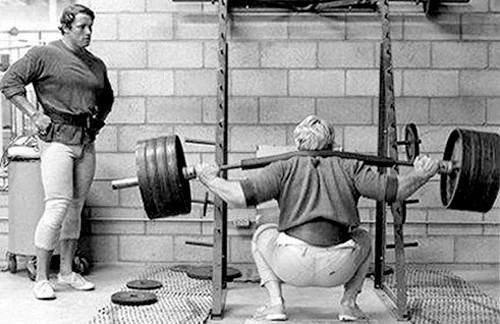
A few quick examples will illustrate why partial reps are so alluring. If a man is capable of squatting 225 for 8 perfect reps, ass-on-heels, i.e. using the maximum possible ROM, that same man will be able to handle 275 for 8 reps going to parallel. However, if the same athlete decides to only dip down to 4 inches above parallel, he will be able to handle 315 pounds for 8. Now which degree of depth do you think the ego-filled alpha male will use when training at the public facility? Factually, the ass-on-heels squat with 225 will without doubt deliver superior muscle-building, strength-infusing results; however, the male ego will not be denied when lifting in a public setting.
For lifters who want honest squat, bench press and deadlift feedback, equipment should support precision rather than disguise flaws. A quality bar such as the Iron Cowboy powerlifting bar or CAP Barbell Rebel Olympic Power Bar, paired with consistent urethane Olympic plates with grips, makes it easier to track real progressive resistance instead of hiding behind sloppy range of motion.
Bench Press Partial Reps
Results be damned, this is about pecking order amongst the tribe when performing in public. Further, no expert is available to call the partial repper on their shortcomings and to point out that results are inferior, which they are. Partial reps result in partial results. The same strategy holds true with any lift you can name.
How about the bench pressers that never lower down all the way and actually touch their chest on each rep and never completely lock out a bench rep at the top? A man that partially bench presses 250 for reps would be hard pressed to handle 200 if forced to touch the chest and lock out fully on each rep. If the partial bench press repper were further forced to pause the weight on the chest, that 250 would likely drop to 185 pounds.
This is where a stable, dedicated bench setup matters. A serious flat Olympic bench press, an Olympic bench station with plate storage, or a complete collection of properly selected weight benches gives the lifter the foundation to practice honest chest-to-lockout repetitions instead of half-reps built around ego.
E-Z Curl Bar Partial Reps
On and on it goes. How about the guy in every gym that puts two 45-pound weight plates on the E-Z curl bar and proceeds to heave the weight to get it started and then bends forward to meet the bar at the top of the rep? That man is receiving zero biceps stimulation and would be hard pressed to properly curl a pair of 40-pound dumbbells where he was forced to start from a dead hang and actually curl the weight upward using biceps alone.
An Olympic EZ curl bar or chrome curl bar can be a terrific tool for biceps curls and arm work, but only if the trainee uses the biceps to move the load instead of turning the exercise into a whole-body heave. In progressive resistance training, the tool is only as useful as the technique applied to it.
Leg Press Partial Reps
The partial rep epidemic is hardly confined to just free weights. Let us not forget the partial rep leg pressers that delight in loading half the weight in the gym onto the leg press and then, with great fanfare and attention-grabbing antics, proceed to push the ponderous poundage all of 12 inches. A deep and proper leg press with 300 pounds would stop this show-off dead in his tracks.
Leg press machines can be excellent for building the thighs when used with control and useful range of motion. Whether the facility uses an angled linear leg press, a leg press and calf raise machine, or other plate-loaded leverage gym equipment, the same principle applies: reduce the range of motion and you reduce the training effect.
Partial Rows, Overhead Presses, and Other Shortchanged Lifts
Partial rep lat pulldowns, partial rep dips, partial rep leg curls, overhead presses and partial rows — no exercise is exempt from making it easier by pushing or pulling it less distance. The male ego is a powerful master, particularly when training in front of other ego-filled males and especially if all the participants agree that partial reps are perfectly acceptable, in fact, the norm. Everyone that buys into legitimizing the partial rep is shortchanging their results.
There is an important distinction: advanced lifters may sometimes use intentional partial-range work for a specific, narrow training purpose. That is not what this article is about. Gallagher is calling out lazy partial reps, accidental partial reps, ego partial reps and technically flawed repetitions that replace useful weightlifting and resistance training with public performance.
Equipment Pairings for Honest Full-Range Training
Full range of motion does not require fancy equipment, but it does require equipment that lets the lifter train honestly. For home gyms, commercial gyms, school weight rooms, first responder fitness rooms, and military training spaces, the fundamentals are still the same: a quality Olympic barbell, stable weight benches, consistent weight plates, appropriate machines, and enough room to execute each rep with control.
For barbell work, Olympic bars and power bars support squats, deadlifts, bench press, rows, and overhead press variations. For machine-based progressive resistance, selectorized and plate-loaded equipment should be used through a range of motion that actually trains the target muscle. For lower-body work, leg press options can be valuable, but only when the lifter resists the urge to load more plates than the useful range of motion can support.
FAQ
What are partial reps in weightlifting?
Partial reps are repetitions performed through only part of the available range of motion. In this article, Marty Gallagher is criticizing lazy or ego-driven partial reps that allow a lifter to handle more weight while reducing the actual training effect.
Why do partial reps produce partial results?
Partial reps often make an exercise easier by shortening the movement. When the lifter reduces the range of motion on a squat, bench press, curl, row, overhead press or leg press, the target muscles receive less complete stimulation and the results are shortchanged.
Are partial reps ever useful?
Intentional partial-range work can have a place for advanced lifters when used for a specific training purpose. That is different from sloppy partial reps used to impress other lifters or avoid the harder portion of the movement.
Which exercises are commonly ruined by partial reps?
Gallagher calls out squats, bench press, E-Z curl bar curls, leg press, lat pulldowns, dips, leg curls, overhead presses, and rows as common examples where lifters shorten the rep and reduce the training benefit.
What equipment supports better full range-of-motion training?
A useful setup includes quality free weights, Olympic barbells, weight plates, stable bench press stations, proper weight benches, and well-chosen leg press or progressive resistance machines. The equipment matters, but honest technique and full range of motion matter more.
About the Author
As an athlete Marty Gallagher is a national and world champion in Olympic lifting and powerlifting. He was a world champion team coach in 1991 and coached Black's Gym to five national team titles. He's also coached some of the strongest men on the planet including Kirk Karwoski when he completed his world record 1,003 lb. squat. Today he teaches the US Secret Service and Tier 1 Spec Ops on how to maximize their strength in minimal time. As a writer since 1978 he’s written for Powerlifting USA, Milo, Flex Magazine, Muscle & Fitness, Prime Fitness, Washington Post, Dragon Door and now IRON COMPANY. He’s also the author of numerous books including Purposeful Primitive, Strong Medicine, Ed Coan’s book “Coan, The Man, the Myth, the Method" and numerous others. Read the Marty Gallagher biography here.
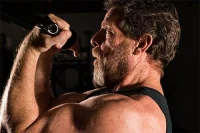
Marty Gallagher is a champion strength athlete, coach, author, and RAW Podcast host known for powerlifting, Olympic lifting, and serious strength training.
