
 Call us today at 1-888-758-7527


Neuroplasticity and Our Ever-Shrinking Concentric Circles
Overcoming Inertia
Overcoming inertia by changing the way we train, eat, move, and think.
Neuroplasticity is commonly described as the brain’s ability to reorganize and adapt in response to experience, environment, injury, disease, or new demands. In this RAW article, I am using neuroplasticity as a practical training metaphor: the willingness to stop repeating stale patterns and to present the body and Mind with new, useful challenges.
The original version of this article cited a pandemic-era survey reporting widespread unwanted weight change. The precise survey figures should be source-checked before publication. The larger point remains: the pandemic, working from home, closures, restrictions, and modern convenience pushed many people into ever-smaller circles of movement.
The Age of Doing Less
We enter the age of doing less. The pandemic and working from home accelerated what the art rock band Devo called devolution, the degrading of the human condition. Our current devolution is due to a lack of physical exertion brought on by restrictions, closures and, above all else, working from home.
Not that long ago, ordinary life demanded more physical labor. People chopped wood, hauled coal, washed clothes by hand, walked more, worked outside more, and handled more of life without powered convenience. Food was simpler and life was rugged. In modern life, the body can go days with almost no demanding movement unless effort is purposefully inserted.
The 1918 influenza pandemic still haunted families for generations. It attacked my muscled-up blacksmith Irish grandfather, leaving his young children and feeble wife untouched. Every generation has its stressors. Our current stressor is strange: too little physical stress, too little muscular effort, too little daily movement.
Our current pandemic experience caused humans to move in ever-smaller concentric circles of movement and activity, further accelerating physical breakdown. Left unstressed, the human body degrades. It falls apart. Devolution.
Shrinking Movement Circles and Easy Injury
One medical professional friend was agog at the acceleration of the devolution. He expressed chagrin at a new trend: people crippled by the slightest exertion, a reaction to new heights and levels of inactivity.
“There is a new level of unfitness. We as a species were not doing all that great before all this forced inactivity. For so many, the new paradigm is to wake up, eat, then start working from home sitting at the computer. The refrigerator is always a few steps away.”
“The old paradigm involved a minimum of activity: wake up, drive to work, get out, walk to the office, walk around the office all day before walking back to the car or public transportation. Not that this was ideal or particularly beneficial, but at least we had some degree of daily movement.”
“Now it’s as if everyone has aged a decade. Inactivity is the new accepted norm. After a mentally exhausting day sitting all day, folks eat a big meal, sit down and watch a movie on Netflix.”
“I quiz my patients when they come to me with an injury. A typical example: last week a patient racked his back picking up a 35-pound child. The child struggled a little bit, and their 43-year-old father ripped a back muscle. Young people are becoming prematurely feeble. Old people are accelerating their own oblivion: feebleness, loss of function, loss of mobility, and inactivity are the new norm. Weakness can become fertile ground for injury.”
So, as Mick Jagger once asked, what is a poor boy to do?
Use It or Lose It: Can Technology Help?
A lot of people are realizing that the work-from-home lifestyle is killing them slowly. It is no coincidence that upscale home training systems such as Peloton and NordicTrack are popular with upscale, moneyed clients who can afford to spend thousands on the core device and then pay a stiff monthly fee to “interact” with an elite trainer who comes into the home via the marvel of modern technology.
Of course, the results are only as good as the instruction given. While the technology is revolutionary, the instruction can be decidedly underwhelming. Too much of the instruction that accompanies interactive devices is the same old non-productive fitness wine served in a flashy high-tech bottle.
While the totally unfit might benefit from the paid cheerleaders that appear onscreen, it remains to be seen whether the cost-benefit ratio weighs in favor of these expensive systems delivering mundane fitness messages. Stripped of fluff and dazzling footwork, many exercise strategies presented are cardio-based methodology straight out of 1985.
Fitness Neuroplasticity Requires Contrast
The solution? This is where neuroplasticity comes in. In this context, neuroplasticity means a beneficial rewiring of habit in response to purposefully presenting the brain and body with new challenges. By purposefully thinking and reacting in new and different ways to new and different stimuli, stale brain complacency is blasted apart.
The smart move is to apply neuroplasticity tactics to “fitness,” strength training, or whatever defining phrase you apply to your transformational physiological efforts. Neuroplasticity demands new ways to go about old challenges. We need to change the way we train, the way we eat, the way we move and the way we think, and often to a dramatic degree.
The benefits do not manifest because we admire the idea of change. The benefits manifest when the change is real enough to challenge the rut.
What Are You Rebelling Against?
When Marlon Brando’s character in The Wild One was asked, “Johnny, what are you rebelling against?” Brando deadpanned, “What do you got?” And so it is with fitness neuroplasticity: rebel against whatever it is you are doing if what you are doing no longer works, assuming it ever worked at all.
Are you training at all? Are you paying attention to food quality? Are you moving with intent? If not, the first step in neuroplasticity is to create and adhere to some sort of logical training and nutrition template.
A First-Step Template for Change
A practical, elemental form of cardiovascular exercise is power walking. Out-of-shape folks can often generate a meaningful heart-rate elevation simply by walking with effort, posture and intensity. Strength training for those badly out of shape can begin with free-hand exercise. Nutrition is simple in concept, though not always easy in execution: clean up the quality of the caloric intake and stop eating past the point of usefulness.
For those already paying attention to nutrition, for those currently training but stagnant, devise a counterstrategy for whatever you are doing nutritionally and devise a strategy antithetical to your current resistance and cardio protocols.
Riding a stationary bike is not enough. Moving your limbs in synchronization with a remote trainer is not enough. Dieting is not enough. There needs to be a synchronized interplay between food, resistance training, cardiovascular training and the psychological aspects of the process.
So much of what passes for expert fitness training is either small robotic movement done on machinery or mindless, limb-flinging “exercise” that has little fundamental impact on any physique other than that of the completely out-of-shape beginner. Too many exercise prescriptions are too broad, too generalized, too mild or too diffuse to be effective.
To generate true fitness neuroplasticity, take a long, hard look at your current resistance-training, cardiovascular and nutritional protocols. The key is to begin training and eating with purpose if you are not already. If you are training and eating with purpose but without effect, legislate some contrast.
“A goal without a plan is a wish.”
Safety Note for Neuroplasticity, Training Change, and Inactivity
This article preserves Marty Gallagher’s RAW perspective on neuroplasticity, inactivity, fitness contrast and shrinking movement circles. It is not individualized medical, neurological, mental-health, nutrition, rehabilitation, or programming advice.
After long inactivity, aggressive change can create problems. Walking, cycling, rowing, dumbbell work, machine training, diet changes, hard conditioning, and resistance training should be scaled to the person’s age, medical history, injury history, sleep, stress, bodyweight goals, and current capacity.
Start gradually. Use progressive loading. Leave room for recovery. People with cardiovascular disease, blood-pressure concerns, diabetes, dizziness, fainting, chest pain, significant orthopedic issues, neurological symptoms, medication concerns, or eating-disorder history should seek qualified guidance before major training or nutrition changes.
Stop or scale back for chest pain, faintness, dizziness, unusual shortness of breath, numbness, sharp pain, radiating pain, sudden weakness, repeated technical collapse, severe fatigue, sleep disruption, disordered eating patterns, or any symptom that feels different from normal training effort.
Equipment Notes for Expanding the Training Circle
Equipment does not create neuroplasticity. A tool only matters if it helps the trainee step outside a rut and impose a useful, appropriately dosed new demand.
For cardiovascular contrast, readers and facilities can compare exercise bikes and indoor rowing machines. Specific options such as the Assault Fitness AirRower Elite rowing machine and the Throwdown HIIT Bike Pro may fit certain training spaces when the user, room, floor, and intended use align.
For resistance-training contrast, compare dumbbells, plate-loaded leverage gym equipment, IRON COMPANY urethane dumbbells, and cable stations such as the Legend Fitness 1131 SelectEDGE cable crossover.
The equipment does not get you out of the shrinking circle. The decision to use the tool differently gets you out of the shrinking circle.
Related Neuroplasticity Reading
For more Marty Gallagher writing on neuroplasticity and training change, read Neuroplasticity Versus Insanity, George Costanza: Neuroplasticity Guru, and Mental Flexibility and Neuroplasticity.

RAW with Marty Gallagher, J.P. Brice, and Jim Steel Podcast
About the Author: Marty Gallagher
As an athlete Marty Gallagher is a national and world champion in Olympic lifting and powerlifting. He was a world champion team coach in 1991 and coached Black's Gym to five national team titles. He's also coached some of the strongest men on the planet including Kirk Karwoski when he completed his world record 1,003 lb. squat. Today he teaches the US Secret Service and Tier 1 Spec Ops on how to maximize their strength in minimal time. As a writer since 1978 he’s written for Powerlifting USA, Milo, Flex Magazine, Muscle & Fitness, Prime Fitness, Washington Post, Dragon Door and now IRON COMPANY. He’s also the author of multiple books including Purposeful Primitive, Strong Medicine, Ed Coan’s book Coan, The Man, the Myth, the Method and numerous others. Read the Marty Gallagher biography here.
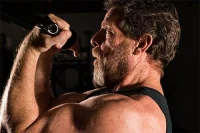
Marty Gallagher is a champion strength athlete, coach, author, and RAW Podcast host known for powerlifting, Olympic lifting, and serious strength training.
