
 Call us today at 1-888-758-7527

Desperately Seeking Struggle: An Ode to Old School Barbell Training
This essay from Marty Gallagher is a defense of old school barbell training: fewer exercises, stricter technique, harder effort, and less dependence on machines. For powerlifters, bodybuilders, weightlifters, athletes, first responders, military personnel, and serious trainees, the lesson still holds: the fastest path to more muscle size and muscle power often begins by simplifying resistance training and embracing the struggle instead of trying to engineer it away.
Desperately Seeking Struggle: An Ode to Old School
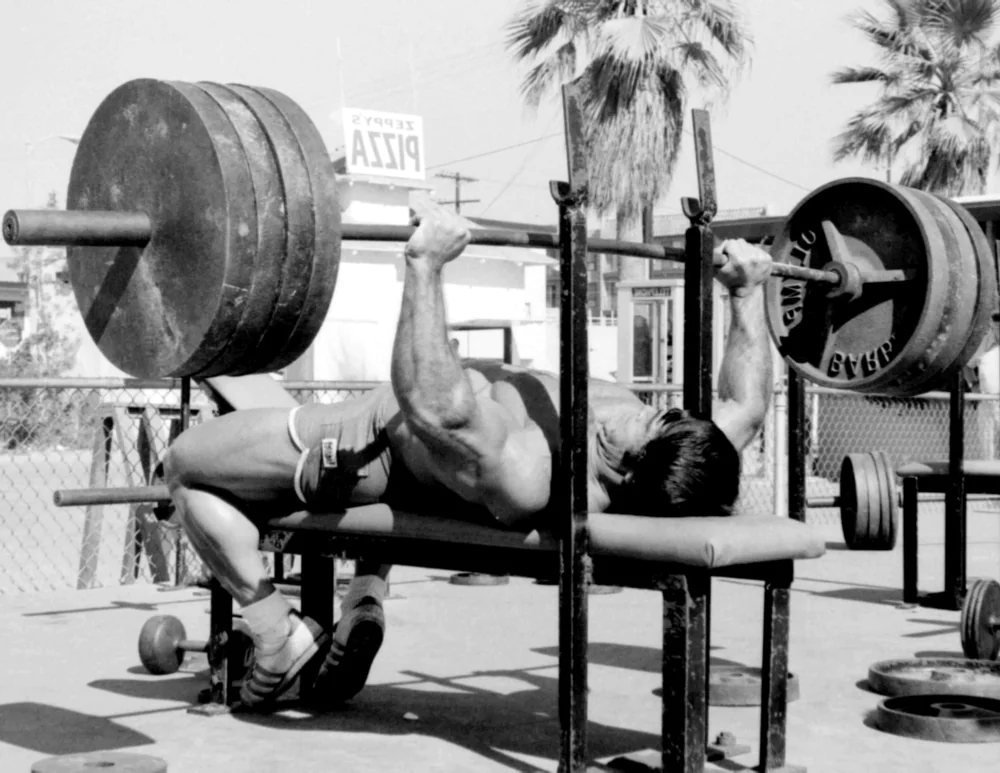
A picture is worth a thousand words. This picture of Franco Columbu training by himself, shirtless, outside in the sun, casually repping a 405 lb. barbell with no spotters, weighing a ripped 185 pounds, caused me to grow nostalgic for those ancient days of yore, what I call the era of iron purity. Back in the day, it was a man and a barbell. The barest of equipment. With the requisite grit, gumption, tenacity and bullheadedness, a man with a barbell would morph himself from man into Superman. Just like Franco did.
The resistance machine revolution occurred in the early 1970s. Universal introduced their 12-station device that began appearing in YMCA weight rooms nationwide. The resistance machine floodgates opened with the bogus “Nautilus Revolution.” Machine training, we were told, was every bit as good, if not better, than those clumsy, dangerous, antiquated barbells.
It turns out that the results derived from resistance training machines were, and are, decidedly inferior to results derived from the awkward barbell movements the machines mimicked. By eliminating the third dimension of tension, the need to control side-to-side movement, machines allow muscle stabilizers to stay relatively inert while pushing or pulling. This lack of muscle stabilizer activation reduces results. That is as true whether the trainee is using plush selectorized gym equipment or fancy plate-loaded leverage equipment.
In our day and age, resistance machines are everywhere and dominate the scene. If you do not have a flock of expensive, complex, glitzy resistance machines to match an armada of ornate cardio devices, do not bother opening a fitness facility. No one will come. Civilians want to be able to sit down, or better yet lie down, while “training.” If results were equal, who would not prefer to use a plush machine as opposed to some gruesome barbell exercise? The dirty little secret of fitness is results are not equal. Not even close. Barbell results blow machine results into the weeds.
Why Old School Barbell Training Still Wins
A lot of people take jabs at CrossFit, yet the CrossFit barebones concept has revitalized barbell training, making it hip to do back squats, front squats, cleans, overhead squats and power cleans, all on a regularly recurring basis within the CrossFit methodology. All praise to CrossFit for revitalizing and popularizing old school barbell training.
Pure barbell training is also successfully practiced in prisons. The lack of strength equipment in a prison turns out to be an actual advantage as prisoners nationwide obtain incredible gains in muscle size and power, this as a direct result of being forced to do fewer things better: barebones equipment, a barbell, some mismatched weight plates, a weight bench, squat racks, a pull up bar and maybe a dip bar. More often than not, regardless of the weather, the training is done outside in the elements. Prisoners make incredible gains in size and strength because of, not despite, their lack of gym equipment.
Barbell training, done right, is raw and primal, brutal stuff. And it is that very brutality that is responsible for its effectiveness. Deprived prisoners routinely outstrip the gains obtained by elite personal trainers plying their trade on high-paying clients. Prison gains in muscle and strength are even more miraculous when you factor in that prisoners often have the worst possible nutrition. Which gives rise to the notation that perhaps our emphasis on sophisticated nutrition can become an overemphasis.
What Franco Columbu Still Teaches Modern Lifters
Franco’s photo exemplifies the best of old school barbell minimalism; a philosophy of strength that says: let us strive to do fewer things better, let us execute a limited number of core exercises, low to moderate rep sets, using super strict techniques, no supportive gear, full range-of-motion movements, and hardcore barbell exercises used to near exclusion. Over time, let us get super strong in these pristine exercises. Do so and become bull strong. Become bull strong and build massive muscles. Strength begets size.
Note that despite the Olympic bar being loaded to 405 pounds, Franco is truly casual about the whole thing. He wears no shirt, he has had no one to lift off or spot him, he is not even dug in, he is perched high on his toes, lightly balanced. His upper torso is arched, his spine bowed back. His grip width is wide and his torso bridged. He uses a motor pathway that focuses all the muscular effort on the pectorals. In about this same time, Franco bench pressed 525 pounds using this same up-on-the-toes, ultra-strict technique. He exceeded the world record in the 181-pound class at the time.
What are the lessons to be learned by the modern trainee? Master the old school barbell exercises. Bench presses need be paused, squats taken deep, deadlifts done right, rows strict, power cleans explosive, overhead presses locked out hard. Poundage is always secondary to technique. Franco casually reps 405 because when your max is 525, 405 is “only” 77% of your max. A man with a 250-pound bench press would need only rep 190 pounds to replicate Franco’s 77%.
For trainees building a practical old school setup, dependable Olympic weightlifting bars, a rugged black oxide Olympic weightlifting bar, stable weight benches, and a serious flat Olympic bench press still make more sense than building an entire room around novelty.
Why Struggle Creates Hypertrophy
We live in an era where everyone knows everything. This is a blessing and a curse. Knowledge is a wonderful thing; however too much of a good thing is a bad thing that leads to paralysis through over-analysis. Beware the curse of too many choices. In the end, success in progressive resistance training is not so much what you do as it is how hard you do it. The key to actualizing results, insofar as building new muscle and dramatically increasing strength and power, lies in your ability to attain training intensities sufficient to trigger hypertrophy.
In the end, successful progressive resistance training requires struggle. Real struggle, intense, prolonged and protracted struggle. If a man repeatedly struggles, over time he remakes and remolds the body. Truly herculean struggle is profoundly transformative. Seek out struggle. Gurus and devices try to take the struggle out of resistance training. How ironic: let us take the resistance out of resistance training, let us make resistance training less resistant, let us make it easier. Barbell training, done old school style, is all about making resistance training harder, not easier.
The iron elite find ways to amplify the struggle and ergo amplify the results. There is an irrefutable relationship between the degree of effort generated and the depth and degree of hypertrophy induced. Do not slip or slide through sticking points. Seek out sticking points like a heat-seeking missile. Embrace sticking points. This is the way of the champion.
We forge the human body, forcibly morphing it; we repeatedly “traumatize” the body in capacity-equaling or capacity-exceeding workouts. The athlete stresses the body to such a degree that new muscle is created as a defense mechanism. Strength increases are concurrent with muscle size increases. The body is biologically forged, and as J.P. Brice would be quick to add, the forging must be done with passion, meaning real enthusiasm for the process. Enthusiasm is born out of factual, actual, measurable results. We seek improvement in physique or performance for our sustained and diligent efforts.
Simplify Your Strength Training
Simplify your strength training: train like a convict. Purposefully limit yourself to the core barbell exercises. The majority of barbell exercises are done standing on your feet: squats, deadlifts, curls, cleans, overhead presses, standing overhead triceps, front raises. Throw in some bench presses, chins and dips. Strength train twice a week. Here would be a two-day power split.
Day 1
- Squat
- Bench press
- Lying tricep extensions, super-setted with standing barbell curls
Day 2
- Deadlift
- Power clean
- Overhead barbell press
- Post curls
- Overhead tricep extensions
- Work up to a single top set in each lift: 5-rep sets; 8-10 reps on curls and triceps
- Each week seek to add poundage or reps
This is a classical, minimalistic, hardcore barbell strength training program. Each successive week limits and capacities are equaled or exceeded in some way. These workouts should be completed in less than one hour. Simplify your training while amplifying your intensity. There are many ways in which to equal or exceed capacity. Our ode to old school suggests that less can be more if less is way more intense.
Old School Equipment Pairings
A modern home gym or small strength space can still honor this philosophy without becoming overbuilt. A sturdy commercial squat stand, a serious power rack, or even a compact bench and squat rack combo can support the exact kind of stripped-down program Marty is talking about. Add a pull up and dip tower, a stable bench, a bar, and enough plates, and the essentials are covered.
If the training room is in a garage, basement, or utility space, practical protection matters too. Durable rubber gym flooring rolls or rugged interlocking rubber gym tiles can make a simple barbell room more durable without changing its old-school spirit.
FAQ
What does old school barbell training mean?
In this article, old school barbell training means using fewer core exercises, stricter technique, full range of motion, minimal supportive gear, and a greater emphasis on effort and progressive overload than on machine variety or comfort.
Are barbells better than machines for building muscle and strength?
Marty Gallagher’s position is yes. He argues that barbells demand more total-body control, recruit stabilizers more effectively, and produce superior resistance training results compared to machines that reduce the need to balance and control the load.
Why does struggle matter so much in resistance training?
Because struggle is what forces adaptation. Gallagher argues that muscle growth and strength increases come from hard, capacity-equaling or capacity-exceeding effort, not from making training easier or more comfortable.
What exercises make up the two-day old school split?
The split centers on squats, bench presses, deadlifts, power cleans, overhead barbell presses, curls, and triceps work. It is a minimalist barbell-based program designed to be completed in under an hour per session.
Can a minimalist barbell program still work today?
Yes. The article argues that a focused, old-school setup built around a barbell, weight plates, a bench, a squat stand or rack, and a pull-up or dip station can still build serious muscle size, muscle power, and real-world strength.
About the Author
As an athlete Marty Gallagher is a national and world champion in Olympic lifting and powerlifting. He was a world champion team coach in 1991 and coached Black's Gym to five national team titles. He's also coached some of the strongest men on the planet including Kirk Karwoski when he completed his world record 1,003 lb. squat. Today he teaches the US Secret Service and Tier 1 Spec Ops on how to maximize their strength in minimal time. As a writer since 1978 he’s written for Powerlifting USA, Milo, Flex Magazine, Muscle & Fitness, Prime Fitness, Washington Post, Dragon Door and now IRON COMPANY. He’s also the author of numerous books including Purposeful Primitive, Strong Medicine, Ed Coan’s book “Coan, The Man, the Myth, the Method" and numerous others. Read the Marty Gallagher biography here.
Marty Gallagher is a champion strength athlete, coach, author, and RAW Podcast host known for powerlifting, Olympic lifting, and serious strength training.
