
 Call us today at 1-888-758-7527


John McCallum - Fountain of Youth
Rereading Keys to Progress
As is my habit, when I get stuck for article ideas, which isn’t too often, I will reread the table of contents of a classic book written by John McCallum, Keys to Progress. Many years ago, Randy Strossen, the owner of Milo magazine, did a wonderful thing and put out a compilation of all 98 feature-length articles John McCallum wrote for Strength & Health magazine between 1965 and 1971. As a writer, just reading the article titles gives me inspiration.
Here are a few timeless themes: building your calves, the home gym, the high-protein / high-set program, parallel bar dips as squats for the upper body, shoulder specialization, the case for the breathing squat, concentration, the Power Look. Simply rereading his titles spurs my brain into a creative headspace. I will hit on a title that catches my imagination and think, what would be my modern take on this McCallum theme?
McCallum, Turgenev and Strength-Writing Characters
As a longtime student of Russian classical literature, I have long thought that John McCallum and Ivan Turgenev, the 19th-century Russian master, had many stylistic similarities. Mac and Turgenev had a lot in common. Both introduced unique characters into the story narrative and expertly brought them to life, a damn tough literary challenge, especially when limited to 1,500 words, as Mac was.
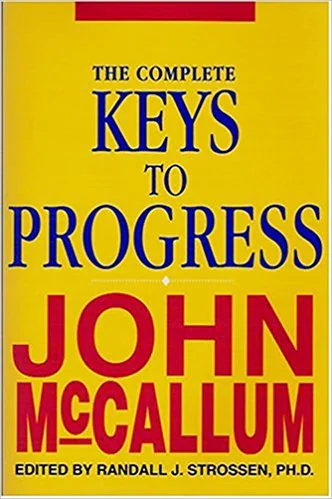
Keys to Progress by John McCallum.
Turgenev used peasants and hunters to illustrate and ornament his folksy tales. McCallum used his weight-training friends and relatives to propel his humorous tales that always had an underlying theme. John McCallum introduced us to a cast of recurring characters: his misguided friends, gym dumbos, iron heroes, iconic immortals, moronic boyfriends dating his daughter, Harry, his swinger uncle.
McCallum’s area of expertise was the acquisition of power and strength, and the concurrent muscle-size increase that always occurs when a man finds a way to become dramatically stronger. The acquisition of muscle and power are themes that never go out of style or grow stale for true alpha males. McCallum’s training advice was as good as any I’ve ever gotten.
Power, Strength, and the 5-Rep Squat
His emphasis on the barbell squat, and most particularly, the 5-rep squat, was again prophetic and profound. He stressed excellent technique and always told his readers how damned hard it is to build strength, increase muscle size and transform the physique. He made the difficulty, the stress, the strain, the gut-busting effort a clarion call. He challenged his readers: if you have the grit and gumption, here are the transformative techniques and tactics of the Iron Gods.
Very recently, I was bored with my own ideas. I picked up my well-worn copy of Keys to Progress and began scrolling down the table of contents until it caught my eye: an article, a series of articles, on anti-aging. Mac labeled it Fountain of Youth training. Reading his thoughts on the subject, penned 55 years ago, has a Nostradamus-like ring. Per usual, John McCallum proved prophetic. His anti-aging prescription was timeless.
McCallum’s Fountain of Youth Template
- Weight training
- Nutrition
- Running, or cardio
He added a fourth category, his version of brain-train, mental recalibration to improve performance in the gym. He called it “concentration,” mental recalibration that enabled the trainee to change eating habits, mental recalibration that must prefigure changes in physique. To quote John McCallum, “No one casually acquires a 500-pound squat or a powerful, rugged physique.” He was big on the Mind thing.
Nutrition: Power Foods and Junk Food
He was prophetic on nutrition. “First off, eliminate all junk food from your diet. All the gooey cakes, candies, cookies, soft drinks, sugar and processed grains. Eliminate them completely. They are junk and you don’t need them. Slash your carbohydrates to the bone, they don’t do much for you, other than make you fat.” What was on his approved list? “The bulk of your diet should consist of protein food. Round it out with fresh fruits and vegetables, many raw.” I use this advice to this day.
John McCallum intuitively knew that dietary fat was not the nutritional enemy. The enemy was refined carbs, industrial foods, sugar, trans fat, and chemical pollutants. In Mac’s time, food quality and food access were different from today. He stressed combining power foods with power training.
John McCallum was a hardcore weight trainer that took methods from the iron greats of his era and passed them along to us, his young readers. He took his training cues from Bill Pearl, Reg Park, John Grimek, Maurice Jones, Harold Cleghorn and a slew of elite Olympic weightlifters. He would relate mythical training sessions undertaken by these Iron Gods that would get me so fired up I would rush to my basement gym and begin training manically.
Cardio, Running, and Staying Useful
John McCallum was prophetic on the inclusion of aerobics into the weight trainer’s template. Mac lived in British Columbia and ran in the woods to “stay in shape.” The conventional thinking of the time was to avoid any type of aerobic activity because it would “tear down” muscle. Mac said this was utter nonsense. Fit athletes can train harder, longer and more often. Well-programmed cardio can support conditioning, work capacity and recovery when the lifter eats and rests accordingly.
He worked as a skin diver and had to be fit to do his job. “What good is it to be able to bench press 500 pounds if you get gassed after walking up three flights of stairs?” Fit lifters often recover quicker than their out-of-shape training partners. His philosophy could be encapsulated as: eat better, lift heavier, harder, and smarter. Don’t neglect cardio.
Put it all together, lifting, nutrition, and cardio, and you have a blueprint for physical transformation. This is the strategy elite athletes use to maximize physique and performance. The same broad categories can help those on the wrong side of 50 seeking to retain usefulness, mobility, and vigor, provided the plan is scaled to the person.

John McCallum was a writer for Strength & Health magazine from 1965 to 1971.
Strength After 50
Naturally, a man in his 50s, 60s or 70s cannot be expected to match strength levels exhibited in his prime strength years, the 20s and 30s. Here is the motto for the over-50 trainee: we can always improve on our current self. That is enough. That is profound.
His postulating about how best to slow aging-related decline rings true to this day. Progressive resistance training strengthens the body and limbs. Strength equates to function. Full-range resistance movements, scaled to the lifter, can help older trainees retain useful strength and mobility.
While an older lifter might not be able to run, they can often find an acceptable cardio alternative. The goal of cardio exercise is to purposefully elevate the heart rate and keep it elevated for a protracted period, at a level appropriate to the trainee. In Mac’s world, be you young or old, sweat is the barometer, insofar as cardio effectiveness. As Mac once quipped, “If you are not sweating, you need to find another gear.”
A Modern McCallum Template
If I were to start working with an average 60-year-old, regardless of gender or degree of fitness, I would begin an elementary progressive resistance program under tight supervision. I would have them clean up their diet, jettisoning junk food, sugar, processed grains, and excessive refined carbohydrates while keeping useful protein, fruits, vegetables and natural carbs that fit the person. I would have them begin an aerobic regimen based on their situation, degree of fitness and availability of tools and gear.
This approach is straight out of the 1965 Mac playbook. And like John McCallum, I would dedicate time and energy to brain-train: using psych to take resistance and cardiovascular training to the next level. Brain-train manifests itself by generating the bulldog adherence needed to succeed. Brain-train is used to break bad habits and establish new and beneficial habits. From a philosophic standpoint, while we might have refined the categories he demarcated, we were just rearranging the furniture: he designed the room and built the house it sits in.
Safety Note for Older Lifters, Nutrition, and Cardio
This article preserves Marty Gallagher’s RAW perspective on John McCallum, Fountain of Youth training, weight training, nutrition, cardio, and brain-train. It is not individualized medical, nutrition, rehabilitation, cardiovascular, geriatric, or programming advice.
Older lifters, deconditioned lifters and anyone returning after a long layoff should scale training to current capacity. Heavy squats, running, hard cardio, aggressive dietary restriction, high-protein eating, carbohydrate reduction, machine training, dumbbell work, and Smith machine work are not automatically appropriate for every person.
People with cardiovascular disease, blood-pressure concerns, diabetes, kidney disease, joint replacements, back pain, balance issues, dizziness, medication concerns, eating-disorder history, or major medical conditions should seek qualified guidance before major training or nutrition changes.
Build gradually. Warm up thoroughly. Use safe ranges of motion, conservative loading, enough recovery and appropriate supervision. Stop or scale back for chest pain, faintness, dizziness, unusual shortness of breath, sharp pain, numbness, radiating pain, sudden weakness, repeated technical collapse, severe fatigue, disordered eating patterns, or any symptom that feels different from normal training effort.
Equipment Notes for Fountain of Youth Training
Equipment does not create the Fountain of Youth. The plan, the effort, the adherence, the food, the recovery, and the willingness to keep moving create the Fountain of Youth.
For the weight-training side of Mac’s template, readers and facilities can compare home gyms, selectorized gym equipment, plate-loaded leverage gym equipment, the Body-Solid Series 7 Smith Machine package, and IRON COMPANY urethane dumbbells.
For the cardio side of the template, compare exercise bikes, treadmills, the Spirit Fitness CT900 commercial treadmill, and the Schwinn Fitness IC Classic indoor cycling bike, when the user, room, floor, medical context, and intended use align.
The equipment supports the method. It does not replace the method.
Related John McCallum Reading
For more Marty Gallagher writing on McCallum’s old-school wisdom, read The Eternal Wisdom of John McCallum.
RAW with Marty Gallagher, J.P. Brice, and Jim Steel Podcast.
About the Author: Marty Gallagher
As an athlete Marty Gallagher is a national and world champion in Olympic lifting and powerlifting. He was a world champion team coach in 1991 and coached Black's Gym to five national team titles. He's also coached some of the strongest men on the planet including Kirk Karwoski when he completed his world record 1,003 lb. squat. Today he teaches the US Secret Service and Tier 1 Spec Ops on how to maximize their strength in minimal time. As a writer since 1978 he’s written for Powerlifting USA, Milo, Flex Magazine, Muscle & Fitness, Prime Fitness, Washington Post, Dragon Door and now IRON COMPANY. He’s also the author of multiple books including Purposeful Primitive, Strong Medicine, Ed Coan’s book Coan, The Man, the Myth, the Method and numerous others. Read the Marty Gallagher biography here.
Marty Gallagher is a champion strength athlete, coach, author, and RAW Podcast host known for powerlifting, Olympic lifting, and serious strength training.
