
 Call us today at 1-888-758-7527

Bench Press Strength Masters: Powerlifting Lessons from Five Lifters
This essay from Marty Gallagher is a first-hand study of five bench press masters: Hugh Cassidy, Kirk Karwoski, Ken Fantano, Gene Donat and Danny D’Arrico. For powerlifters, bodybuilders, weightlifters and serious strength athletes, the lesson still holds: elite bench power is built with individualized technique, brutal barbell and dumbbell work, relentless practice, and the right equipment, from a stable Olympic bench press station to a dependable powerlifting bar.
Bench Press Strength Masters
Featured Strength Training Equipment: bench press, barbell, dumbbell
Five Masters of Bench Press Strength
I have had the great fortune to train with five bench press masters: Hugh Cassidy, Kirk Karwoski, Ken Fantano, Gene Donat and Danny D’Arrico. At the tiptop levels of any strength sport, athletes develop signature lifting techniques that maximize poundage handling ability. Individualized techniques get the most out of body type and skeletal structure. Much time, thought and practice goes into honing bench press techniques. Tactically all five of these men essentially used the same training template to maximize bench power. The methods used by each man had far more commonalities than differences; it was all barebones barbell and dumbbell work; simplistic, brutal exercises done with bar-bending poundage. In each training session, you gave 105% because you were lifting with the best in the world.
For today’s lifters trying to build a stronger bench press, the essentials are still recognizable: a sturdy leverage bench press or competition-style bench setup, the right Olympic bar, heavy dumbbells, and enough disciplined repetition to turn technique into second nature.
Hugh Cassidy: Raw Bench Press Power and Back-Off Sets
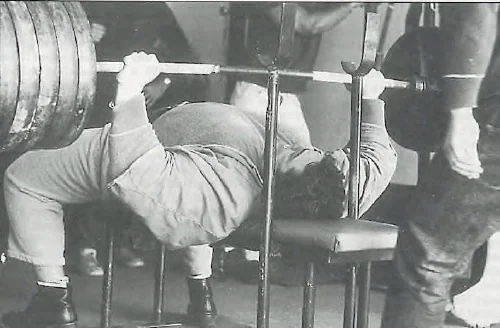
Hugh Cassidy: at the 1971 world powerlifting championships Hugh Cassidy bench pressed 570 pounds raw, i.e. no bench shirt, and most amazingly the bench press was done with a 2-second pause on the chest, as was the rule of the day. When Cassidy swung into competition mode, 10-12 weeks before a major competition, he would bench heavy, twice a week. In weeks 1-4, he would work up to a top set of 8 reps. In weeks 5-8, he’d work up to a top set of 5. In the final four weeks, two weeks of triples and two weeks of doubles.
Hugh performed two lighter sets of bench presses, he called them “back-off” sets. These were done after his top set. These lighter sets were done with a wider grip and paused. He would then work up to a heavy five-rep set of seated, alternate overhead dumbbell presses and finish with arms, biceps and triceps. We did this twice a week. This was a lot of work and to follow this body-shattering regimen, which I did for five years, you needed to eat copious calories. We would force-feed to accelerate healing and recovery, session to session; otherwise the body could not cope with the relentless pounding. Squats and deadlifts were done twice weekly in the same marathon session.
Kirk Karwoski: From Good Bencher to Incredible Bencher
Kirk Karwoski: Kirk bench pressed 585 weighing 275. He was a guy that was a good bencher that morphed himself into an incredible bencher. I was Kirk’s lifting coach for ten years and I introduced him to three bench press mentors: Ed Coan, Hugh Cassidy and Ken Fantano. When Kirk started working with me he was a legitimate 440 raw bench presser weighing a doughy 240 pounds. I got him on a Cassidy/Coan bench routine. Kirk benched big, once a week, and did heavy-ass incline barbell presses on a second day, three days later. He could incline 445 for 5 strict reps.
Kirk did a little bit of arm work, maybe 3-4 sets for bis and tris each week, but he could strict-rep a pair of 100 lb. dumbbells to high-rep failure. He built 21-inch ripped arms on eight sets of arms per week — but what sets those eight were! The final piece of the puzzle for Kirk was sending him to Kenny Fantano “bench press finishing school.” Ken taught Kirk his patented, ultra-sophisticated style of benching and Kirk took to the tricky technique like a duck to water: the technique ultimately added 150 pounds to his bench press and allowed him to dramatically grow his chest, shoulders, arms and lats; all as a direct result of adopting the Fantano bench press style.
That combination of heavy barbell pressing and brutal dumbbell work remains a practical lesson. Lifters building similar pressing strength today can pair a serious Olympic bar such as the Body-Solid black oxide Olympic weightlifting bar with progressive dumbbell work using urethane hex dumbbells or a full rubber hex dumbbell set.
Ken Fantano: The Most Sophisticated Bench Press Technique
Ken Fantano: the greatest bench presser I ever trained with, Ken hit a 633-pound paused double, two reps, done raw — no bench shirt. Ken stood 5-10, weighed 360 pounds and could move like a cat. He looked like the old-time Canadian strongman, Louis Cyr. Kenny was a savant/innovator insofar as bench pressing. His ideas were incredibly unique. He had a technique that was easily the most sophisticated I have ever encountered. His training approach was as unique as his technique.
He and I would sit at the glass counter in his gym, The Muscle Factory, in West Haven, Connecticut as he would patiently draw detailed renderings of the different phases of the bench press. He was left handed and massive — yet he had a light touch and an artistic flair; his bench diagrams were augmented by his soft-voiced, low-key explanations as to what was happening, or should be happening, at each critical juncture of the barbell bench press. I was flabbergasted and enthralled: this was genius and I knew it. He was influenced by no one: it all originated in his scientific/artistic brain. I never benched the same after working with him.
He felt that the bench press was a “technique lift” and done his way it certainly was. His bench technique was easily as complex as a perfect baseball bat swing, a perfect ace tennis serve, or a 350-yard golf drive. He “strength trained” the bench by developing a monster incline bench press: 400 pounds worth of dumbbells benched for 6 paused reps. Inclines “give me the contraction I’m looking for Mart.” He felt the pure pec push power he needed was built with dumbbell incline presses. He built thrust power needed to launch his competition benches with these once-weekly heavy inclines.
For lifters who want heavy dumbbell incline work without needing a full rack of fixed dumbbells, adjustable systems like the PowerBlock Elite USA 90 adjustable dumbbell set can support serious pressing progress in a more compact training space.
Gene Donat: Explosive Bench Press and Athletic Power
Gene Donat: Gene was one of three 600-pound raw bench pressers, and one of three 950-pound squatters, that trained at the Muscle Factory — which was incredible considering the gym had like 200 members. Gene and Danny D were Kenny protégés. Gene stood five feet six and weighed 400 pounds, yet he too was agile as a cat, extremely spry and athletic. Gene was a baseball catcher that made it to the semi-pro level and caught up until he weighed 360. He could hit and he could sprint.
Gene used Kenny’s slump-and-jolt style to bench 600. Gene squatted an official 954 in the USPF nationals and placed high in their national championships repeatedly. Gene had the biggest calves I’ve ever seen. One night after a lot of beer we measured them at 22 inches cold. He could leap up onto a picnic table and had a wonderful, glowing personality. Gene and Danny were Ken’s training partners and all three men, in addition to 600-pound bench presses, all had 950-pound below-parallel squats.
A marathon session was done on Sunday, a day that the gym was closed to the public. A dozen high-level lifters would gather and slog their ways through squat, bench, deadlift and arms. They would come in on Thursday and work up to three sets of 6 in the dumbbell incline press. Gene used a rebound squat style where he would bottom out 36-inch thighs onto 22-inch calves, like shock absorbers. Gene was a superb athlete that became a superb lifter.
Danny D’Arrico: Brute Force and the Muscle Factory Template
Danny D’Arrico: Danny was a truly unique alpha male personality. Unruly, unmanageable, hair-trigger and crazed, Danny was a freaking powerhouse: he squatted 950 and benched 600 pounds raw, weighing 275 pounds. Dan was his own man in life but in training he followed Ken’s exercise template and lifted right along with us. He had extreme quirks: when he squatted he insisted on wearing a squat suit, tight knee wraps and a belt, even on his lightest warm-up sets.
Why does a man that is going to squat 900 for three reps in an hour go to trouble and hassle to wear a squat suit, straps up, tight wraps and a belt on a 135-pound set? “I want to preserve all my strength for the top set Mart.” Okay. Where Ken’s benches were art, and Gene’s benches were explosive, Danny bulled his benches, as he did all his lifts. Another star baseball player, he was aggressive, funny and unpredictable. He took second to Dave Passanella at the 1988 APF nationals.
I was privileged to work with these men for a full year. Our after-training exploits were numerous, humorous and often dangerous and usually involved massive amounts of food and alcohol and Danny teeing off on some unsuspecting tough guy. The bench press and squat styles that were perfected at the Muscle Factory were radical and light years ahead of their time.
Equipment Pairings for Building Bench Power
The common thread between Cassidy, Karwoski, Fantano, Donat and D’Arrico was not gimmickry. Their bench press strength was built on heavy barbell work, heavy dumbbell incline presses, carefully refined technique and training partners that raised the standard in every session. For home gyms, commercial strength rooms, school weight rooms, first responder facilities and military training spaces, a strong bench setup starts with a stable bench press station, a dependable Olympic bar, and dumbbells heavy enough to support serious pressing work.
For plate-loaded pressing options, the Arsenal Reloaded Iso Flat Press can support heavy flat pressing outside the straight barbell bench press pattern. For lifters who prefer classic barbell work, a quality bar such as the CAP Barbell 7ft chromed Olympic weight bar can serve as a practical foundation for bench press, incline press and other upper-body strength work.
FAQ
What is Bench Press Strength Masters about?
Bench Press Strength Masters is Marty Gallagher’s first-hand account of training with five elite bench pressers: Hugh Cassidy, Kirk Karwoski, Ken Fantano, Gene Donat and Danny D’Arrico. The article focuses on raw bench press strength, individual technique and the barbell and dumbbell work that built massive bench power.
What did the five bench press masters have in common?
Gallagher explains that the five lifters had far more commonalities than differences. Their training relied on barebones barbell and dumbbell work, brutal effort, heavy poundages and technique refined to match each lifter’s body type and structure.
Why did Ken Fantano consider the bench press a technique lift?
Fantano viewed the bench press as a highly technical lift with distinct phases and critical positions. Gallagher compares the sophistication of Fantano’s bench press technique to a perfect baseball swing, tennis serve or golf drive.
How did dumbbell incline presses support bench press strength?
In the article, Ken Fantano used heavy dumbbell incline presses to build the pure pec push power and thrust needed to launch his competition bench presses. Kirk Karwoski also used heavy incline barbell pressing as a second weekly pressing day.
What equipment supports serious bench press training?
A serious bench press setup starts with a stable Olympic bench press, a quality Olympic or powerlifting bar, heavy dumbbells, and enough loading options to progress safely and consistently. Plate-loaded presses and leverage bench press machines can also support heavy pressing work when they fit the training goal.
About the Author
As an athlete Marty Gallagher is a national and world champion in Olympic lifting and powerlifting. He was a world champion team coach in 1991 and coached Black's Gym to five national team titles. He's also coached some of the strongest men on the planet including Kirk Karwoski when he completed his world record 1,003 lb. squat. Today he teaches the US Secret Service and Tier 1 Spec Ops on how to maximize their strength in minimal time. As a writer since 1978 he’s written for Powerlifting USA, Milo, Flex Magazine, Muscle & Fitness, Prime Fitness, Washington Post, Dragon Door and now IRON COMPANY. He’s also the author of numerous books including Purposeful Primitive, Strong Medicine, Ed Coan’s book “Coan, The Man, the Myth, the Method" and numerous others. Read the Marty Gallagher biography here.
Marty Gallagher is a champion strength athlete, coach, author, and RAW Podcast host known for powerlifting, Olympic lifting, and serious strength training.
