
 Call us today at 1-888-758-7527


Curse Of Too Many Choices
“He Purposefully Limited Himself”
A mile wide and an inch deep versus an inch wide and a mile deep.
Standing on the shoulders of giants: Marcus Miller and mentor Miles Davis. The mature artist pares back, leaves space, gets more from less, and does fewer things better. Economy and sparseness are the highest evolution of the mature artist.
I watched an excellent documentary on Marcus Miller. Best known as one of the planet’s premier bass players, Miller is a film and jazz composer, record producer, arranger, multi-instrumentalist and force of nature. Marcus was born in Brooklyn, raised in Jamaica, Queens, in 1959, and grew up in a musical family. His father, William Miller, was a church organist and choir director. His musical family included jazz pianist Wynton Kelly. Marcus was immersed in music from birth.
His credentials are staggering. Marcus spent years as a premier session musician, co-wrote Aretha Franklin’s “Jump to It,” worked with a galaxy of major artists, and became one of Miles Davis’s great late-career collaborators. He composed, produced and arranged Tutu, one of the definitive late Miles albums.
Marcus Miller, Jaco Pastorius, and Narrowing the Choices
Marcus recalled an eye-opening experience he had in the mid-1970s when he had a private practice session with Jaco Pastorius, the Jimi Hendrix of the bass. Marcus was shocked when Jaco explained that he purposefully did not use all the technology at his disposal. He eliminated half the electronic possibilities on purpose.
There were two pickups on Jaco’s fretless Fender Jazz bass, yet Jaco only used the back pickup. This made his sound thinner and more nasal, but it increased clarity and forced him to be more creative, more nimble, more tonally aware.
Jaco limited himself. He closed in his possibilities.
Jaco was a purposeful primitive. He was doing fewer things better. By eliminating half the possibilities, he compressed the technical components he needed to master. Fewer choices forced him to be more innovative with what was left. Marcus explained that Jaco refused to be seduced by the curse of too many choices. Counterintuitively, he purposefully limited his choices. Rather than expand his choices, he reduced them.
Miles Davis and the Power of Fewer Notes
Later Marcus noted that his ultimate mentor, Miles Davis, did much the same thing in a different way. When Miles first came onto the scene, he wanted to play like Dizzy Gillespie, fast and high. The more Miles matured, the fewer notes he played. And the more effective and profound those perfectly selected notes became. They impacted like thunderbolts.
The Japanese revere artistic restraint. The use of space and openness in Japanese architecture and flower arranging is considered a high form of art. What is the irreducible artistic core essence? How much can be removed without losing effectiveness? What is the nucleus of the artistic atom?
Artistic minimalism in the hands of a true master is nothing short of profound.
Artistic Minimalism and Strength Minimalism
There are parallels in hardcore power training. Elite strength athletes, including IPF world powerlifting champions, have their own version of closing in the possibilities. They narrow the choices. They too do fewer things better. Strength minimalism in the hands of a true master is nothing short of profound.
Our particular arena of strength expertise is absolute strength, which includes isometric and isotonic strength. Strength has three generalized types: absolute strength, explosive strength, and sustained strength. Our forte is the acquisition of absolute strength: raw brute power, size, lean muscle mass, low-end torque, and limit strength.
In the beginning, it was all about progressive resistance maximalism. Up until and through the 1950s, hardcore strength athletes trained with free weights three times weekly in the belief that unless a weight-trained muscle was retrained every 36 hours, that muscle would regress and gains would slip through your fingers. This was the settled science of the era and no other viewpoint was considered or allowed. Dissent was viewed as heretical and “flying in the face of science.”
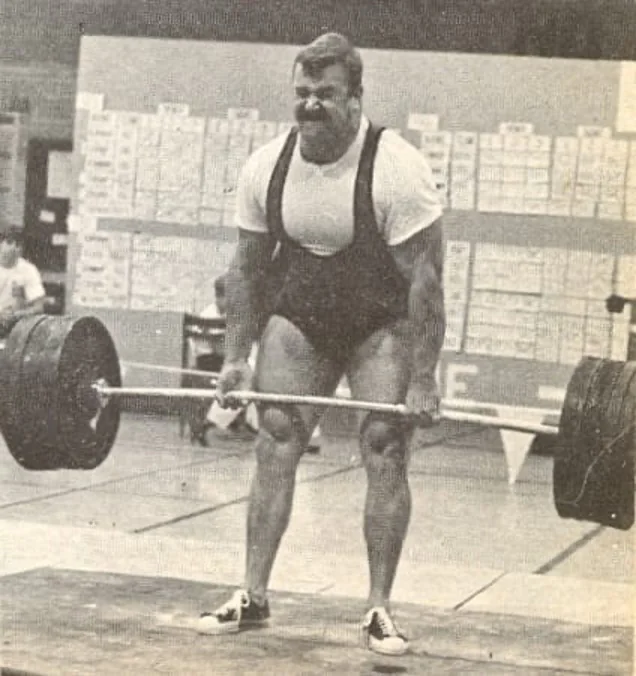
Blood on the gym floor: Hugh “Huge” Cassidy did not suffer fools lightly. I apprenticed under him for five years.
Hugh Cassidy and the First Reduction
This changed as powerlifting became a formal competitive sport in the 1960s. My mentor, my Miles Davis, Hugh “Huge” Cassidy was one of the early power pioneers. Hugh was the first superheavyweight powerlifting world champion. He took the heretical step of reducing his thrice-weekly power-training sessions to twice a week.
Reality forced change. Hugh followed where progress led. He was a biological scientist who used his own body as his laboratory. When these early power pioneers began barbell bench pressing 450 to 500 pounds for reps, squatting and deadlifting 700 pounds for reps, they were unable to recover in time for the next session. While a man squatting 200 pounds for reps might be able to squat three times weekly, ask the man repping 600.
These men discovered that by cutting back, by training twice weekly, progress skyrocketed. Even so, blasting away, balls out, twice weekly, still pushed the limits of human tolerance: that which does not kill me makes me stronger.
For five years I engaged in twice-weekly slaughter-fests in the Vulcan forge that was Cassidy’s dank basement gym. To cope, we slammed calories to create food-induced anabolism. After a Cassidy workout, our bodies were shattered, traumatized, and without copious calories recovery was impossible. Rest was the final piece of the muscle and power equation.
We were young men seeking to forcibly morph ourselves from human into inhuman, from good into great, from large into gargantuan. Cassidy did not mess around. He trained national and world champions. In each session we did squats, bench presses, deadlifts, overhead presses, and arm work. You got your facts learned, and if you could survive, you grew massive and doubled your strength.
To accelerate recovery, we ate like ravenous wolves or sumo wrestlers. We loved sleep and slept like hibernating bears. After a Cassidy training session, we would hit a buffet en masse, like a plague of locusts, consume massive calories and fall into a catatonic sleep stupor. We grew while we slept in that blissful state of suspended animation. Even so, we could barely cope with the trauma of twice-a-week power training.
The Second Wave: One Lift, One Time Per Week
The second wave of power champions arrived in the 1980s. These men slashed twice-a-week power training to once a week for each lift. The new breed was squatting and deadlifting 800-plus pounds for reps and bench pressing enormous raw poundage. They found there was no way they could handle that level of loading twice a week, no matter how much food they ate and regardless of how much sleep they got.
The squat and deadlift use many of the same muscles: erectors, abs, upper thighs, glutes, hamstrings and more. Twice-weekly power training meant pounding the same muscle groups repeatedly with limit efforts. If a man was repping 600 to 800 pounds in his squats and deadlifts, blasting the same muscles four times a week proved impossible. It was counterproductive, potentially injurious and totally unnecessary.
Doug Furnas and the End of the Light Day
World champion and world record holder Doug Furnas explained the evolution. In high school and college, he said, the men weight trained three times a week. They were smaller and weaker. When they began training under world champion Dennis Wright, they squatted twice a week, heavy. They got too strong and were not recovering session to session.
“The breakthrough occurred when we dialed it back,” Furnas explained. “At first we tried to compromise. Instead of two heavy squat days, now we would have a heavy day and a light day. After a while, we figured out that the light day wasn’t doing a damned thing, other than cutting into our recuperation. We said to hell with the light day. That’s when our progress exploded.”
The uber-elite power men of that era — Furnas, Coan, Karwoski, Cash — began training each lift one time a week and producing lifts that remain legendary in strength history. It was the birth of strength uber-minimalism. These men believed in the rested effort, in doing fewer things better, and doing them less often.
Do Fewer Things Better
The power giants narrowed their possibilities. They began doing fewer things better, lifting heavier, more precisely and less often. They allowed for space between sessions. They pared back and reduced until they were left with the core essence of a system: absolute strength, stripped to the studs.
Consider purposefully narrowing your training possibilities. In our age of the Delphic oracle called Google, humanity is afflicted with the curse of too many choices. We have become a species of surface skimmers, flittering from one fragrant flower to the next, deluded hobbyists. Are you a mile wide and an inch deep? Marcus, Miles, Jaco, Cassidy and Furnas were an inch wide and a mile deep.
If you are a serious resistance trainer, rip a page from Jaco’s book and purposefully narrow your scope of training possibilities. Do less more intensely.
Equipment Notes for Minimalist Strength Training
Minimalist strength training does not require many tools. It requires the right tools used seriously. A stripped-down strength room can be built around a bar, plates, rack, bench, dumbbells, safe flooring, and enough discipline to stop chasing novelty.
For a focused barbell room, lifters, and facilities can compare Olympic weightlifting bars, weight plates, dumbbells, weight benches, and power cages and platform racks.
A focused setup might include the Body-Solid GPR400 Commercial Power Rack, the PowerBlock Commercial PowerBench, IRON COMPANY Urethane Dumbbells, a Legend Fitness American Made Olympic Weightlifting Bar, and TKO Solid Rubber Bumper Plate Sets, when those tools match the lifter, room, budget, and program.
The equipment does not create minimalism. The lifter does. The tools simply give the narrowed system a place to happen.
Safety Note for High-Intensity Minimalist Power Training
Elite strength minimalism is not beginner minimalism. Training a lift once weekly can work beautifully for advanced lifters handling massive poundage, but beginners may need more practice, lighter loads and more technical rehearsal before reducing frequency.
Heavy squats, bench presses, deadlifts and overhead presses require progressive warm-ups, honest loading, secure plates, suitable racks, spotters or safeties where appropriate, and enough recovery to make the next session productive. Do not confuse “do less” with “do reckless.”
Stop or scale back for sharp pain, dizziness, numbness, repeated technical collapse, abnormal fatigue, missed reps that were predictable before they happened, or any workout that becomes a different workout than the one being trained.
This article preserves Marty Gallagher’s RAW strength-training philosophy and firsthand powerlifting history. It is not individualized medical, rehabilitation, or programming advice.
RAW with Marty Gallagher, J.P. Brice, and Jim Steel Podcast.
About the Author: Marty Gallagher
As an athlete Marty Gallagher is a national and world champion in Olympic lifting and powerlifting. He was a world champion team coach in 1991 and coached Black's Gym to five national team titles. He's also coached some of the strongest men on the planet including Kirk Karwoski when he completed his world record 1,003 lb. squat. Today he teaches the US Secret Service and Tier 1 Spec Ops on how to maximize their strength in minimal time. As a writer since 1978 he’s written for Powerlifting USA, Milo, Flex Magazine, Muscle & Fitness, Prime Fitness, Washington Post, Dragon Door and now IRON COMPANY. He’s also the author of multiple books including Purposeful Primitive, Strong Medicine, Ed Coan’s book Coan, The Man, the Myth, the Method and numerous others. Read the Marty Gallagher biography here.
Marty Gallagher is a champion strength athlete, coach, author, and RAW Podcast host known for powerlifting, Olympic lifting, and serious strength training.
