
 Call us today at 1-888-758-7527

Placebo Power Part 2: Nutritional Supplements
“Don’t tell me it doesn’t work!” The mind is a powerful thing. Nutritional supplements, placebo, protein powder, and old-school weight training.
This Marty Gallagher nutrition article is not a supplement sales pitch. It is a hard-edged story about belief, placebo, protein powder, creatine monohydrate, brutal weight training, and the strange way a lifter’s mind can amplify a training cycle. Marty’s point is not that bogus nutritional supplements should be trusted; his point is that when savage effort, food, rest, youth, momentum, and belief collide, the result can feel like magic.
Old-School Nutritional Supplements and Belief
As an avid reader of the muscle mags in the mid-1960s, I innocently believed all the exaggerated hype and over-blown promises made for the nutritional supplements of the era. I needed these nutritional supplements and their miraculous results. But for years they were beyond my reach, financially.
Now, in 2019, I know that every single nutritional supplement offered by anyone back in those primal days was intentionally or unintentionally bogus, uniformly anemic, worthless, if not downright harmful. Still, there are counterintuitive examples of great gains made using lame methods and bogus products. I have my own tale of substantial improvement using a bogus product. Back then, I attributed my sensational results, erroneously, to this miracle product. That turned out to be an impossibility.
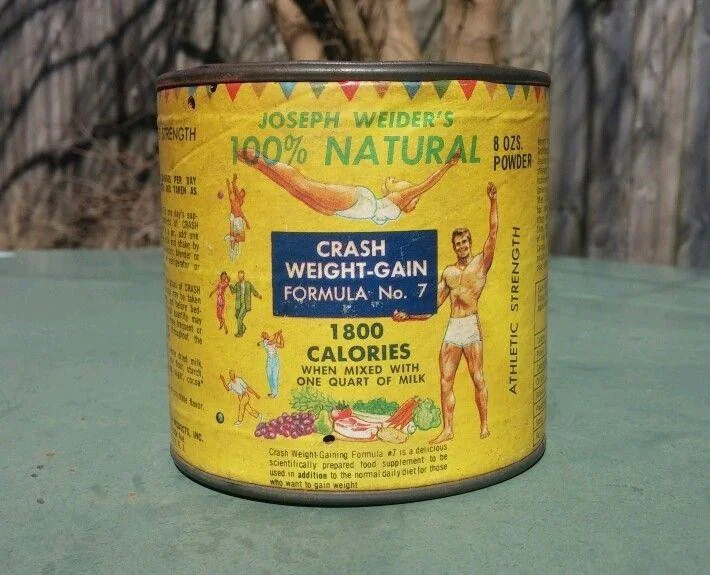
When my friends and I got our driver’s licenses, our whole world opened up. My training partners and I drove downtown to visit a “health food” store. They carried York Barbell products, barbells, weight plates, weight benches, squat racks, and assorted fitness tools, wrist rollers, iron boots, and crusher type devices. The health food store also carried York protein products and other "nutritional" supplements. Bob Hoffman had noted that Joe Weider was selling the hell out of Crash Weight Gaining Formula #7 and counterattacked by offering a “superior” product at half the price.
Weight Gainers and Protein Powders for Building Muscle
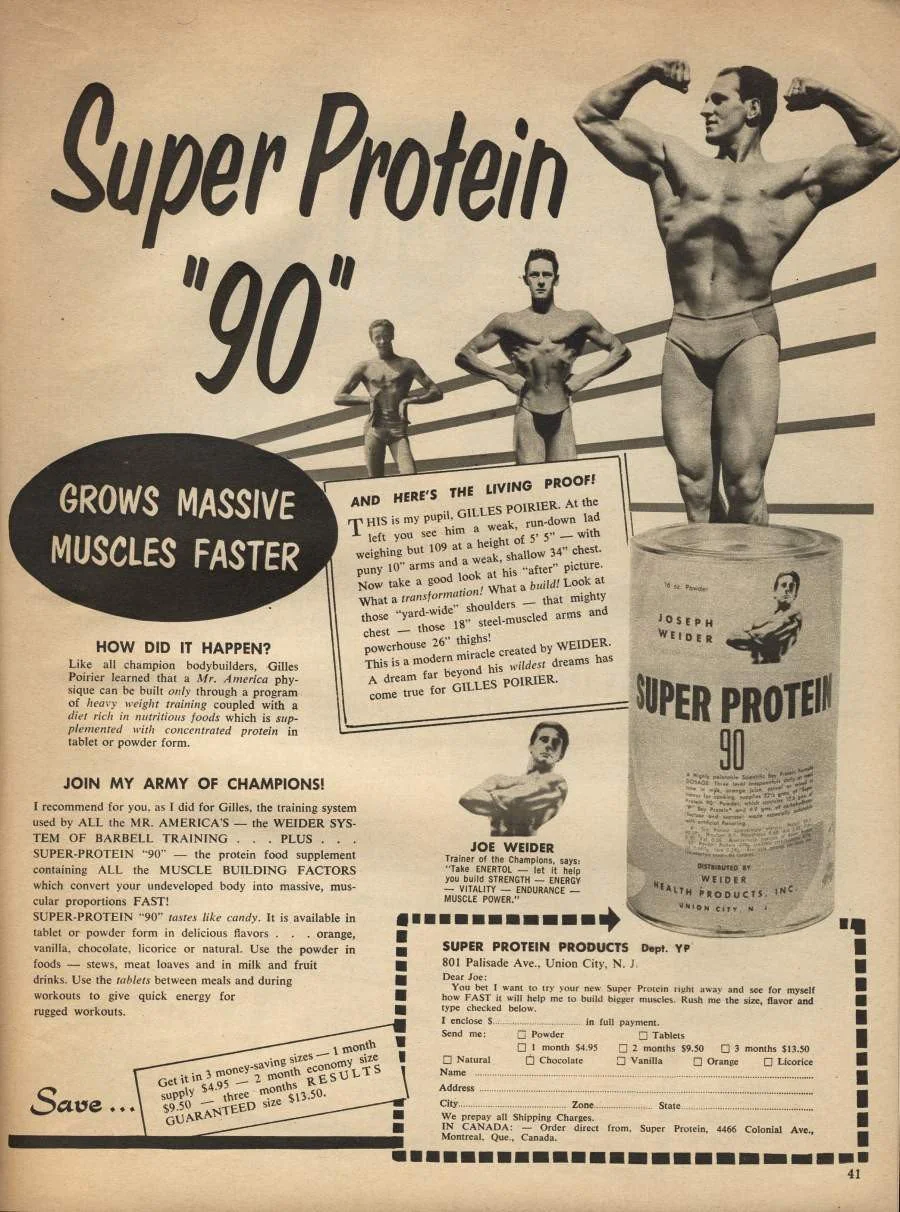
Weight gainers and protein powders for building muscle
Hoffman’s Quick Gain Weight powder was priced at $6.95 for a four-pound canister, this was the right price for the right product at the right time, I was ecstatic. It was all falling together. I raised the cash by walking 72 holes of golf, as a caddy, 36 on Saturday and 36 on Sunday. Flush with cash, I went on a mission to obtain Hoffman’s Quick Gain Weight Powder.
I saw my current 170-pound-self swelling and growing exponentially. Here was the recommended strategy, “Two quarts of whole milk mixed with eight servings of Hoffman’s Quick Gain Weight powder will provide 2,500 calories and 150 grams of protein.” Drink this every day until it runs out. 2,500 calories would be broken up, drank over the course of the day, a pint at a time. I made mine up in the morning, mixing it in a big Kool Aid pour jug.
I launched my 14-day blitzkrieg effort on a Monday morning. I did exactly as recommend. I dedicated my life to this. I ripped through my 4-pound cannister, gaining 14 pounds of bodyweight in 14 days. Not only did I blow the minds of friends and family, I blew my own mind. I took my whole game to the next level in one incredible 14-day spurt.
It was only in 2018 that I found out that this incredible nutritional supplement gain-weight product was bogus, absolute nutritional garbage, undeniably detrimental; anemic ingredients loaded with unconscionable levels of pure, unadulterated refined sugar. Yet, I obtained incredible gains in size and strength, leaping from a bodyweight of 171 to 185, an 8% increase in lean muscle mass, this in fourteen days and using a completely bogus product.
Hoffman claimed, “Our protein is the highest biologic value.” Turns out Hoffman’s protein products were made from the worst possible protein: he bought low-grade soy that grew in abundance around York, Pennsylvania. He would buy surplus soy at cut-rate prices and have it chemically converted into powder form. The disgusting taste of powdered soy was disguised by cutting the powder with various flavored filler and sugar, lots and lots of sugar.
As a protein, soy is anemic, incomplete and impotent. The worst form of nutritional supplement. Period. I won’t even discuss soy merits as a supplemental protein source. This terrible protein has a putrid taste that Hoffman counteracted by adding ungodly amounts of highly refined sugar. Any actual nutritional benefits I derived during my incredible 14-day growth spurt was completely attributable to, first and foremost, my savage weight training: I trained fourteen straight days and busted ass every single session.
I backed up the murderous training with face-stuffing gluttony, supplemented with two quarts of whole milk, each and every day. The sugar-laden chocolate powder, when mixed with whole milk, was delicious; this because it contained as much sugar as a cup of Hershey’s chocolate syrup or half a bottle of Bosco. The powder made the milk go down easy, but it was a chemical cesspool.
The Perfect Storm Behind the 14-Day Spurt
So, what accounted for my spurt? It was the perfect storm: I was the right age. My young body was flooded with testosterone. I was training hard and right and often. I was able to stuff my face on a consistent and ongoing basis. I was lean and highly conditioned. Because of my blazing athlete’s metabolism, any surplus calories were instantly converted into muscle, not fat.
I took on a different mindset when I commenced my 14-day Quick Gain Weight blitzkrieg: first off, I wasn’t a skeptic, I was a believer. I had seen the mental movie so many times that I knew exactly how the process should unfold. It seemed to me that this was predestination unfolding. Once I launched, every day without fail, I gained that pound, every day I got bigger and stronger. Whatever it took for that day, I did it, I made it happen.
I upped my regular food intake, dramatically. We used food and milk, calories, thousands and thousands of calories, to unwittingly make ourselves anabolic. I trained for fourteen straight days and subjected myself to the hardest and heaviest workouts of my life, to that point. And it was easy. Every day I awoke believing that I was better than yesterday: tangibly, mathematically better, bigger, stronger, irrefutably mathematically better than yesterday. Every day I awoke on fire to achieve the day’s lifting and bodyweight goals. Momentum took hold in around day three.
People marveled in real time at my transformation. The effect was enhanced by having my moderate length student haircut shaved down into a Marine DI cut. This was a boy-to-man tipping point. I never again replicated the rapidity of those results. It was a perfect storm for drug-free muscle gains: tons of calories, a raging metabolism, a testosterone-drenched boy body, incredibly intense lifting sessions, lots of rest, and stress-free care-free living. Oh, and a berserker mindset.
The incorrect conclusion my 15-year old self reached was that the Quick Gain Weight nutritional supplement actually worked. As in “Don’t tell me it doesn’t work! I gained 14-pounds in 14 days!” The real lesson is that a recalibrated Mindset can be a powerful ally in the transformative quest. An occasional burst of fanaticism, as in my 14-day blitzkrieg, will liberate a man, blast him out of whatever velvet rut of sameness and stagnation he finds himself in. The psychological placebo effect can generate a strong and unshakable belief in method and self. It all springs from a recalibrated mindset.
Another quick and related tale...
Creatine Monohydrate, Placebo, and Powerlifting Belief
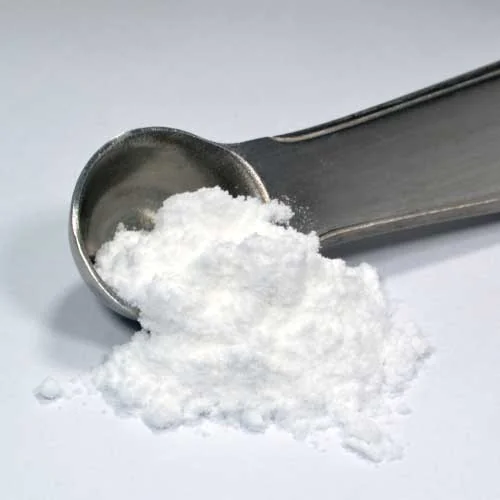
Creatine monohydrate nutritional supplement for gaining size and strength
Back in the 1990s, I worked as a feature article writer for Muscle & Fitness magazine. The Weider's had, by this time, long since won the “muscle war” with Bob Hoffman. The Weider’s and bodybuilding won in a landslide, particularly after Olympic lifting ditched the overhead press in 1972. Bodybuilding popularity, male and female, exploded, largely because of the efforts of Joe Weider.
Dr. Jim Wright was the longtime science editor at Flex magazine and my friend. He related to me that Flex had lab tested a bunch of commercially available samples of creatine monohydrate. This was back when creatine was first coming onto the scene. Weider was thinking about marketing their own creatine powder and decided to see what the competition was doing. When the lab analysis came back, 8 out of 11 products tested flunked: terrible potency, weak, anemic products; the modern versions of Quick Gain Weight. Many big name super-popular brands of creatine were impotent rip-offs.
In about this same time I got a phone call from my friend, superheavyweight world champion powerlifter Brad Gillingham. Brad had won the national championships and was deep in preparation for the upcoming world championships. He was relating to me the incredible benefits he was obtaining from this new product: creatine monohydrate.
He had never tried this new supplement and it was taking Brad’s muscle size and strength to new levels. Brad related in his Minnesota plain-speak that, while he had never been on steroids, the results he was obtaining from creatine seemed “steroid-like” to him.
His squat had shot up 40 pounds and his bench press 25. He felt creatine made all the difference. It was this nutritional supplement that enabled him to add 15-pounds of much needed muscle. I made the mistake of asking what miracle brand of creatine he used; he named one of the worst, an anemic brand that had ranked near the bottom of creatines Flex had tested.
I almost blurted out the truth that his selected brand was as impotent and bogus as a nutritional supplement gets. I held my tongue and in a flash of inspiration said, “Oh, indeed. You have brilliantly selected the right brand. Dr. Wright at Flex tested different type for potency and your brand came in first place by a country mile. Jim Wright told me the stuff was so off-the-charts potent that he was shocked it wasn’t banned.”
“I knew it!” Brad said. He gained ten more pounds of muscle and won the IPF world powerlifting championships that year with a 600-pound bench press and 880-pound deadlift, all 100% drug free, just jacked out of his mind on creatine. I have never told him that story to this day. This despite seeing him regularly. He’ll be surprised. The Mind is a powerful thing.
Read Placebo Power Part 1 here.
The Real Nutrition Lesson
The useful lesson is not that every lifter should trust old protein powder, sugar-heavy gainers or whatever supplement label happens to sound convincing. The useful nutrition lesson is that food, belief, recovery, and brutal resistance training can become intertwined. A lifter who believes completely in a plan often trains harder, eats more consistently, sleeps with purpose, and attacks the barbell with a different level of commitment. That can matter.
For powerlifters, bodybuilders, weightlifters, athletes, first responders, and military trainees, nutrition still needs to be judged by the total context: the athlete, the goal, the training cycle, the food quality, the supplement quality, the amount of work being done, and the actual measurable results. Placebo is powerful, but it does not replace honest food, honest work, honest loading, and honest recovery.
Equipment Pairings for the Training Side of Nutrition
Marty’s story keeps circling back to the same reality: the gains did not come from a powder canister alone. They came from eating hard and training harder. Lifters building a serious home gym, school weight room, commercial facility, first responder fitness room, or military training space can start with strength training equipment and free weights that support repeatable barbell work.
For barbell training, options include Olympic weightlifting bars, the Iron Grip OB-7 Industrial Chrome Olympic Weightlifting Bar, and the IRON COMPANY urethane barbell set. For loading, lifters can compare IRON COMPANY premium rubber bumper plates and American Barbell urethane Olympic grip plates.
For the rack and bench side of the program, a simple setup can include the Body-Solid Commercial Squat Stand, Alpha competition flat bench with face savers, or Arsenal Reloaded ISO Incline Press when those tools match the facility and training goal. The equipment does not create the placebo effect; it gives the motivated lifter a place to convert belief into work.
Nutrition and Supplement Note
This article is historical nutrition commentary, not medical advice and not a recommendation to use any specific supplement, sugar-heavy weight gainer, protein powder or creatine monohydrate product. Supplement quality, tolerance, labeling, medical history, diet strategy, training age, and recovery needs vary. Lifters should evaluate supplements carefully and consult a qualified professional when needed. Likewise, Marty’s 14-day training blitz is part of a personal story, not a universal training prescription.
Placebo, Nutrition, and Supplements FAQ
What is Placebo Power Part 2 about?
Placebo Power Part 2 is Marty Gallagher’s story about old-school nutritional supplements, protein powders, creatine monohydrate, and the way belief can influence training behavior. The article argues that mindset can intensify effort, consistency, and commitment, even when the product being credited is not the real cause.
Did the old weight gainer actually cause Marty’s 14-pound gain?
Marty’s conclusion is no. He later learned that the product was a poor-quality sugar-heavy powder. He attributes the results to a perfect storm of youth, calories, whole milk, hard training, rest, a high metabolism, and total belief in the process.
What is the placebo effect in strength training nutrition?
In this article, the placebo effect refers to the power of belief to change behavior. If a lifter believes a supplement is working, that belief can make him train harder, eat more consistently, recover with purpose, and attack daily goals with more intensity.
What does the creatine monohydrate story show?
The creatine story shows how powerful belief can be for an elite lifter. Brad Gillingham believed a specific creatine product was producing major strength and muscle gains, and that belief became part of an already serious powerlifting training cycle.
Is Marty saying nutritional supplements do not work?
No. The article is more specific than that. Marty is criticizing bogus or weak supplements and the overblown claims surrounding them, while showing that mindset, food, hard training, and recovery can be mistaken for supplement magic.
What equipment supports the training side of this nutrition lesson?
A practical setup can include barbells, Olympic weightlifting bars, weight plates, bumper plates, a squat stand, weight bench, and other free weight equipment. Nutrition matters, but the training stimulus still has to come from hard, repeatable work.
About the Author
As an athlete Marty Gallagher is a national and world champion in Olympic lifting and powerlifting. He was a world champion team coach in 1991 and coached Black's Gym to five national team titles. He's also coached some of the strongest men on the planet including Kirk Karwoski when he completed his world record 1,003 lb. squat. Today he teaches the US Secret Service and Tier 1 Spec Ops on how to maximize their strength in minimal time. As a writer since 1978 he’s written for Powerlifting USA, Milo, Flex Magazine, Muscle & Fitness, Prime Fitness, Washington Post, Dragon Door and now IRON COMPANY. He’s also the author of numerous books including Purposeful Primitive, Strong Medicine, Ed Coan’s book “Coan, The Man, the Myth, the Method" and numerous others. Read the Marty Gallagher biography here.
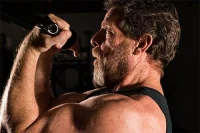
Marty Gallagher is a champion strength athlete, coach, author, and RAW Podcast host known for powerlifting, Olympic lifting, and serious strength training.
