
 Call us today at 1-888-758-7527

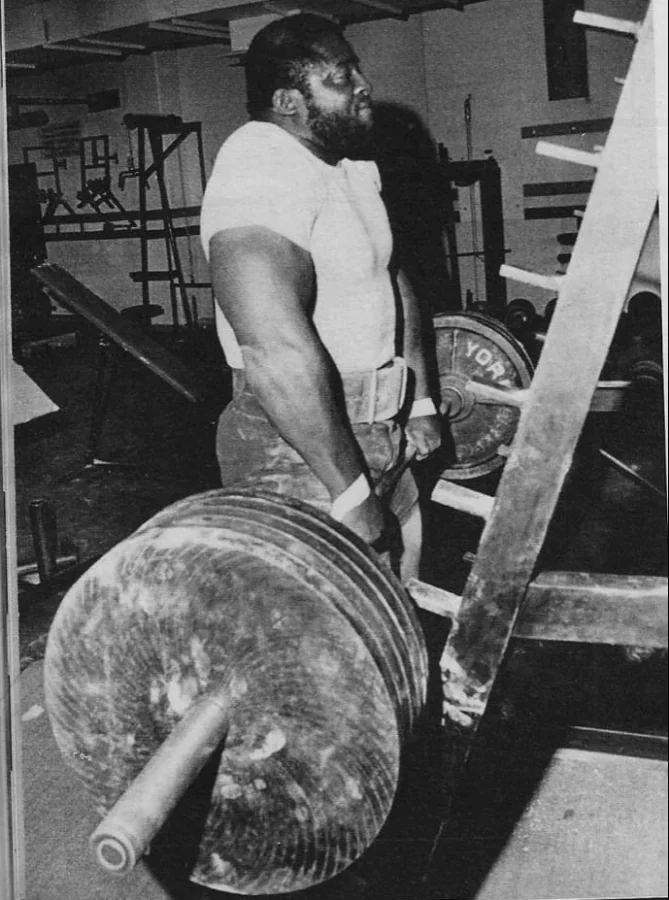
John Gamble - Unknown Powerlifter and Bad to the Bone
World Champion Powerlifter John Gamble
World Champion powerlifter John Gamble, shown in the featured image. He would sweat down from 290 to 275 in 24 hours, look like this, and set world records.
A 1980 Maryland Powerlifting Meet
In 1980, a half dozen powerlifters from Mark Chaillet’s gym traveled from Temple Hills, Maryland, to Havre de Grace, Maryland, for an annual powerlifting competition put on by strength legend Bill Starr’s brother Don. This was in the glorious era when there was only one American powerlifting federation, the USPF. I was not lifting, I was coaching. Hugh Cassidy showed up to see his old friend Bill Starr. I remember the three of us retiring to somebody’s car to smoke a joint. I lay in the backseat too tongue-tied and stoned to talk as Hugh and Starr reminisced and laughed. I worshiped Starr from afar and up close I was Starr-struck.
I would be coaching three lifters and headed back inside. As I entered the warm-up area, I saw Bill Dunn and John Gamble. I had seen Dunn at the Junior Nationals in Richmond a few months earlier; he was a massive man, I would guess 330 pounds. He was top heavy: broad, thick in the torso and arms, and light in the legs. Bill had what my Irish father would call “piano legs.”
Dunn was primarily a bench press expert and on the cusp of a 600-pound bench press; this at a time when only a handful of men had crashed the 600-pound raw bench press barrier. Bill was the head strength and conditioning coach at the University of Virginia, a big-time job at a D1 school. He had traveled north four hours to Maryland to take a shot at an official 600-pound bench press.
Bill Dunn’s Bad Day
As massive and impressive as Dunn was, the guy he was with was way more impressive. Freaky. Bigger and more muscular than any human I had ever seen. His name was John Gamble, and he was Dunn’s assistant coach. John Gamble stood 5-11 and weighed 275 pounds, this after sweating down from 290. At 275, he was ripped. Because John Gamble was a balanced lifter, he had a balanced physique.
John was not just humongous, he was ripped: veins on his arms, veins on his delts, pec striations, gigantic arms that rippled when he moved them, a giant set of traps, lats like Dorian Yates and a powerhouse set of glutes and thighs. Oddly, he had disproportionately small calves, the only thing that stopped him from, in my opinion, striding onstage to win the Mr. Olympia. Gamble was twice as big as the then-current Olympia winners. John dwarfed Bertil Fox, the IFBB mass monster. Gamble and I were the same height. My honest 19-inch arms looked like plastic squirt guns next to his .50 caliber Desert Eagles.
John Gamble was on the front end of his short powerlifting career and had traveled to a Maryland meet to post his first official 800-pound barbell squat. Bill Dunn was there to post a monster bench press. However, before being allowed to bench press, Dunn would have to post a squat, even a token one. Bill did just that: he took a token 135-pound squat. His name was called, he came onstage and dunked the weight. As he strode offstage three red lights came on. In his carelessness, Dunn had not dipped low enough with the 135. The USPF rule was that the upper hip joint needed to sink lower than the top of the knee. Dunn laughed at his own sloppiness.
He repeated the 135-pound squat on his second attempt. He did not slop through it; he took his time and did it right. Three red lights. Not low enough. Now he was not laughing. He was incredulous and angry. From my vantage point, Dunn obviously was not used to squatting deep. Likely no one he trained with criticized the boss’s depth in a lift he did not care about or emphasize.
Bill was so top-heavy that the instant he broke his knees to squat, he leaned forward, and the more he bent forward, the more it pulled his ass into the air. Factually, the USPF judges were correct: his squats were high. Could he correct himself on the third? Had I been asked, I would have suggested loading his big ass down with, say, 405, enough poundage to push his tight, muscled-up body below parallel. Get enough weight on the bar to push him below parallel: the 135 was not heavy enough to force him down.
Now he was angry and embarrassed. He stormed onto the platform for his third squat attempt. Again, he took it down and again he stood up and again his squat was high. Turned down on his third attempt, he was now out of the competition. He would not be allowed to bench press, and ergo, this trip, his twelve weeks of training, the expense — it was all wasted. And he wanted someone to blame. This is when the cursing and the foot-stomping and finger-wagging started.
The UVA contingent went berserk, though any honest broker would affirm Bill’s squats were high. When Dunn refused to clear the platform, Don Starr strode right up to him and got right in Bill Dunn’s face. Though outweighed by 150 pounds, there was not one shred of doubt in my mind that Don Starr was about one millisecond from blasting Dunn in the face. It was that hot instant, that split second when the slightest movement on the part of either one of the belligerents will set fists and feet flying.
Dunn stepped off, turning suddenly, walking away, cursing a blue streak, but walking away nonetheless.
John Gamble Enters the Story
Despite the upset of his boss’s squat drama, John Gamble was there to squat eight hundred. He never cracked a smile in the five hours I was in his presence. His platform presence was, as expected, frightening. He was fierce. He seemed to swell up even larger than his already humongous self as he snorted an ammonia snapper immediately before he attacked the barbell. His first attempt in the squat was around 750. I watched him like a hawk: he had a relatively wide squat stance. Oddly, after setting up, his left foot was ever so slightly behind his right. He used a lot of forward bend but had no problem burying the 750. He was a deep squatter.
The 800-Pound Squat Miss
On his second attempt with 800 pounds, he roared out. He ripped the barbell out of the rack, stepped back, set up, broke his knees and, as he hit the bottommost point in the hole, lost his balance forward. Two skinny spotters each grabbed 400 pounds of the 800-pound barbell. Then something happened that I had never seen before or since. John Gamble’s right knee hit the platform; his other three limbs and torso maintained the squat position. Gamble began to shake, the weight plates began to shake, the little spotters began to shake, and Gamble went down on two knees.
He did not break at the waist as he kneeled with the eight hundred on his back. The spotters, now clinging to their 400 pounds of plates, were helping maintain his kneeling with eight hundred. A woman in the audience screamed as Gamble pitched forward and did a face plant with an 800-pound barbell across the back of his neck.
The little spotters flew off like Frisbees as the 800-pound barbell fell forward in a semicircle, hitting the platform with all the speed and velocity an out-of-control 800-pound barbell cares to have. An 800-pound barbell travels as fast as it wants and cares not one whit if someone’s neck and skull happen to be underneath. The barbell hit the platform and rebounded. Gamble’s entire body hit the platform and rebounded. He appeared to levitate off the floor. Six men rushed onto the platform.
Gamble was pinned like a butterfly. His body shook violently. I felt sure I had witnessed powerlifting’s first fatality. Had his skull been cracked open? Was his neck broken? Six men carefully removed the barbell. John Gamble popped erect as if nothing had happened. He did not grin and wave to the audience, smiling, hey I’m alright! He stomped off in a rage.
Ten minutes later he rolled out from backstage, composed and focused. Fueled by his friend’s embarrassment and his previous encounter with eight hundred, he was determined to snatch victory from the jaws of a bad day. He slaughtered the eight hundred — easily — this time with four burly spotters.
From Unknown to World-Class
That was my first encounter with John Gamble. The next time was at the USPF national powerlifting championships. He had improved exponentially and with incredible rapidity. He simply showed up and took over the 275-pound class. He came out of nowhere to become the best in the world within two years of becoming a powerlifter. John, like Doug Furnas, Jim Cash, Larry Pacifico, and Kaz, had been a high-level elite athlete before his brief sojourn into big-time competitive powerlifting. Cream rises to the top.
At his peak, he was unbeatable. The immortal Dan Wohleber, the first man in history to deadlift nine hundred, could outlift Gamble in the squat and the deadlift. Unfortunately for Danny, he ripped off his left pec early on in his career and that kept him from ever bench pressing what his squat and deadlift suggested he might. Gamble was shy of a 600-pound raw bench press. Surviving meet data list Gamble with personal bests of 892.8 in the squat, 573.2 in the bench press, 826.7 in the deadlift, and 2,270.7 in the total. His 2,270 total record stood untouched for ten years.
The 24-Hour Weight Cut
Years later, in an interview with Powerlifting USA magazine, John related to me that prior to setting the world total record he showed up to the national championships weighing 290. The day before the competition he went to his hotel room and, wearing a rubber suit, would get under a hot shower. He would stand under the hot water for as long as he could stand it, get out, dry off, and repeat every hour on the hour with no food or liquid. In 24 hours he dropped 16 pounds.
The next day he made weight, 274.5 pounds. He had to commence lifting two hours later and set a three-lift world-record total that stood for nearly a decade. John, having won the world championship and set world records, quit powerlifting, and moved on to strongman competition, placing third in the World’s Strongest Man competition.
From Powerlifting to Strength Coaching
My friend Pat ran the athletes’ food service at the University of Virginia. He and John developed a friendship that led to John and me doing several articles. John Gamble succeeded Bill Dunn as the head strength and conditioning coach at UVA. He stayed for ten years. John went on to become the head strength and conditioning coach for the Miami Dolphins. He held this position for years before becoming the Dolphins’ Director of Player Development.
John had strong and definitive ideas about training athletes. He told me his core strategy was to have his athletes get really good at the classical barbell and dumbbell exercises. He wanted his athletes lifting “on their feet,” as opposed to the then-hip Nautilus training where every exercise was done sitting.
In an interesting turn of events, the man that finally bested Gamble’s 2,270 total record was my lifter, Kirk Karwoski. I coached Kirk when he totaled 2,300 to finally break Gamble’s historic total record. Had John decided to stay with powerlifting, he would have posted truly astronomical numbers.
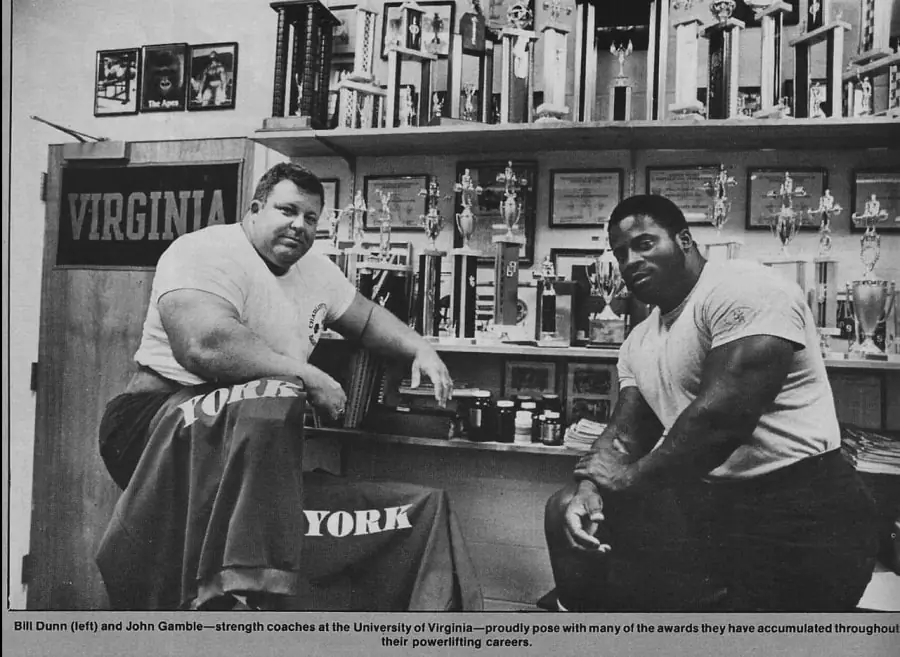
Bill Dunn and John Gamble at the University of Virginia.
Equipment Notes for Heavy Powerlifting Training
Gamble’s world was built around basic powerlifting tools: a bar, plates, collars, racks, spotters, and a platform or training surface that could survive maximal work.
For serious powerlifting setup, lifters and facilities can compare powerlifting equipment, Olympic weightlifting bars, weight plates, barbell collars, and power cages and platform racks.
A heavy-duty setup might include the Arsenal Alpha-7 power rack, a bar such as the Iron Grip OB-7 industrial chrome Olympic weightlifting bar, loading such as IRON COMPANY premium rubber bumper plates, and secure loading tools such as Lock-Jaw barbell collars, when those tools match the room, floor, lifter, load, and intended training style.
The equipment does not create the powerlifter. The lifter, the coaching, the progression, the nerve, the recovery, and the long war with the iron create the powerlifter.
Safety Note for Maximal Squats, Spotting, and Weight Cutting
This article preserves Marty Gallagher’s RAW powerlifting memory and old-school strength-history perspective. It is not individualized medical, rehabilitation, weight-cutting, equipment-rating, or programming advice.
Maximal squats, bench presses, and deadlifts require appropriate warm-ups, safe loading, qualified spotters, secure collars, suitable rack height, suitable platform or flooring, and clear miss procedures. Spotters must be large enough, skilled enough, and positioned well enough to help with the actual load being attempted.
Rapid weight cutting through dehydration, rubber suits, hot showers, saunas, fluid restriction, or food restriction can be dangerous. Gamble’s 24-hour cut is preserved here as powerlifting history, not as a recommendation.
Ammonia inhalants or “snappers” are also preserved here as historical platform detail, not as required or risk-free performance tools. Stop or scale back for dizziness, faintness, chest pain, unusual shortness of breath, confusion, neck pain, head impact, numbness, dehydration symptoms, uncontrolled bar path, or any failed lift that compromises safety.
RAW with Marty Gallagher, J.P. Brice, and Jim Steel Podcast.
About the Author: Marty Gallagher
As an athlete Marty Gallagher is a national and world champion in Olympic lifting and powerlifting. He was a world champion team coach in 1991 and coached Black's Gym to five national team titles. He's also coached some of the strongest men on the planet including Kirk Karwoski when he completed his world record 1,003 lb. squat. Today he teaches the US Secret Service and Tier 1 Spec Ops on how to maximize their strength in minimal time. As a writer since 1978 he’s written for Powerlifting USA, Milo, Flex Magazine, Muscle & Fitness, Prime Fitness, Washington Post, Dragon Door and now IRON COMPANY. He’s also the author of multiple books including Purposeful Primitive, Strong Medicine, Ed Coan’s book Coan, The Man, the Myth, the Method and numerous others. Read the Marty Gallagher biography here.
Marty Gallagher is a champion strength athlete, coach, author, and RAW Podcast host known for powerlifting, Olympic lifting, and serious strength training.
