
 Call us today at 1-888-758-7527

Kirk Karwoski Never Grinds
The Grand Maestro
Observations on an Iron God.
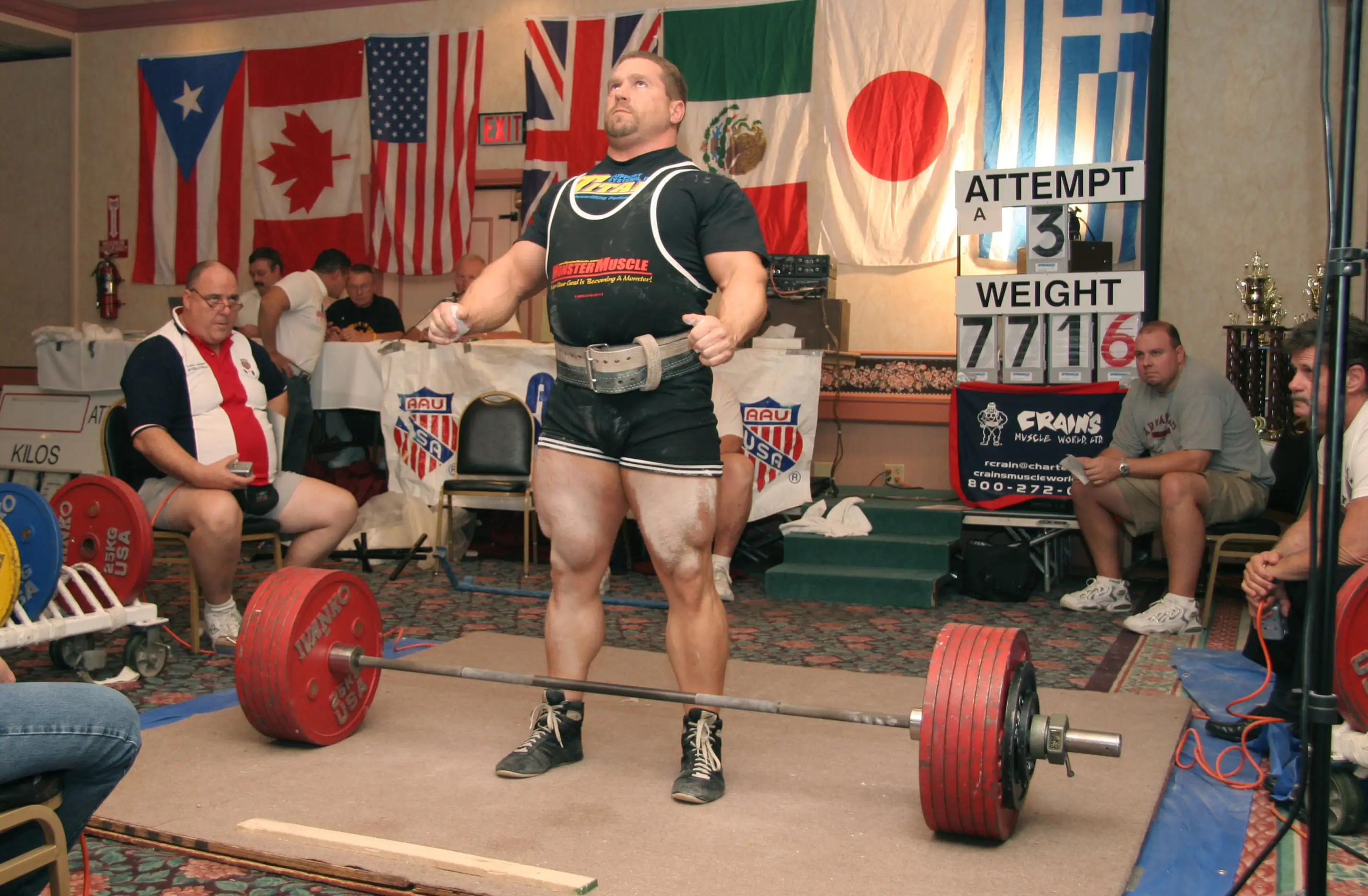
World Powerlifting Champion Kirk Karwoski inhaling prior to deadlifting 771 pounds while weighing 239. Earlier on this day he raw squatted 826. I talked him into entering a raw meet, this 10 years after his retirement. He trained for six weeks and posted a raw, no knee wraps, below-parallel squat that had not been exceeded for fifteen years. He pulled a thigh muscle on his 826 squat, a second attempt. We had planned on taking 845 before the pull occurred. He deadlifted this 771 injured.
A Lifelong Passion for Lifting Massive Weights
Kirk Karwoski is without question one of nature’s mysterious and wondrous creations. Kirk walks, talks, acts, thinks, and strides through life like no one else. His uniqueness is part genetic, part environmental, and part passion quest. He found out very early on what he excelled at: lifting massive weights in a prescribed fashion for short distances. He began progressive resistance training at age 11 and by age 16 he was a champion. At age 20 he set his first junior world record.
The Hindu mystics have a saying I never tire of repeating, “The happiest man connects the morning of his life with the evening.” Those that find their lifelong passion early on and pursue it throughout the entirety of their lives become masters and grand masters. Oscar Wilde said the purpose of life is “self-improvement,” which coincidentally should be the motto of hardcore resistance training. Decades later, I still see Kirk, a Wonder of Nature, as the Russians called Paul Anderson back in 1955, every week.
I never tire of watching him lift in our weekly training session at “Bubbles” Berry’s country gym. Kirk squats and deadlifts one time a week, working up to a single “top set.” Before the flu madness broke his stride, Kirk was routinely hitting 650 for doubles in the squat and deadlift, this weighing 260, and without any real strain.
If he bench-presses heavy, his shoulders bother him. He no longer competes, so he no longer benches heavy. He trains with us on Sunday. He squats and then deadlifts immediately after he finishes squatting. He never does more than five reps and favors doubles in both the squat and deadlift.
One Top Set, Once a Week
His strength strategy is sophisticated simplicity. The strategy is obscured by the poundage he bulls around and the ease with which he handles whatever he ties into. Watching Karwoski lift is like watching Jeff Beck play guitar. What he is doing is mind-blowingly simple: once a week in the squat and deadlift he works up to a predetermined, preplanned poundage, his top set.
Kirk squats once a week. No squatting three times a week. No leg assistance work. Just squats. No five sets of five, no eight sets of three, no multiple static top sets. Just one top set: maul the weight, move on. Each week he tweaks the reps or tweaks the poundage or both. Karwoski instinctively and intuitively periodizes every training session.
Periodization Keeps the Monster Healthy
A classic periodized cycle is 12 weeks in length. Three four-week micro-cycles are tucked inside a 12-week macro-cycle. There are shorter and longer cycles, the periodized point being: jump in using modest poundage, pristine technique and higher reps. Each week, slightly increase the poundage, alter the reps, or both.
Kirk is the Grand Maestro of periodization. After 35 years, periodizing becomes second nature. Because he is so strong, one of his recurring later-in-life issues is that if he comes on too strong, progresses too quickly, he can injure himself. Though his huge muscles are quite capable, his tendons, ligaments, and muscle insertion points often lag behind. This is his athletic Achilles’ heel. If his periodized incline is too steep, if the weekly poundage increases are too radical, he risks a pull or tear, derailing progress.
Psyche Is Reserved for the Endgame
Kirk refuses to use his legendary psyche in ordinary training. Kirk possesses mental hounds-of-hell. His Mind is so strong that if he unleashes his mental hounds-of-hell, he is able to will his body past capacity. His psyche is akin to nitrous oxide on a street racer. Push the magic button and instantly obtain 200 to 300 additional horsepower — just make sure to shut down the effort before the engine explodes.
His psyche ability is so developed and intense that it can only be used once he is at least six weeks into a cycle. His chances of injury skyrocket if he unleashes his psyche, resulting in a past-capacity effort, too early in a periodized cycle. Psyche is reserved for the final few weeks of a successful 6- to 10-week cycle.
Explosive, Normal, and Grind Speed
The most astonishing aspect of how Karwoski trains is the explosiveness with which he handles every single repetition. Watching Kirk lift this past weekend, at age 57, I marveled, yet again, at the fact that Kirk never, ever grinds a poundage. Grind is one of three identifiable rep speeds: explosive, normal, and grind. Explosive, as the name implies, is a rep done faster than normal. Kirk has always subscribed to a concept called compensatory acceleration.
Compensatory acceleration, in the Karwoski sense, means every rep is attacked with maximum clean intent. It does not mean jerking, rushing, losing position, or letting technique deteriorate. The bar is moved explosively while the body stays organized. Kirk’s speed is built on technical ownership, not impatience.
Treat 135 Like 1,000
I have seen Karwoski train more often than anyone on the planet. Whereas most strength athletes slop through their warm-up attempts, getting increasingly focused as they get deeper into the warm-up sets, Kirk has his Mind set before the first rep of the first set. He treats his first warm-up set with 135 as if it were 1,000 pounds. This is a critical point that deserves expansion. Karwoski does what I call “imagining.” He tricks his brain into thinking that every rep of every set is with 1,000 pounds.
In his Mind, he has flipped the imagining switch. Pay close attention to him as he approaches his first warm-up with 135. Look at the expression on his face. Hear him growl as he grips the barbell with the precision and exactitude of a 1,000-pound effort. During the same Sunday training session in which I was having these revelations about Kirk’s explosiveness, I watched the other eleven lifters work through the core lifts: squat, bench press, deadlift, overhead press, and power clean.
What the Rest of Us Should Copy
None could match Kirk’s explosiveness. No one could move a 135-pound barbell as fast as he could. All the other lifters used normal speed or grind speed to complete their top sets. Not a man was able to explode his top set.
I am now insisting the 14-year-old I am training explode every rep of every set on the important lifts — safely, technically and under supervision. I am going to do the same in my own training. So should you, assuming the weight, technique and setup allow it. We should not just pay attention to what champions do; we should mimic how they do it: the focus, the patience, the technical precision, the respect for the first warm-up, and the refusal to turn every heavy rep into an ugly grind.
Equipment Notes for Karwoski-Style Barbell Training
Karwoski’s style does not require novelty. It requires a serious bar, enough load, stable setup, precise technique, and the discipline to make every warm-up rep look like it matters.
For free-weight strength training, lifters and facilities can compare Olympic weightlifting bars, weight plates, dumbbells, and half racks and quarter cages. These are the basic tools that support squats, deadlifts, bench presses, and the kind of focused top-set work Gallagher describes.
A practical setup might include a power bar such as the Iron Cowboy Powerlifting Bar, loading such as American Barbell rubber Olympic grip plates, and assistance tools such as IRON COMPANY urethane hex dumbbells, when those tools match the lifter, room, load, budget, and intended use.
The equipment does not create the Karwoski effect. The lifter, the intent, the technique, the patience, and the refusal to grind create the effect.
Safety Note for Explosive Squats, Deadlifts, and Youth Lifters
This article preserves Marty Gallagher’s RAW firsthand observations of Kirk Karwoski. It is not individualized medical, youth-training, rehabilitation, or programming advice.
Explosive intent is not the same thing as reckless speed. Squats, deadlifts, bench presses, overhead presses, and power cleans require technical mastery, appropriate warm-ups, safe loading, competent coaching, proper rack or platform setup, and honest stop rules.
Youth lifters, beginners, older lifters, injured lifters and deconditioned trainees should use properly designed, supervised and age-appropriate training. Maximal attempts, competitive powerlifting-style loading, and “psyche” should not be copied casually.
Stop or scale back for sharp pain, dizziness, chest pain, unusual shortness of breath, numbness, repeated technical collapse, uncontrolled bar path, missed warm-ups, fear-driven reps, or any rep that turns into an ugly grind the lifter cannot own.
Related Kirk Karwoski Reading
For more on Kirk’s squat mastery, read Kirk Karwoski’s Historic 800 x 5 Raw Barbell Squat. For a different snapshot of Karwoski at his physical peak, read Kirk Karwoski Beach Video: Powerlifting Peak 1994.
RAW with Marty Gallagher, J.P. Brice, and Jim Steel Podcast.
About the Author: Marty Gallagher
As an athlete Marty Gallagher is a national and world champion in Olympic lifting and powerlifting. He was a world champion team coach in 1991 and coached Black's Gym to five national team titles. He's also coached some of the strongest men on the planet including Kirk Karwoski when he completed his world record 1,003 lb. squat. Today he teaches the US Secret Service and Tier 1 Spec Ops on how to maximize their strength in minimal time. As a writer since 1978 he’s written for Powerlifting USA, Milo, Flex Magazine, Muscle & Fitness, Prime Fitness, Washington Post, Dragon Door and now IRON COMPANY. He’s also the author of multiple books including Purposeful Primitive, Strong Medicine, Ed Coan’s book Coan, The Man, the Myth, the Method and numerous others. Read the Marty Gallagher biography here.
Marty Gallagher is a champion strength athlete, coach, author, and RAW Podcast host known for powerlifting, Olympic lifting, and serious strength training.
