
 Call us today at 1-888-758-7527

Mark Chaillet - Occam’s Unknowing Disciple
Dare to Do Less
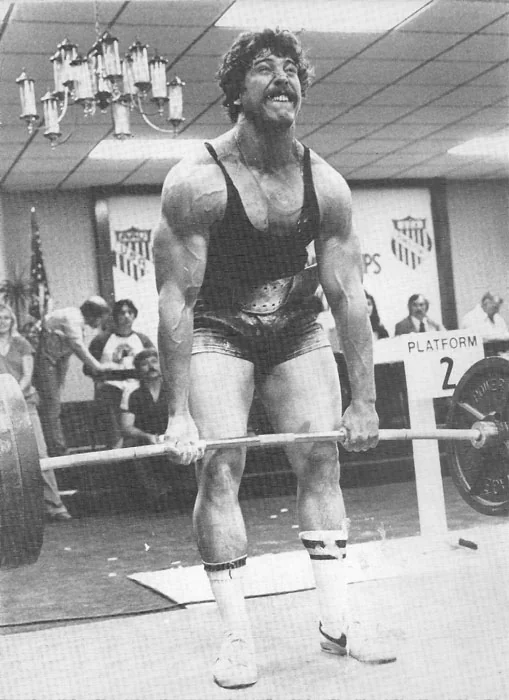
Occam’s proof: Mark Chaillet, shown in the featured image, pulls 800 pounds weighing 220 at age 20. Note the veins on his delts and pecs. Mark was my training partner for six years. He was a deadlift grand maestro, a world champion, and world record holder. He was the all-time master of minimalist powerlifting.
Occam’s razor is often summarized this way: when competing methods produce the same result, select the simpler method, the one with fewer assumptions and fewer moving parts. In powerlifting language: if two systems build world champions and world records, select the one that requires less time, less clutter, fewer exercises, and fewer chances to waste effort.
In April of 1985, Mark Chaillet was already one of the most feared deadlifters in America. He had pulled massive poundage in competition and was regarded inside our circle as a deadlift world-record-level man. It was Thursday and the workout began at 4 p.m. sharp. On this day Chaillet, who stood 5-9, weighed an athletic 280 pounds. He had the widest shoulders and the largest hands I have ever seen on a man that height. He was lean, with no belly, monstrous muscles and a physique hard as a diamond. With his long arms, oversized hands, freaky wide back, huge head, and short legs, Mark looked positively simian: a human silverback.
A good-looking man, an athlete, Chaillet was no shrinking violet. Author Ken Kesey once asked Hell’s Angels founder Sonny Barger how they “picked” Hell’s Angels. “We don’t pick ’em — we recognize them!” Sonny retorted. Barger would have recognized Chaillet in a heartbeat.
Mark Chaillet was closer to me than a brother for a long period of time. His whole family — dad Buck, mom, sister and brother Ray — recognized and embraced me. When I first met Mark, he was a college student, and the power he possessed was already obvious.
The 1977 Collegiate Deadlift Shock
At the 1977 collegiate national championships, Mark weighed 220 and pulled 800 pounds. The photo at the top of this article was taken on that day. It is a photo of him deadlifting the 800 pounds needed to win the national title, this after coming back from a 70-pound deficit.
The other lifters in the 220-pound class were so far ahead of Mark after the squat and bench press that they forgot all about him. They were shocked stupid when he asked for 800 pounds, 100 pounds more than any of his eighteen 220-class opponents had deadlifted.
Mark ripped the 800 off the floor. It slowed at the knees, his sticking point. His hip-hinge kicked in and Mark pulled the ponderous poundage to lockout. Elation turned to rage when the lift was turned down. Defeat snatched from the jaws of victory.
In powerlifting, every lift is judged by three referees. Two out of three must agree that a lift has no disqualifying technical flaws. Two judges felt that on Mark’s 800 the power-bar velocity had stalled. Stopping is a legitimate cause for disqualification; slowing or stalling is not the same thing. Very subjective — and while Mark’s lift might have slowed, and might even have stalled, it did not stop.
The silver lining in this black-cloud day was powerlifting god Larry Pacifico, nine-time world champion, was at the meet and after seeing Mark in action offered him an apprenticeship. Mark would move to Dayton and study under Larry for several years. Mark worked as a manager in one of Larry’s gyms and trained with Larry, Eric Von Stuber, and the other Dayton super-lifters.
Chaillet’s Gym and the 700-Plus Platform
Mark Chaillet moved back to Maryland in 1980 and opened Chaillet’s Gym in Temple Hills. The gym was the hardest of the hardcore, a power palace that generated national and world champions on a regular and routine basis. When Mark’s gym opened, our training group — Marshall Peck, Joe Ferry, and me — began training there. We had trained together in Hugh Cassidy’s basement for five years and our move to Mark’s was with Cassidy’s blessing.
On this particular Thursday, Mark Chaillet was five weeks out from the national powerlifting championships. I was Mark’s coach. He and I devised his training schedule. For twelve weeks, twice a week, we gathered to train. Monday was squat and bench day. Thursday was deadlift day. These sessions were not open to the public. Those that made the cut could attend and participate.
On a typical Thursday, twenty-plus deadlifters would show up to lift on one of three adjacent platforms, all in the same sunlit room on the second floor over the auto-parts store. On platform #1 were those who had deadlifted up to 550 pounds. Platform #2 was the 550-to-700 club. The main deadlift platform was elevated. Platform #3 sat in the center of Chaillet’s Gym, like the altar it was. This was the 700-plus platform.
There would be a half-dozen of us lifting with Mark Chaillet on the big platform. One Thursday in the mid-eighties I counted fourteen locals and gym members who had pulled 700 or more in competition: me, Mark, brother Ray, Graham, Markovich, Don Mills, Joe Povinale, Joe F., Marshall, Frank Neicter, Frank Hottendorf, Jeff B., Rooney, and Mark Dimiduk.
We all used the same deadlift style, a technique invented by world champion Hugh Cassidy. Our collective style was a narrow-stance, upright conventional deadlift that used a lot of leg power to break the bar from the floor. Hugh Cassidy passed his well-thought-out technique along to his senior students, all of whom later became national and world champions: Dimiduk, Chaillet, Don Mills and me. We spread the word further.
The Thursday Deadlift Session
Mark Chaillet would deadlift wearing his lifting singlet and his white wrestling shoes. To my eternal aggravation, he was always on the telephone. Mark talked on the telephone more than a 15-year-old cheerleader. The portable phone, then a new invention, was a technological wonder: how was it possible to talk over a phone that didn’t have a curly cord coming off the receiver?
Mark had a giant portable phone the size of a cigar box. It had a three-foot antenna. He would wander around the gym, oblivious to anyone and everyone, having the most incredible phone conversations with God-knows-who about God-knows-what. I wanted to grab it and throw it out the window.
At 4 p.m. sharp on Thursday, he would flatten the antenna, walk to the lifting platform, and start the deadlift workout.
| Set | Weight and Reps | Purpose |
|---|---|---|
| 1 | 255 x 3 | First warm-up; two gold 100-pound plates, a 45-pound bar and collars |
| 2 | 455 x 3 | Second warm-up; fast and without fanfare |
| 3 | 655 x 1 | Six gold hundreds plus bar and collars; explosive single |
| 4 | 735 x 1 | Another easy warm-up single |
| 5 | 785 x 1 | Final warm-up single; on and ready |
| 6 | 835 x 1 | Top set; crisp, explosive, and done for the day |
Between sets he would sit backwards on a folding chair and watch the others lift, offering comment and exhortation. Five minutes after each pull we would “chip it,” adding weight to the bar. When ready for the top set, he would stand, cinch his custom-made weightlifting belt, chalk his hands and have me or brother Ray pop an ammonia capsule under his nose.
He would inhale the hideous vapors and let out three successively louder stentorian bellows. Then he would turn, stride to the barbell and without fanfare rip it to completion. Mark manhandled 835 for a crisp single rep. He was done for the day.
He had done six sets of deadlifts for a grand total of ten reps. That would be the entirety of his back work for the week.
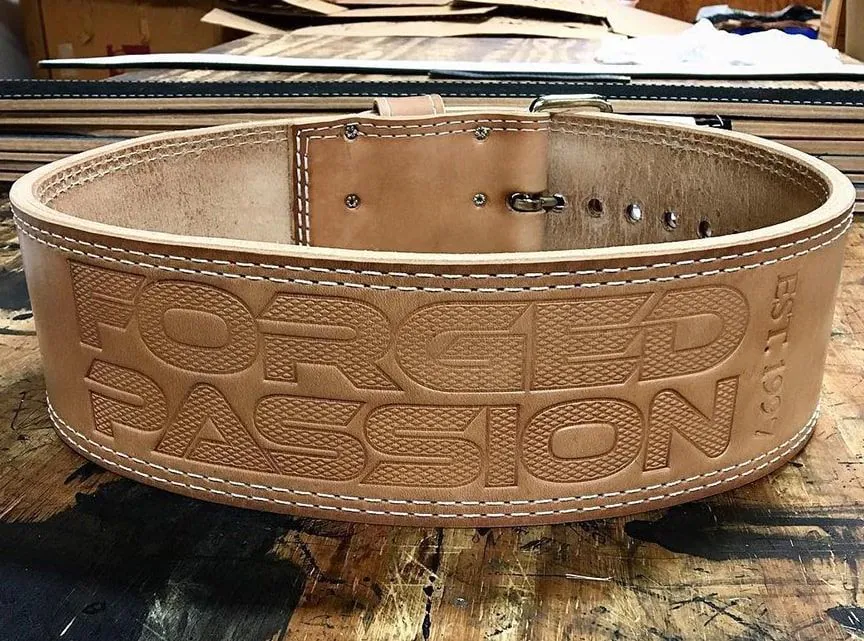
Forged Passion Leather Power Belt
No Assistance, No Back-Off Sets, No Nothing
Mark Chaillet would do no other assistance work. None, zero, nada. No back-off sets or back-down sets, no arm work, no shoulder work, no ab work, no nothing. As soon as he was done with his top single for the session, the training session was over. He would immediately jump back on his portable phone.
No, he wasn’t injured or debilitated. Here was his secret: though he was very good at it, Mark didn’t like to lift weights all that much.
His Thursday workout was no aberration. On Monday he would work up to a single rep in the squat and a single rep in the bench press. Done. Altogether, Chaillet might perform a total of 30 reps per week, cumulative.
The surviving public record does not capture every gym lift and every coaching-room feat. OpenPowerlifting lists Chaillet’s archived competition personal bests as 925.9 in the squat, 523.6 in the bench press, 848.7 in the deadlift and a 2,260 total. When I write that Mark eventually squatted a legitimate below-parallel 1,000 pounds in the gym and pulled 880, that should be understood as my firsthand coaching and strength-world recollection, not as a surviving official OpenPowerlifting competition line.
Mark’s best lifts were performed weighing roughly 275 pounds. He showed me how little could be done and still obtain maximum results when the lifter is genetically gifted, brutally specific, intensely focused, technically consistent, and relentlessly realistic with the loading.
Occam’s Razor in Powerlifting
The plan was to hit every preplanned, periodized rep and poundage target for twelve straight weeks. All that mattered was that the lifter hit the weekly periodized goal. Who cares what strategy is used? If you made all the weekly goals for 12 straight weeks performing 30 reps a week, spike the ball — you’re the winner.
You don’t have to live in the gym to win titles, set records and grow gargantuan.
Most lifters turn their lives upside down trying to obtain the muscle and strength results Chaillet came by with so little training. The contrast between bodybuilding-style marathon volume and Chaillet’s minimalist strength assault could not have been greater. Do we need to live in the gym in order to attain sensational gains? Mark didn’t.
Occam’s razor states that if two methods deliver the same results — world championships and world records — select the simpler method, the method with fewer moving parts, the method that takes less time.
You cannot have fewer moving parts than Chaillet’s three-exercise training menu of mainly single-rep sets. You cannot train a competitive lift less than once a week and still practice it weekly. You cannot spend much less time training and achieve as much as Mark Chaillet achieved.
What made it all work was his off-the-charts intensity and his relentless consistency. Despite handling gargantuan poundage, the training weights were extremely conservative and realistic for him. He very, very rarely missed a training rep.
Mark Chaillet, unknowingly, was the ultimate personification of Occam’s ideal of sparse effectiveness. Mark was Occam’s finest adherent without knowing who the medieval friar was. Chaillet was way too bright to be called an idiot savant, yet he devised something that was the ultimate in sparse, efficient effectiveness. He found the nucleus of the power and strength atom. It was unintended genius.
Dare to do less.
What Modern Lifters Should Learn from Chaillet
The lesson is not that every lifter should abandon assistance work, conditioning, hypertrophy training, mobility work, or technical practice. The lesson is that the training system should fit the athlete, the goal, and the season.
Mark’s system worked because every moving part mattered:
- He trained only the three powerlifts.
- Each lift was trained once per week.
- All top sets were preplanned and periodized.
- He worked to one important single and stopped.
- He did not waste energy on exercises he did not believe mattered.
- He avoided missed reps by using realistic training weights.
- He arrived fresh, mentally aroused and technically consistent.
- He had elite genetics, elite skill and elite commitment.
For some lifters, more work is the answer. For others, less work done with far greater concentration is the answer. Chaillet proved how far less can go when less is brutally specific.
Equipment Notes for Ultra-Minimalist Powerlifting
Ultra-minimalist powerlifting makes equipment quality more important, not less important. If the entire training week turns on a few heavy singles, the bar, plates, rack, and platform must be dependable.
For a Chaillet-style strength room, lifters and facilities can compare Olympic weightlifting bars, weight plates, and power cages and platform racks.
A serious rack setup such as the Arsenal Alpha-11 Double Half Rack, a general-purpose bar such as the Body-Solid Chrome Olympic Weightlifting Bar, and durable loading such as Troy black iron wide-flanged weight plates can support hard barbell training when matched to the athlete, facility, and stated specifications.
The equipment does not create Chaillet’s minimalist genius. It only gives the lifter a safe, stable place to test whether less can really become more.
Safety Note for Heavy Singles and Minimalist Powerlifting
Chaillet’s system was an advanced, elite-level powerlifting system. It should not be copied blindly by beginners, injured lifters, deconditioned trainees, or anyone without technical mastery, competent partners, and appropriate equipment.
Heavy single-rep squats, bench presses and deadlifts require progressive warm-ups, realistic planned targets, secure collars, suitable rack safeties, stable platforms, competent spotters where appropriate, and the discipline to stop when technique breaks. The fact that Mark did very little does not mean what he did was easy. It was brutally concentrated.
This article preserves Marty Gallagher’s firsthand historical coaching perspective. It is not individualized medical, rehabilitation, or programming advice.
Related Mark Chaillet Reading
For more on Chaillet’s minimalist powerlifting system, read Powerlifting Training Mentors: Mark Chaillet - Part 2 and House of Pain Part II: Mark Chaillet.
RAW with Marty Gallagher, J.P. Brice, and Jim Steel Podcast
About the Author: Marty Gallagher
As an athlete Marty Gallagher is a national and world champion in Olympic lifting and powerlifting. He was a world champion team coach in 1991 and coached Black's Gym to five national team titles. He's also coached some of the strongest men on the planet including Kirk Karwoski when he completed his world record 1,003 lb. squat. Today he teaches the US Secret Service and Tier 1 Spec Ops on how to maximize their strength in minimal time. As a writer since 1978 he’s written for Powerlifting USA, Milo, Flex Magazine, Muscle & Fitness, Prime Fitness, Washington Post, Dragon Door and now IRON COMPANY. He’s also the author of multiple books including Purposeful Primitive, Strong Medicine, Ed Coan’s book Coan, The Man, the Myth, the Method and numerous others. Read the Marty Gallagher biography here.
Marty Gallagher is a champion strength athlete, coach, author, and RAW Podcast host known for powerlifting, Olympic lifting, and serious strength training.
