
 Call us today at 1-888-758-7527

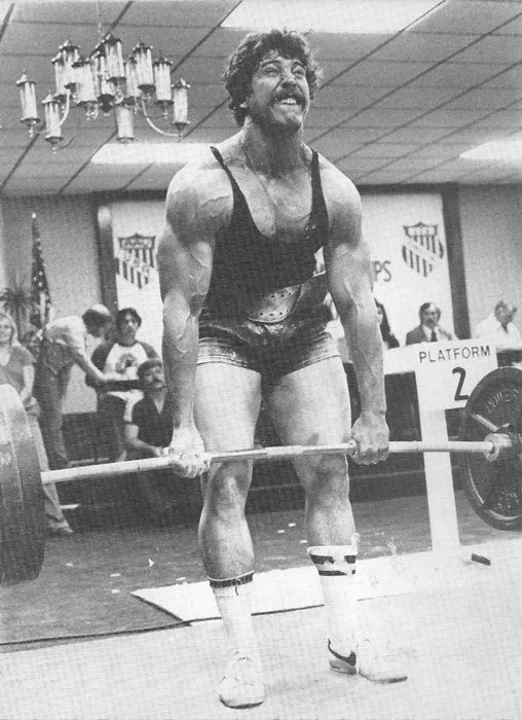
Powerlifting Training Mentors: Mark Chaillet - Part 2
Powerlifting Training Mentors: Similarities and Contrasts
Mark Chaillet: Minimalistic Savant
In 1980 Mark Chaillet opened his hardcore powerlifting training gym in Temple Hills, Maryland. Marshall Peck, Joe Ferry, Dan Pinkston, Mark Dimiduk, and several other elite Cassidy students shifted from powerlifting training in Hugh Cassidy’s basement to training at Mark’s new facility. This was with Hugh’s blessing. We were cramming a lot of big bodies into his subterranean gym, and sessions were getting longer and longer and quite crowded.
Hugh Cassidy’s Basement: Purposefully Primitive Powerlifting
Hugh’s gym was in the unfinished basement of his cottage-like country home. The basement had 9-foot ceilings and was cramped, dank and dark. Airless, three tiny windows let in three tiny squares of sunlight. Cassidy’s gym was akin to Vulcan’s forge. He molded bodies. Everything was raw, homemade, functional, logical, and industrial. Hugh did not own a standard Olympic weightlifting set. At Cassidy’s, we trained using six-foot sleeveless exercise bars.
Hugh was an expert welder and all the gym equipment was handmade: he constructed flat benches, incline benches, a pulldown/pushdown device, the squat rack, and a low stool that allowed us to sit low enough to press overhead. Hugh cut jagged 100-pound weight plates out of raw steel. On one was scrawled 98.5, on the other 102. You would cut your hands if you handled these weight plates wrongly or roughly. It was the post-apocalyptic barbell set.
This was a family home. Hugh had incredible kids. His son was a professional violinist named Danny and his daughter was the sublime Eva Cassidy. They would often be working on new material directly over top of us Orcs toiling in the basement. They would be sitting in the upstairs living room, making beautiful and surreal music while the trolls were grinding away in the basement—but in deference to the Cassidy artists, we trolls toiled silently.
We kept the noise to a minimum, a tall order for a group of alpha males engaged in hardcore powerlifting training. No one acted out or got rowdy. This was Zen powerlifting training with Cassidy as the head monk. In the early days he trained with us; in later years he would drift into and out of our sessions. He would watch us, quietly exhort the “good efforts,” and offer technical corrections and incisive comments after each top set.
There was no screaming or loud cursing. No one dropped a deadlift or dropped a power clean. No loud music or manic exhortations at Hugh’s. We adapted and developed a communal vibe of quiet controlled ferocity. We were encouraged to get massively psyched-up before a big effort—but it had to be mime ferocity.
Hugh’s psyche was to take three “cooling breaths.” I later saw this same ferocious quietude exemplified when working in competition with Ed Coan and Doug Furnas. These men would get massively psyched prior to a world record lift, yet to the observer, Ed and Doug seemed calm. Unless you were within ten feet of them you would not see the white-hot psyche each man generated before a world record attempt.
At Cassidy’s we were not there for the fancy gym equipment or to stare at mirrors. There were no mirrors or tanning beds. We were there for the instruction. Eventually we became too strong for the short barbells. Past 650 pounds in the squat and we had to hang dumbbells on coat hangers off the ends of the bar. For real.
Sweaty and humid in the summer, unheated in the winter, everything was homemade, off-sized, off-speed, and odd. Hugh Cassidy’s basement gym was the epitome of sparse, hardcore and purposefully primitive.
Chaillet’s Gym: Sunlight, Music, and Strength
Transferring to Chaillet’s was like being released from a five-year term at hard labor in a Siberian gulag and immediately moving into a 5-star hotel with free gourmet food, an open bar, and populated with extremely attractive women. The subterranean Cassidy crew emerged into the sunlight, blinking and pale, yet muscled-up and super-strong. We were primal and schooled. We sought a Monty Python phrase, “And now for something completely different.”
Nothing could be more completely different than transferring from Hugh’s basement to Mark’s gilded palace of the sun. We spent years grinding away using the Cassidy powerlifting training template in monk-like isolation, applying enforced quietude and uber-concentration. Overnight the cellar-dwellers were paroled from dank and claustrophobic into a sunlight-drenched powerlifting Club Med.
Mark’s place was bright, upbeat, boisterous, a party environment with an 80s rock music soundtrack. That was Chaillet’s. It attracted the strongest of the strong like an irresistible magnet. I had a front row seat.
The facility, the gym equipment, the owners, the patrons—everything was first rate and perfect in every way. This was paradise for the serious power trainer. Any exercise machines there were placed down the hallway in a separate room next to the tanning beds.
I adopted Mark’s powerlifting training approach because I was ready for a radical change. I had done my time in Cassidy’s basement and now, a certified power monk, I was ready to enter a whole new and wider world. I had paid my dues at the feet of the Master. Now what? The elite “Hugh Crew” migrated en masse from Cassidy’s subterranean Vulcan forge to Chaillet’s power wonderland.
It seemed impossible that anything this hardcore could be this nice. The gym was a family effort: Buck, Mark’s salty dad, a retired high-ranking DC police officer, ran the gym half the time. Mark and Buck built out the entire second-floor space themselves. Mark’s mother, sister and brother Ray were also behind the counter at various times.
The location was right, the equipment was right, the vibe was right, the time was right, and everyone’s progress took off. There was a tangible group synergy. Each successive week everyone got a little bigger and a little stronger.
With the benefit of hindsight, segueing from Hugh’s ultra-maximalism to Mark’s ultra-minimalism proved the perfect move made at just the right time, a powerful catalyst. There could have been no greater powerlifting training contrast. When it comes to igniting progress, contrast is King.
Mark Chaillet’s Minimalist Powerlifting Logic
Chaillet came along at exactly the right time. His presence was awesome: he was monstrous, he had an outrageous, muscled-up flesh and blood superhero body with world record strength. Good looking, street smart, aggressive, clever, Mark was a well-spoken hard man, a carefree iconoclast.
His position was simple: powerlifting is a 1 x 1 competition. Doing single repetitions is an art form that cannot be mastered without practice.
Mark viewed as ludicrous the conventional thinking that single repetitions should be avoided in powerlifting training. The idea was to save the single-rep strength for the competition. Mark demurred. “Why are you avoiding that which you must do in competition? It makes no sense to avoid doing what we are being judged on.”
Mark was all about single reps and recovery. He would talk at length about how the body needs to be completely rested between all-out efforts. He was championing the rested effort way before anyone else. It was another prophetic oddity about Mark. I got the sense that Mark did not really like powerlifting or lifting weights. He was just really, really good at it.
Mark didn’t care about the history of strength or strength greats of the past. He didn’t read the muscle mags or care to talk about powerlifting training. He just zeroed in on the fact that, regardless what you do, how smart you are, how often or long you train, in the end the guy with the biggest single rep was the winner in powerlifting.
Getting good at single reps was all new to me. I was there to learn. Now it was all about technique and psyche and the rested effort. Going from Hugh’s ground-and-pound template to Mark’s rested-effort template—not that he ever called it that—created an ideal powerlifting training contrast.
The Hugh/Mark segue gave me a future frame of reference for appreciating the role of contrast in training. Those of us that survived the Cassidy approach were powerlifting commandos: after five years of twice-weekly pounding, after five years of continual progress, things were leveling off. I threw in with Mark and mimicked his powerlifting training strategy for two years.
I peaked and shifted my own powerlifting training to an Ed Coan/Doug Furnas “modified Cassidy” training template—which I later taught to Kirk Karwoski.
Working with Mark, I had a fabulous burst of progress. All the Cassidy basement creatures improved radically after emerging into the sunlight and shifting from Hugh’s twice-weekly atomic devastation into Chaillet’s once-a-week beach party of rested singles.
Mark’s strategy was simple: “We’re going to work up to our preplanned, periodized poundage for a single rep—and then quit!” We did nothing else. The purity of his approach was that Mark did nothing else. No other powerlifting training of any kind.
No back-off sets, no assistance work, no abs, no hamstrings, no cardio, no nothing meant no nothing.
The Chaillet Two-Day Powerlifting Template
| Day | Lift | Method | Planning |
|---|---|---|---|
| Day 1 | Squat | Work up to a single rep | Each week has a specified periodized top-set poundage |
| Day 1 | Bench press | Work up to a single rep | Each week has a specified periodized top-set poundage |
| Day 2, three days later | Deadlift | Work up to a single rep | Each week has a specified periodized top-set poundage |
Below is a replication of a Chaillet 12-week periodized training cycle. It would commence 14 weeks prior to a big competition. Mark would usually begin these cycles light in bodyweight and slightly out of shape.
A Chaillet-Style 12-Week Cycle
| Week | Deadlift | Squat | Bodyweight |
|---|---|---|---|
| 1 | 700 | 720 | 258 |
| 2 | 715 | 740 | 260 |
| 3 | 730 | 760 | 262 |
| 4 | 745 | 780 | 264 |
| 5 | 760 | 800 | 266 |
| 6 | 775 | 820 | 268 |
| 7 | 790 | 840 | 270 |
| 8 | 805 | 860 | 272 |
| 9 | 820 | 880 | 274 |
| 10 | 835 | 900 | 276 |
| 11 | 850 | 920 | 278 |
| 12 | 865 | 940 | 280 |
| 13 | Off | Off | 277 |
| 14 | Competition taper | Competition taper | 275 |
Mark used roughly fourteen days between the last heavy training lifts and competition. It would be impossible to come up with a training strategy more diametrically opposed to Hugh’s uber-maximal approach than Mark’s uber-minimal approach.
Mark and I immediately hit it off. We became fast friends and training partners. I became Mark’s competitive coach and we campaigned Mark at the national and international level for six years.
What the Record Book Shows
The surviving OpenPowerlifting record for Mark Chaillet lists personal best competition lifts of 925.9 pounds in the squat, 523.6 pounds in the bench press, 848.7 pounds in the deadlift and a 2,260-pound total. Those are the recorded meet results available in that database.
When I write that Mark squatted a legitimate 1,000 pounds at about 280 bodyweight, that should be understood as my firsthand coaching and gym recollection, not as a surviving official competition result in OpenPowerlifting.
As I have previously noted, never has a man gone so far on so little. It was mind-blowing how little training Mark did to develop his incredible strength and mind-blowing body.
If Cassidy exemplified the far right of the volume pendulum swing, Chaillet staked out the extreme left of the volume pendulum swing. Mark taught me a valuable lesson, one that I never forgot: the smartest athlete is the one that obtains the most results from the least amount of effort.
Why Contrast Can Restart Progress
Occam’s razor contends that if results are equal, select the simpler system, the one taking the lesser amount of time and energy to complete. Get the most-est from the least-est and you be the smart-est.
You could not do anything less than Mark’s ultra-minimalistic template and still train. He was truly the savant of minimalism.
Those who train all the time and feel burnt out should rip a page from the Chaillet playbook and try some ultra-minimalism powerlifting training. Learn what it feels like to train fresh and rested.
The larger lesson is not that every lifter should immediately abandon assistance work, conditioning, mobility, hypertrophy work or technical practice. The larger lesson is that every effective system has a shelf life. When the body and mind grow stale, dramatic contrast can create a new adaptive jolt.
For some lifters, more work is the answer. For others, less work, done with higher concentration, is the answer. Chaillet proved how far “less” could go when less was brutally specific, preplanned, technically sound and performed by a genetically gifted, highly skilled, fully committed powerlifter.
Equipment Notes for Minimalist Powerlifting
Ultra-minimalist powerlifting makes equipment quality more—not less—important. If the entire training week turns on a few heavy singles, the bar, plates, rack and platform must be dependable.
The Iron Cowboy Powerlifting Bar is built around the squat, bench press and deadlift, with aggressive knurling, center knurling, 28.5 mm shaft diameter, 200,000 PSI tensile strength and a 45-pound listed weight.
Accurate loading matters when the cycle is based on week-to-week planned poundage. IRON COMPANY urethane Olympic plates with grips provide durable commercial training plates with a three-hole grip design for easier handling.
A heavy-singles program also requires a rack that can be set up correctly and used consistently. The Arsenal Strength Alpha-11 Power Rack is one commercial rack option for facilities that need stable powerlifting stations, adjustable safeties and room for serious barbell work.
None of this equipment creates Chaillet’s strength. The equipment merely creates the environment in which a trained lifter can express strength safely and repeatedly.
Safety Note for Heavy Singles and Minimalist Powerlifting
Mark Chaillet’s method was an elite powerlifting case study, not a beginner template. Heavy singles require technical consistency, competent spotters, rack safeties, realistic attempt selection, and the discipline to stop after the prescribed lift.
Beginners, older trainees, injured lifters and athletes without coaching should not copy maximal singles casually. Build technique with submaximal work first. Use the safeties. Load progressively. Do not attempt a personal record when sleep, warm-ups, pain, balance or bar speed tells you the day is wrong.
Ultra-minimalism works only when the few sets performed are technically excellent and recoverable. Doing too little badly is not minimalism. It is just bad training.
Continue the Powerlifting Training Mentors Series
RAW with Marty Gallagher, J.P. Brice, and Jim Steel Podcast
About the Author - Marty Gallagher
As an athlete Marty Gallagher is a national and world champion in Olympic lifting and powerlifting. He was a world champion team coach in 1991 and coached Black's Gym to five national team titles. He's also coached some of the strongest men on the planet including Kirk Karwoski when he completed his world record 1,003 lb. squat. Today he teaches the US Secret Service and Tier 1 Spec Ops on how to maximize their strength in minimal time. As a writer since 1978 he’s written for Powerlifting USA, Milo, Flex Magazine, Muscle & Fitness, Prime Fitness, Washington Post, Dragon Door and now IRON COMPANY. He’s also the author of multiple books including Purposeful Primitive, Strong Medicine, Ed Coan’s book “Coan, The Man, the Myth, the Method" and numerous others. Read the Marty Gallagher Biography for a more in depth look at his credentials as an athlete, coach and writer.
Marty Gallagher is a champion strength athlete, coach, author, and RAW Podcast host known for powerlifting, Olympic lifting, and serious strength training.
