Gym Equipment Storage
Gym Equipment Storage for Organized Strength Rooms and Training Spaces
Gym equipment storage keeps dumbbells, barbells, weight plates, kettlebells, medicine balls, cable attachments, bands, mats, and accessories organized in home gyms,... Read More
Gym Equipment Storage for Organized Strength Rooms and Training Spaces
Gym equipment storage keeps dumbbells, barbells, weight plates, kettlebells, medicine balls, cable attachments, bands, mats, and accessories organized in home gyms, garage gyms, schools, studios, commercial fitness centers, tactical training rooms, and government facilities. Compare rack type, equipment compatibility, footprint, loading access, mobility, wall or floor mounting, flooring, freight, and product-level procurement documentation before ordering.
The right storage rack is not just the one that holds the most equipment on paper. It has to fit the free weights you already own, fit the room, keep walkways usable, match the training traffic, and work with the floor surface below the loaded rack.
IRON COMPANY has supplied gym equipment and flooring solutions since 1997. Buyers can compare individual storage products, request a quote, and contact Customer Care for help reviewing current availability, storage compatibility, freight requirements, and facility purchasing needs.
How to Choose Gym Equipment Storage
Start with an equipment inventory before choosing a rack. Count the actual dumbbells, plates, bars, kettlebells, balls, cable attachments, collars, bands, ropes, and mats that need storage, then measure the items that will sit on or hang from the rack. Similar-looking products can require very different storage geometry.
- Equipment type: Select the rack around the item being stored. Dumbbells, barbells, Olympic plates, bumper plates, kettlebells, medicine balls, stability balls, and cable attachments each require different shelf, peg, hook, or cradle designs.
- Rack geometry: Compare tray depth, saddle spacing, peg diameter, peg length, shelf height, vertical clearance, hook spacing, and wall clearance before assuming a rack is universal.
- Loaded weight: Confirm product-specific shelf capacity, peg capacity, total rack capacity, and intended use rating before loading heavy free weights or placing a storage rack in a shared facility.
- Room footprint: Measure the rack footprint plus user access, loading space, walkways, door swings, wall distance, mirrors, columns, racks, benches, and traffic around the storage area.
- Fixed or mobile design: Mobile racks may help flexible rooms, but loaded movement requires attention to floor surface, caster quality, total loaded weight, turning radius, and staff control.
- Wall or floor mounting: Wall-mounted bar holders, gun racks, and high-vertical storage units should be matched to the mounting surface and manufacturer instructions before drilling, anchoring, or loading.
- Flooring below the rack: Heavy storage concentrates weight in a small footprint. Review the floor surface, rubber flooring thickness, rack feet, and subfloor conditions before placing a loaded rack.
- Freight and receiving: Larger storage systems may ship by parcel or freight. Confirm carton size, pallet handling, delivery method, and the route from curbside or receiving area to the final room.
Top 5 Essential Considerations for Selecting Gym Equipment Storage
- Equipment Compatibility & Geometry Fit: Never assume a storage rack is universal across all free weight styles. Specialized items require specific tray, peg, or saddle configurations; for instance, thick bumper plates will exhaust a standard weight plate tree's peg space much faster than slim cast iron plates, requiring a dedicated horizontal bumper plate rack like the Body-Solid GBPR10 or a single-sided bumper plate tree. Similarly, while a 3 tier dumbbell rack like the Body-Solid GDR363B is built with angled shelves for standard hex dumbbell sets, a round-head urethane dumbbell set or adjustable dumbbells may require flat utility shelves or cradle-style configurations like the York Barbell ETS 2-Tier 10-Pair Dumbbell Rack with Cradles (69046) to protect the weight heads.
- Footprint, Clearance, & Training Flow Space: Balancing space limitations against vertical height requirements is vital for establishing an efficient workout environment, whether engineering garage gym storage systems or layout maps for high-traffic tactical training facilities. Space-saving gym storage structures like a vertical dumbbell rack or a vertical barbell holder (such as the floor-mounted Apollo Athletics DR-5 9-bar standing holder) preserve precious square footage but require ample ceiling clearance to lift and extract bars safely. Furthermore, buyers must evaluate hand clearance spacing between multi tier utility rack shelves—such as on heavy duty weight racks holding dumbbells up to 100 lbs.—to protect users' hands from injury during rapid re-racking.
- Weight Capacity, Construction Gauge, & Subfloor Requirements: Safe weight distribution planning protects both your training partners and your facility's physical infrastructure. Commercial gym storage solutions call for fully welded frames or heavy-gauge steel construction rated for continuous loads; the steel gauge and capacity are listed on each product page. Loading heavy plate sets onto a rolling weight plate tree or a multi-storage gym rack concentrates force onto small contact points; buyers should evaluate their finished rubber flooring thickness and underlying concrete subfloor before installing loaded maximum-capacity towers to limit flooring indentations or surface sagging.
- Mounting Security, Facility Anchoring, & Operational Mobility: Choosing between freestanding weight storage, fixed wall mounted bar hangers, or mobile vertical weight trees alters your room setup and localized safety compliance. High-vertical units like a vertical barbell holder or wall mounted barbell rack (such as the IRON COMPANY 2 Bar Vertical Barbell Storage Rack) demand a structural stud backing and heavy duty masonry hardware to manage the leverage of hanging bars. Conversely, multi-purpose classrooms and flexible team training zones benefit from bumper plate holders with wheels or a mobile vertical weight tree like the multi-directional caster wheel-equipped Body-Solid GWT86, allowing staff to shift entire plate sets smoothly across the floor zone between training sessions.
- Environment Use Rating, Government Procurement, & Warranties: Matching product-level structural documentation to your exact clientele or patient type helps avoid code violations and voided manufacturer warranties. Light commercial gym racks designed for personal training studios or corporate wellness centers may fail inspection if placed into tactical training zones or institutional fitness equipment racks facing extreme operational abuse. Government and military procurement agents must verify TAA compliance, GSA contract status, and country of origin for specific configurations—such as the Legend Fitness 3193 Olympic Peg Plate Holder—before processing agency purchasing cards, and confirm that the chosen heavy-duty weight rack carries a full commercial warranty matching the facility's liability demands.
Compare Gym Equipment Storage Rack Types
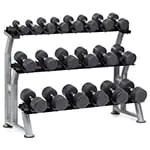
Dumbbell Storage Racks
Best fit: Dumbbell sets, hex dumbbells, rubber hex dumbbells, urethane dumbbells, round-head dumbbells, pro-style dumbbells, studio dumbbells, and adjustable dumbbell systems.
Buyer guidance: Match the rack to the dumbbell head shape and handle length. Flat or angled trays are commonly used for hex-style dumbbells, while round-head or pro-style dumbbells may require different shelf depth, saddle spacing, or rack geometry. Confirm the rack’s intended dumbbell type before ordering a full set.
Weight Plate Storage Racks
Best fit: Olympic plates, bumper plates, urethane plates, rubber-coated plates, cast iron plates, and standard plates where the rack is built for the correct hole size and plate profile.
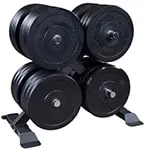
Buyer guidance: Confirm whether the rack is built for Olympic 2" center holes or standard 1" plates. Bumper plates are usually thicker than compact cast iron plates, so peg length and spacing matter as much as total weight capacity. Review plate diameter, plate thickness, peg spacing, and loading access before choosing a vertical tree or horizontal bumper rack.
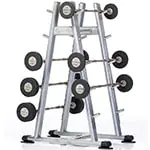
Barbell Storage Racks
Best fit: Olympic bars, power bars, curl bars, specialty bars, fixed barbells, and training bars that need vertical, horizontal, wall-mounted, or floor-mounted storage.
Buyer guidance: Barbell storage should protect the bar from unnecessary floor contact while keeping sleeves, collars, and walkways clear. Verify bar length, sleeve orientation, wall backing, mounting hardware, ceiling height, and whether vertical storage is practical for the room before selecting a wall hanger or floor holder.
Kettlebell Storage Racks
Best fit: Cast iron kettlebells, coated kettlebells, competition kettlebells, adjustable kettlebells, and kettlebell sets used in home, studio, school, and commercial strength rooms.
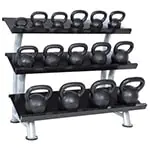
Buyer guidance: Kettlebells vary in base width, handle height, bell diameter, and coating. Check shelf depth, shelf spacing, front access, and total loaded weight before assuming a two-tier or three-tier rack will fit the whole run.
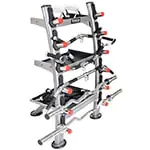
Cable Attachment Storage Racks
Best fit: Cable handles, lat bars, curl bars, triceps ropes, ankle straps, collars, chains, bands, and functional-training accessories used near cable columns, functional trainers, jungle gyms, and selectorized machines.
Buyer guidance: Compare hook count, hook spacing, shelf space, corner layout, double-sided access, and proximity to the machines being used. A centralized rack can improve workflow, but it should not create a floor obstacle in a cable-training lane.
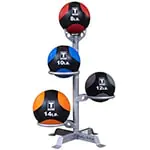
Ball Storage Racks
Best fit: Medicine balls, slam balls, wall balls, stability balls, yoga balls, and larger training balls that can roll into walkways when left on the floor.
Buyer guidance: Confirm ball diameter, rack tier spacing, vertical clearance, caster needs, and whether the rack will hold heavy slam balls or lighter stability balls. Large stability balls need more volume than their weight suggests, while dense medicine balls may require stronger shelf planning.
Match Storage Racks to the Training Environment
Home and Garage Gyms
Home gym storage usually starts with limited floor space, low ceilings, wall constraints, and a mix of dumbbells, bars, plates, kettlebells, and accessories. Compact A-frame plate trees, vertical bar holders, wall-mounted bar hangers, kettlebell shelves, and smaller dumbbell racks can work well when the mounting surface, loaded weight, and room traffic are planned first.
Commercial Gyms and Training Studios
Shared facilities need storage that matches daily use, member behavior, cleaning routines, and the way equipment is re-racked between sessions. Review use rating, rack capacity, shelf design, welds, hardware, caster type, replacement parts, and how the loaded rack will sit on the flooring.
School Weight Rooms and Athletic Facilities
School and team environments often need storage near racks, benches, platforms, and functional training zones. Plate trees, barbell racks, dumbbell racks, and kettlebell shelves should be located so athletes can load and unload equipment without crossing lifting lanes or creating bottlenecks during group sessions.
Government, Military, and Institutional Fitness Spaces
Institutional buyers should verify product-level documentation before ordering. Confirm the exact SKU, use rating, country of origin, contract eligibility, freight, installation responsibility, anchoring guidance, warranty language, replacement-part support, and any agency-specific requirements.
Multi-Purpose Rooms and Flexible Training Spaces
Rooms used for small-group training, functional fitness, classes, and open floor work may benefit from mobile ball racks, mobile plate trees, accessory towers, or compact free-weight storage. Mobility is useful only when the loaded rack can be moved safely on the flooring and does not interfere with walkways or training zones.
Dumbbell, Plate, Barbell, and Kettlebell Fit Planning
Dumbbell Rack Fit
Do not choose a dumbbell rack by overall rack length alone. A 5–50 lb. hex dumbbell set, a 5–100 lb. pro-style set, and a round urethane set can require different tray widths, shelf spacing, handle support, and pickup clearance. If your dumbbells have short handles, wide heads, round heads, or oversized plates, verify rack compatibility before ordering.
Weight Plate Tree Fit
Olympic plates and standard plates use different center-hole sizes, and bumper plates can consume storage peg space quickly because their thickness is more uniform across weight increments. Before ordering a plate tree, count the plates, measure the thickest plates, and review how the heaviest plates will be loaded and unloaded without crowding adjacent pegs.
Barbell Storage Fit
Barbell storage should match the bar type and the room. Vertical holders save floor space but require enough ceiling height and clear lifting space to remove long bars. Wall-mounted holders save floor area but require a suitable mounting surface and hardware review. Horizontal racks are useful for multiple fixed or specialty bars but require more wall length.
Kettlebell Rack Fit
Kettlebell racks need enough shelf depth for the base, enough vertical space to clear the handle, and enough front access for safe pickup and re-rack. Competition kettlebells, coated kettlebells, cast iron kettlebells, and adjustable kettlebells may not sit the same way on one shelf.
Load Distribution, Flooring, Anchoring, and Placement
Loaded storage racks can concentrate a large amount of weight into a small footprint. Before placing a rack, evaluate the subfloor, finished flooring, rubber surface, rack feet, weight distribution, and whether the room is on a slab, upper level, garage, basement, or commercial deck. For structural concerns, use product documentation and qualified facility guidance rather than relying on category copy alone.
A compatible gym flooring layout can help define the storage zone and protect the finished room layout, but it does not replace product-specific placement, leveling, anchoring, or load guidance. Heavy racks should not be placed on soft, unstable, uneven, or moisture-damaged surfaces without review.
Wall-mounted and high-vertical storage deserve extra attention. Verify the mounting surface, hardware, loaded weight, wall backing, clearance, and manufacturer instructions before installing a wall bar holder, wall gun rack, or tall storage unit. If a product requires anchoring, do not skip that step.
Mobile vs. Fixed Gym Storage Racks
Mobile storage can be useful in studios, school weight rooms, and multi-purpose training spaces where equipment moves between stations. A mobile plate tree, ball rack, or accessory cart can help with room turnover, but it should be selected with the loaded weight, caster size, floor surface, turning radius, and staff responsibility in mind.
Fixed storage is usually the better direction when the loaded rack will remain in one strength area, when the rack is tall or heavily loaded, when wall storage is needed, or when a facility wants the most predictable layout. In either case, choose the rack based on how it will be loaded every day, not just where it will sit when empty.
Freight, Receiving, and Assembly Planning
Small storage racks may ship by parcel, while larger commercial racks, heavy dumbbell racks, welded frames, long horizontal bar racks, and multi-tier systems may ship by freight. Review packaged dimensions, shipping weight, delivery method, liftgate needs, receiving hours, dock or forklift access, and the route to the final room before ordering.
Some storage racks ship fully welded, while others require assembly. Assembly time, hardware, tools, final leveling, caster installation, wall mounting, and floor anchoring should be reviewed on the individual product page. For facilities, assign responsibility before the delivery arrives so equipment does not sit boxed in a hallway, receiving dock, or training lane.
- Ground Parcel Eligibility: Compact accessory trees, wall-mounted barbell hangers, and lightweight residential organizers that remain within strict weight and size limits can occasionally ship boxed via standard ground parcel channels like UPS or FedEx.
- LTL Freight Requirement: Heavy-duty dumbbell racks, commercial multi-tier kettlebell shelves, horizontal bumper plate cradles, and high-capacity central accessory towers are oversized and too heavy for standard parcel trucks. These products must ship fully strapped, banded, and shrink-wrapped onto standard or custom-made wooden pallets via Less-Than-Truckload (LTL) freight.
- Robust Transit Protection: Because commercial storage racks have heavy steel frame assemblies and dense structural steel shelves, they are palletized to keep components upright, limit shifting, and protect the powder-coat finish during transit.
- Delivery Scheduling: Whether delivering to a residential home, a commercial gym facility, or a federal government/military installation, the freight carrier will issue a mandatory 24-hour notification call to set a specific delivery date and appointment window.
- Curbside Liftgate Service: Unless your delivery location features a dedicated commercial loading dock or an on-site forklift, the carrier will provide liftgate service to safely lower the palletized crate from the trailer bed down to ground level for a standard curbside delivery.
- Facility Maneuvering: Freight drivers are only responsible for curbside drop-off and are restricted from bringing items inside. Because gym storage equipment concentrates immense, awkward mass into a single footprint, IRON COMPANY strongly recommends having a team of helper assets ready at the time of delivery.
- Specialized Transport Tools: To safely move the heavy framework from the curb through entry doors without incident, users should have specialized moving tools on hand—such as a heavy-duty furniture moving dolly, an appliance hand truck, or a panel cart.
- Assembly Requirements: Most heavy storage systems arrive flat-packed for freight safety, requiring manual alignment of structural uprights, cross-bolting support tiers, securing protective dumbbell saddles, or installing multi-directional casters.
- Tool Recommendations: While basic factory assembly guides and hardware packages are enclosed, having your own tools—such as a socket set, adjustable wrenches, and a dead-blow mallet—is recommended for leverage and for checking that every steel joint is secured before loading free weights.
Strong Fit and Not Ideal For
Gym Equipment Storage Racks Are a Strong Fit For
- Home gyms, garage gyms, studios, school weight rooms, commercial gyms, tactical training spaces, and institutional facilities that need organized equipment access.
- Buyers storing dumbbells, barbells, Olympic plates, bumper plates, kettlebells, medicine balls, stability balls, cable attachments, bands, mats, and accessories.
- Facilities that can verify rack capacity, equipment compatibility, floor fit, receiving access, and installation requirements before purchase.
- Strength rooms that need cleaner traffic flow around racks, benches, free weights, plate-loaded machines, and cable stations.
- Government and institutional buyers prepared to confirm product-level documentation before procurement.
People that should purchase gym equipment storage products:
Who Needs Gym Equipment Storage? Top 10 Core Facilities & Users — Organizing a workout space requires matching the storage architecture to the people utilizing the floor. From compact residential spaces to high-traffic military bases, picking the correct rack system depends on user mechanics, footprint availability, and structural parameters. The ten profiles below are the buyers and facilities that benefit from dedicated gym equipment storage, and why an organized layout is worth the investment.
Garage Gym Owners & Home Fitness Enthusiasts
- Why it is a critical investment: Residential spaces require strict space-saving gym storage to keep floor plans clear for vehicles, laundry, or walking paths. Home gym organization relies on keeping multiple styles of free weights condensed into single, highly efficient footprints.
- Key buying considerations: Available budget and physical space availability are the primary driving factors. Wall-mounted vs. freestanding storage options determine the structural impact on a home. Wall-mounted systems conserve precious square footage but require solid wood studs, whereas freestanding units spread the static load directly across the floor finish.
- Targeted configurations: Multi-tier utility racks like the Body-Solid Pro ClubLine Storage Rack (SAR100) or space-saving angled frames like the Body-Solid 40" 3-Tier Hex Dumbbell Rack (GDR363B) safely support heavy loads without consuming large room footprints.
Commercial Health Clubs & Full-Scale Fitness Centers
- Why it is a critical investment: High-traffic venues face continuous equipment use and varied member behavior. Inadequate commercial dumbbell storage can lead to scattered weights, floor obstruction liability, and premature degradation of expensive free-weight steel and rubber coatings.
- Key buying considerations: Weight capacity, heavy-duty steel construction, and warranty terms are the key requirements. These spaces require specialized dumbbell racks engineered for multi-sided dumbbells with flat trays vs. round dumbbells with saddles or cradles to maintain floor order and reduce rolling hazards.
- Targeted configurations: Large-scale saddle rails like the industrial Body-Solid Pro ClubLine Commercial 3-Tier Saddle Dumbbell Rack (SDKR1000SD) keep round dumbbells deadlocked, while high-volume plate posts like the Body-Solid High Capacity 2" Olympic Plate Rack (GWT76) keep weight plates readily accessible.
Federal Government Agencies, Military Bases, & Tactical Facilities
- Why it is a critical investment: Military installations, tactical training facilities, and federal government entities operate under stringent, high-performance structural demands. Their training regimens call for dense, functional, and clearly identifiable gear setups that allow rapid squad transitions.
- Key buying considerations: Procurement eligibility via GSA contract status or TAA compliance status is required. Racks must offer heavy-duty construction, sound weld integrity, and specific structural documentation to satisfy command safety inspections.
- Targeted configurations: IRON COMPANY holds GSA Contract 47QSMA22D08NN; heavy-duty tactical storage systems like the Legend Fitness Commercial Two-Tier Hex Dumbbell Rack (3170) or the high-capacity Legend Fitness Long Three-Tier Kettlebell Rack (3316) are quoted with product-level eligibility confirmed.
Physical Therapy Clinics & Medical Rehabilitation Centers
- Why it is a critical investment: Clinical rehab centers cater to individuals navigating physical limitations or post-surgical recovery. Forcing a patient or medical practitioner to bend down to floor level to lift a heavy kettlebell or medicine ball can add liability and biomechanical strain.
- Key buying considerations: The safety features of the rack and the specific patient type must steer the purchase. Equipment must sit directly within the ergonomic "power zone" (between knuckle and chest height). Sound limitations are also critical; rubber-insulated or lined shelves help minimize metal clanging to foster a quieter, therapeutic healing environment.
- Targeted configurations: Accessible, waist-height layouts such as the Troy Barbell VTX 2-Tier Kettlebell Rack (KBR-14) or self-guided exercise stations like the Prism Fitness Group SMART FTC Floor Mount - 1 Bay Package provide accessible, organized accessory placement.
High School and Collegiate Athletic Weight Rooms
- Why it is a critical investment: Team sports environments require synchronized group training. Racks must be strategically positioned next to lifting lanes and power cages so student-athletes can quickly load or strip bars without crossing lifting lanes or creating spatial bottlenecks.
- Key buying considerations: Compatibility with highly specific training equipment is paramount. Teams utilizing thick solid-rubber bumper plates require bumper plate storage engineered explicitly for plate thickness and uniform diameter, rather than traditional vertical trees built solely for thinner iron plate dimensions.
- Targeted configurations: Multi-post trees like the heavy-duty Body-Solid Commercial Weight Tree (GWT66) handle high-diameter bumper plates, while horizontal options like the wheeled TKO Defiant Strength 72" Horizontal Bumper Storage (DS-950-72) permit quick relocation across the lifting platform zone.
Boutique Personal Training Studios & Functional Fitness Classrooms
- Why it is a critical investment: Micro-studios run high-energy, fast-paced circuits incorporating a wide spectrum of functional tools—including medicine balls, conditioning ropes, suspension straps, resistance bands, and foam rollers—all on a very constrained training floor.
- Key buying considerations: Layout flexibility and multi-purpose versatility are paramount. Studios must weigh horizontal vs. vertical storage racks to get the most use from limited space. Choosing modular systems allows trainers to condense diverse accessory types onto a single vertical tower.
- Targeted configurations: Vertical multi-tier systems like the Body-Solid Compact Gym Accessory Storage Tower (GAR50) or the Troy Barbell VTX Fitness Accessories Storage Rack (GVLAR) centralize ropes, mats, handles, and small weights into a neat, compact footprint.
Corporate Wellness Centers & Apartment Gym Spaces
- Why it is a critical investment: Unsupervised residential or workplace gym environments require self-explanatory safety features. Weights must intuitively go back to designated places to keep walkways clear and protect property management or corporate entities from structural floor damage and tripping hazards.
- Key buying considerations: Sound limitations and strict space limitations are top priorities. Multi-family housing complexes can face structural noise transmission issues. Racks should be equipped with thick sound-dampening wear guards or plastic saddles to reduce the acoustic clatter of re-racking weights over living quarters.
- Targeted configurations: Lined flat tray configurations like the York Barbell Three-Tier Hexagonal Dumbbell Rack (69129) lower acoustic impact, while double-sided vertical pillars like the York Vertical Rubber Hex Dumbbell Rack (69001) save valuable space.
Group Exercise Studios (Vinyl, Neoprene, & Studio Dumbbell Users)
- Why it is a critical investment: Aerobic classes, step sessions, and indoor cycling studios rely on high quantities of light, vinyl-coated or neoprene-covered dumbbells. Stacking these compact hand weights on flat commercial shelves can cause disorganization and scratch the colorful protective coatings.
- Key buying considerations: The rack profile must match small-format handle distances and hand-weight diameters. Studios require a dedicated vertical aerobic dumbbell rack or specialized studio dumbbell rack built with narrow slot spacing to keep light weights sorted cleanly by color and increment.
- Targeted configurations: High-capacity vertical pillars like the matte black Body-Solid 12-Pair Vertical Aerobic Dumbbell Rack (GDR24B) or the compact Troy Barbell Compact 10 Pair Dumbbell Rack (T-HDR) keep lightweight group fitness assets highly organized and easily accessible.
Cable Machine Areas & Selectorized Training Lanes
- Why it is a critical investment: Cable columns, functional trainers, and jungle gym cable systems require an immense assortment of machine attachments, including lat bars, triceps ropes, multi-grip handles, stirrups, and ankle straps. Leaving these items piled on the floor next to cables can create an entanglement hazard.
- Key buying considerations: Proximity hook count and hook spacing. A proper gym attachment organizer should feature elongated hooks and individual hanging tiers so that cable handles and heavy attachment bars do not overlap adjacent slots.
- Targeted configurations: Dedicated cable handle storage racks like the heavy-duty TKO Commercial Cable Attachment Rack (848ACR-BK) or the Troy Barbell Cable Attachment Storage Rack (GTAR) keep functional training accessories visible, protected, and off the floor.
Multi-Purpose Athletic Facilities & Flexible Community Spaces
- Why it is a critical investment: Multi-use recreational halls, basketball gym floors, and school gymnasiums frequently shift between open floor sports and structured strength classes. Equipment must be brought onto the floor for the workout and removed afterward to clear the courts.
- Key buying considerations: Fixed vs. mobile design parameters. Rolling storage carts require high-grade, large-diameter industrial casters that roll over sports floors or dense rubber tile surfaces without locking up, pivoting erratically, or scuffing the wood subfloor.
- Targeted configurations: Rolling weight plate trees like the Body-Solid Mobile Vertical Weight Plate Tree (GWT86) provide mobile convenience, while dual-sided hanging designs like the Body-Solid Mobile Hanging Mat Rack (GHMR10) roll group mats away in seconds.
Gym Equipment Storage Racks May Not Be the Right Choice For
- Buyers who have not measured the dumbbells, plates, bars, balls, kettlebells, or attachments being stored.
- Rooms without enough clearance for loading plates, re-racking dumbbells, removing barbells, moving mobile racks, or keeping walkways open.
- Facilities trying to place light-duty residential racks into high-traffic shared settings without verifying use rating and warranty terms.
- Wall-mounted storage projects where wall backing, hardware, or mounting suitability has not been confirmed.
- Projects requiring product-level GSA, TAA, Buy American, Made in USA, country-of-origin, capacity, or structural documentation that has not yet been verified.
People that should do more research before buying gym equipment storage products:
Who is NOT a Good Candidate for Gym Equipment Storage? Top 6 Profiles — While organizing your workout floor is generally a sound step toward home gym organization or commercial floor safety, certain spatial layouts, equipment assortments, and procurement scenarios make purchasing a pre-built storage rack an impractical decision. Based on geometric limitations, structural limitations, and engineering criteria, here are the top 6 people and facility profiles that are not ideal candidates for traditional gym equipment storage racks.
Gym Owners and Lifters with Unmeasured or Custom Proprietary Free Weights
- Why they are not a good fit: Gym equipment storage is precision-engineered around standardized manufacturing rules for handle distances, head dimensions, and plate diameters. Buyers who skip a physical equipment inventory and purchase a rack blindly run a real risk of structural incompatibility.
- The specific structural conflict: If your weight collection consists of short-handled dumbbells, oversized non-standard plates, or highly custom shapes, standard racks may not fit. Round dumbbells placed onto a multi tier utility rack with flat shelves can roll off without a roll-stop tray. Conversely, multi-sided dumbbells or hex dumbbells placed onto a specialized saddle rack—such as the Body-Solid Pro ClubLine Commercial 2-Tier Saddle Dumbbell Rack (SDKR500SD)—will not rest level in the curved cradles. Always measure head widths and handle lengths before choosing a storage design.
Facilities facing Severe Space Limitations or Restricted Clearance Zones
- Why they are not a good fit: Although adding a heavy duty weight rack is intended to clean up space saving gym storage, it can backfire drastically if the literal room footprint or clear access lanes are too tight to permit bi-directional loading.
- The specific structural conflict: Shoving a wide, structural rack like the Troy Barbell VTX 3-Tier Horizontal Dumbbell Rack (TDR-3) into a narrow walkthrough space will physically block critical training lanes. If pulling a 45-pound plate off a tree post or grabbing a kettlebell forces a lifter to step into a selectorized machine lane, a squat stand area, or a door swing path, you lack the minimum essential layout clearance. In ultra-confined training environments without proper walkways, standard horizontal racks do more harm than good.
Leased Properties or Residential Rooms restricted to Drywall-Only Mounting
- Why they are not a good fit: Residential renters, garage gym owners with metallic framing, or corporate tenants who are legally or structurally blocked from drilling deep anchors into solid wood studs or structural masonry are poor candidates for hanging storage units.
- The specific structural conflict: Heavy steel fixtures like the IRON COMPANY 4 Bar Vertical Barbell Storage Rack (IC4BARHANGER) or a multi slot barbell gun rack exert large, concentrated shear loads directly on their mounting surfaces. Hanging multiple 7-foot Olympic bars on bare drywall with plastic anchors risks structural failure of the mount. If you cannot verify your wall backing or lack the freedom to anchor industrial hardware, avoid a wall mounted barbell rack and invest in freestanding weight storage like the upright Body-Solid 5 Olympic Bar Holder (GOBH5).
High-Traffic Commercial Settings seeking to Use Residential Gear
- Why they are not a good fit: Budget-conscious buyers managing high-volume commercial training venues are highly incompatible with residential-grade home gym organization systems, even if those racks look visually similar to industrial options.
- The specific structural conflict: Utilizing a light commercial gym rack or a residential tree—such as the compact CAP Barbell Economy A-Frame Regular Plate Tree (RK-1BB)—in a collegiate athletic weight room, school strength space, or public wellness center can lead to rapid equipment damage. Residential racks lack the heavy-gauge steel framing and continuous industrial welds required to handle constant dropping and high daily member volume. Overloading a light home tree exceeds its weight capacity, loosens the bolts, and can void the manufacturer warranty.
Open-Air, Outdoor Fitness Zones and High-Humidity, Unconditioned Spaces
- Why they are not a good fit: Facilities looking to store free weights in coastal open-air parks, unprotected backyards, non-insulated carports, or corrosive humid environments are poor fits for most standard weight racks.
- The specific structural conflict: Standard interior-grade storage racks utilize a basic electro-statically applied powder coat finish. When these steel tubes are left in un-climate-controlled garage gym settings or outdoor zones, salt air and rainwater can get beneath the powder coat layer. This can lead to accelerated rust and joint oxidation. Unless the equipment documentation details hot-dipped zinc galvanization or a marine weatherproof finish, standard powder-coated frames are not made for the elements.
Federal Purchasing Officers Requiring Documented Compliance Prior to Verification
- Why they are not a good fit: Institutional fitness coordinators, military logistics personnel, and federal government contractors bound to GSA contract status or TAA compliance status constraints are not good candidates for ordering off simple web descriptions without pre-purchase validation.
- The specific structural conflict: While IRON COMPANY holds GSA contract 47QSMA22D08NN, this does not automatically make every product option, color variation, or country of origin eligible for a federal procurement card. Ordering a multi tier utility rack blindly online without verifying its exact product-level TAA compliance can result in immediate procurement rejection during a strict agency compliance audit. Institutional buyers should contact Customer Care for a line-item quote with product-level eligibility confirmed.
Common Gym Equipment Storage Buying Mistakes to Avoid
- Assuming one rack fits every dumbbell: Hex, round, urethane, solid-head, pro-style, compact, studio, and adjustable dumbbells can require different tray or saddle designs.
- Choosing a plate tree by weight capacity only: Plate diameter, plate thickness, center-hole size, peg spacing, peg length, and loading access are just as important as total capacity.
- Mixing standard and Olympic plate assumptions: Confirm whether the rack is intended for 1" standard plates, 2" Olympic plates, or both before ordering.
- Ignoring bumper plate thickness: Bumper plates can fill storage pegs faster than thinner cast iron plates. Count plates by physical width, not only by weight.
- Buying a wall rack without checking the wall: Wall-mounted bar holders need a suitable mounting surface and correct hardware. Drywall alone should not be assumed adequate.
- Overlooking total loaded rack weight: A storage rack may look compact, but the combined loaded weight can be substantial. Review the floor surface and subfloor before placement.
- Blocking training lanes: Storage placed too close to power cages, squat stands, benches, cable machines, or walkways can create congestion even when the rack itself fits.
- Moving loaded racks without a plan: Mobile racks should be moved only when the casters, flooring, loaded weight, and staff procedure support that use.
- Assuming every rack is suitable for outdoor or humid environments: Verify product documentation before using indoor powder-coated storage in garages, outdoor areas, high-humidity rooms, or corrosive environments.
- Treating every product as contract eligible: Company contract status does not prove product-level eligibility, country-of-origin status, or solicitation fit.
When designing an organized strength training space, selecting the right gym equipment storage solutions involves much more than finding a rack that simply holds your weights on paper. Choosing the wrong framework can compromise facility safety, ruin expensive flooring, and bottleneck active training lanes.
To make the purchase go smoothly for your home gym, commercial facility, or tactical training center, evaluate these top 6 critical mistakes before finalizing your storage footprint:
Miscalculating Dumbbell Head Geometry vs. Tray Design — A common industry pitfall is assuming that a single, standard dumbbell rack can accommodate any free weight setup. For example, angled tier shelf systems like the Body-Solid GDR363B are highly depth-optimized for traditional cast iron hex dumbbells. However, if you are attempting to store oversized round head urethane, solid-head, or pro-style dumbbells, they frequently require different shelf spacing, saddle configurations, or distinct cradle depths to allow safe pickup clearance without pinning fingers.
Overlooking Bumper Plate Thickness on Storage Peg Trees — Selecting an Olympic weight plate tree on overall weight capacity alone often falls short. Standard iron plates are highly compact, meaning a short storage post can hold multiple units. In stark contrast, vulcanized rubber bumper plates are uniform and significantly thicker across all weight increments. A standard vertical weight tree or mobile vertical tree can run out of physical peg length long before reaching its maximum structural weight rating. For high-volume bumper plate layouts, horizontal bumper plate cradles or heavy-duty commercial trees with extended horn clearance are the fit.
Mixing Standard One-Inch and Olympic Two-Inch Plate Requirements — Residential and garage gym builders frequently confuse standard and Olympic sizing constraints. Traditional, light-duty standard weight plates utilize a small one-inch center hole, which will physically never slide onto a two-inch diameter Olympic storage post. Conversely, storing a two-inch Olympic plate on a thin one-inch regular tree peg lets the plate tilt, shifting the rack's center of gravity and creating a tip hazard. Racks like the standard-peg York Barbell 69035 and the Olympic-peg York Barbell 69036 exist as separate, non-interchangeable systems for this precise reason.
Ignoring Kettlebell Handle Heights and Base Dimensions — Kettlebell racks require a detailed dimensional cross-reference of the gear you own rather than a generic shelf assumption. Cast iron kettlebells feature compact bodies, while competition models use a uniform external bell diameter regardless of weight tier. Flat tray systems like the Troy Barbell VTX 2-Tier Kettlebell Rack require a clear spacing calculation; a competition kettlebell handle can hit the underside of an upper rack tier before the base sits flush on the bottom steel tray.
Blindly Mounting Wall Storage Units Without Structural Anchoring — Utilizing space-saving wall mounts—such as vertical bar hangers or horizontal gun racks—is a way to free floor square footage, but it demands proper surface evaluation. Attempting to anchor a multi-bar hanger into hollow drywall with standard anchors can shear under the leverage of multiple steel bars. Heavy steel bars should be anchored directly into structural wood studs or solid masonry wall backing using structural lag bolts, to reduce the risk of localized wall damage. Additionally, storing long bars vertically demands a direct audit of your ceiling height relative to the bar length to avoid boxing your equipment in.
Misjudging Concentrated Dead-Weight Loads on Flooring Surfaces — A compact vertical rack holding multiple heavy plate runs or pro-style dumbbell sets concentrates a large downforce onto a restricted footprint. Forcing a heavily loaded rack onto a soft, unbacked floor surface or thin, low-density resilient mats can cause the frame feet to gradually punch through, splitting subfloor seams and cracking the underlying raw concrete deck over time. When engineering high-density storage zones, it is vital to pair the system with commercial-grade rubber flooring rolls or high-impact interlocking tiles to distribute structural dead weights evenly.
Maintenance, Inspection, and Facility Operations
Storage racks should be inspected according to the exact product instructions. Facility staff should check visible hardware, welds, shelves, pegs, hooks, casters, wall mounts, floor anchors, frame alignment, rubber or plastic contact points, and any areas where plates, bars, or dumbbells repeatedly touch the rack.
Shared facilities should define who is responsible for cleaning, re-racking expectations, damaged-part reporting, out-of-service tags, and replacement-part requests. Keep product manuals, warranty documents, serial numbers, purchase records, and quote documentation available for facility managers and service contacts.
Use cleaning methods appropriate for the rack material and finish. Do not assume one cleaner is suitable for powder coat, chrome, plastic saddles, rubber contact pads, wheels, hardware, or wall-mounted components unless the product documentation supports it.
Featured Gym Equipment Storage Options
IRON COMPANY 2 Bar Vertical Barbell Storage Rack
This wall-mounted Olympic bar hanger is listed as a steel bracket for vertical storage of two Olympic weight bars. Review current mounting requirements, wall compatibility, hardware needs, bar fit, shipping terms, and product documentation before installing it in a home or facility.
CAP Barbell Economy A-Frame Olympic Plate Tree for Home Gyms
The CAP RK-2BB is listed as a compact A-frame Olympic plate tree for home gym use with five weight pegs and compatibility with Olympic plates with 2" center holes. Confirm plate type, plate thickness, total loading plan, floor placement, and current specifications before ordering.
Body-Solid Mobile Vertical Weight Plate Tree
The Body-Solid GWT86 is a mobile vertical plate tree listed with a 38" weight horn and multi-directional caster wheels for Olympic plate storage. Review the current weight capacity, caster guidance, floor surface, loaded movement, dimensions, and shipping details before selecting it for a flexible training layout.
Body-Solid 5 Olympic Bar Holder
This Body-Solid vertical bar holder is designed to organize multiple Olympic bars in a compact floor footprint. Confirm bar sleeve fit, bar count, ceiling clearance, loaded stability, room placement, and product-specific use guidance before ordering.
Body-Solid Compact Gym Accessory Storage Tower
The Body-Solid GAR50 is listed with multiple storage levels for items such as balls, resistance bands, tubes, jump ropes, foam rollers, yoga mats, and related accessories. Review current accessory fit, room footprint, shipping terms, and whether the tower matches the items being stored.
Body-Solid 40" 3-Tier Hex Dumbbell Rack
The Body-Solid GDR363B is listed as a 40" three-tier rack designed for hex-style dumbbells, with angled shelves and a stated best fit for a 5–50 lb. cast iron hex dumbbell set. Verify compatibility if storing round-head, pro-style, compact, or non-standard dumbbells.
Troy Barbell VTX 2-Tier Kettlebell Rack
The VTX KBR-14 is listed as a two-tier kettlebell rack with 12-gauge steel construction and a compact footprint for home or commercial use. Confirm kettlebell sizes, shelf spacing, total storage plan, flooring, and current capacity documentation before ordering.
Product names, availability, prices, ratings, dimensions, capacities, finishes, shipping terms, warranties, mounting requirements, and procurement status can change. Review the current product page and request a quote before ordering.
Related Free Weights, Strength Equipment, and Storage Planning Categories
Storage planning should happen alongside the equipment being stored. Browse free weights, barbells and sets, dumbbells and dumbbell sets, kettlebells and kettlebell sets, Olympic bars, and weight plates before finalizing storage rack style, shelf size, peg spacing, and room layout.
For complete strength-room planning, compare half racks and quarter cages, plate loaded and leverage equipment, power cages and platform racks, squat stands and modular racks, and weight benches. Storage should keep these stations accessible without crowding barbell loading zones, bench setup areas, or machine walkways.
Gym Equipment Storage Guides and Buyer Resources
For broader facility planning, read Gym Equipment Purchasing Guide 2020, Best Olympic Weight Plates and Barbell Plate Packages, and The Ultimate Rubber Hex Dumbbell Buying Guide.
Facility and procurement buyers can also review IRON COMPANY capabilities for fitness equipment and gym flooring projects and GSA bid information. Product-level eligibility, configuration details, ordering method, freight, warranty, and documentation should be verified before treating any storage rack as available through a specific purchasing channel.
For current ordering support, quote help, or category guidance, visit IRON COMPANY Customer Care.
Government and Institutional Gym Storage Purchasing
IRON COMPANY holds GSA contract 47QSMA22D08NN. Contract status does not establish that every gym equipment storage rack, wall-mounted bar holder, dumbbell rack, plate tree, kettlebell rack, accessory tower, color, option, or configuration is available through GSA, a Government Purchase Card, or a specific agency purchasing channel.
Before ordering, verify product-level contract eligibility, country of origin, current pricing, ordering method, freight, installation scope, warranty terms, and any applicable TAA, Buy American, Berry Amendment, or agency-specific requirements. Institutional buyers should also confirm intended use, storage capacity, receiving access, floor placement, anchoring guidance, and replacement-part support for the exact rack configuration.
Common Questions About Gym Equipment Storage
What type of storage rack should I use for weight plates?
Choose by plate type first. Olympic plates require storage designed for 2" center holes, while standard plates use 1" center holes. Bumper plates are thicker than many cast iron plates, so peg length and spacing matter. Vertical trees conserve space, while horizontal bumper racks may make plate loading easier in high-volume zones.
Can I store bumper plates on a regular vertical weight tree?
- The Answer: Not efficiently. Standard weight plate trees are engineered primarily around dense, compact cast iron plates. Solid rubber bumper plates have a uniform, significantly thicker profile across all weight increments, meaning they will consume linear peg length far faster and crowd adjacent tiers. Bumper plates are usually made to a consistent diameter across weights so the bar sits at the same height from the floor; each product page lists the exact diameter.
- The Buyer Guide: When executing an asset inventory, measure the exact physical width of your plates rather than calculating total weight capacity alone. If your training goals rely on thick bumpers, regular vertical trees can crowd adjacent pegs. Instead, opt for deep, specialized horizontal bumper storage like the Body-Solid Horizontal Bumper Plate Rack (GBPR10) or the rolling TKO Defiant Strength 72" Horizontal Bumper Storage (DS-950-72), which feature dedicated slots to keep high-diameter plates separated.
How do I know if my dumbbells will fit a rack?
Measure dumbbell head width, handle length, head shape, and total set length before choosing a rack. Hex dumbbells often work on flat or angled trays, while round-head, urethane, pro-style, or compact dumbbells may require a different rack geometry.
- The Answer: No, dumbbell racks are not universal. Flat trays or angled shelves are built for multi-sided weights like hex, rubber hex, and urethane hex variations so they sit flush and stable. Conversely, round dumbbells require distinct cradles or protective saddles to block rolling and keep the floor in order.
- The Buyer Guide: Handle geometry and head diameter are just as critical as length. Placing round weights on a flat tray can let them shift or roll off, while hex weights will not sit properly in contoured cradles. If you have short-handled weights or high-capacity needs, look into protective saddle designs like the Body-Solid Pro ClubLine Commercial 3-Tier Saddle Dumbbell Rack (SDKR1000SD) to lock round profiles in position. For multi-sided home setups, an angled flat shelf like the Body-Solid 40" 3-Tier Hex Dumbbell Rack (GDR363B) offers stable incremental storage.
Are wall-mounted barbell holders a good idea?
They can save floor space and keep bars off the ground when the mounting surface and hardware are appropriate. Confirm wall backing, bar count, loaded weight, sleeve clearance, ceiling height, and installation instructions before using wall-mounted bar storage.
Should I choose vertical or horizontal barbell and weight racks?
- The Answer: Your physical space availability, facility type, and user demographics must dictate this choice. Vertical layouts—such as an upright vertical barbell holder or vertical dumbbell rack—reduce your floor footprint, making them a fit for garage gym storage systems or studio organizers. Horizontal storage requires more floor footprint or wall length but offers quicker loading access.
- The Buyer Guide: Vertical units require careful consideration of ceiling clearance and physical loading mechanics. Lifting a 7-foot Olympic bar straight up into a tall vertical sleeve requires high ceilings and steady physical control. For tight quarters with low ceilings, shifting to a wall mounted barbell rack or wall mounted bar hanger like the IRON COMPANY 12 Bar Barbell Storage Rack (IC12BARHORZ) saves floor area without the overhead lift of a vertical sleeve.
Should I choose a mobile or fixed storage rack?
Choose mobile storage when the room layout changes often and the loaded rack can be moved safely on the floor surface. Choose fixed storage when the rack will stay in one location, carry heavier loads, or require wall or floor anchoring.
Can one storage rack hold dumbbells, kettlebells, plates, and accessories?
Some accessory towers and combination storage racks hold multiple item types, but fit is product-specific. Confirm shelf spacing, peg diameter, hook spacing, total loaded weight, and the actual equipment dimensions before choosing a multi-purpose rack.
Do gym storage racks need to be anchored?
Some wall-mounted, floor-mounted, tall, or heavily loaded racks may require anchoring or specific installation steps. Review the product instructions and consult qualified installation or facility professionals when needed.
Is it safe to install a wall-mounted storage rack on bare drywall?
- The Answer: No. Wall-mounted barbell hangers and gun racks carry large, concentrated shear loads. Screwing commercial steel brackets directly into bare drywall with plastic expansion anchors creates a point of failure once heavy solid-steel bars are re-racked.
- The Buyer Guide: Before ordering a wall unit, you must pre-verify your wall composition and hardware backing. Wall-mounted designs require direct anchoring into solid wood studs, professional wood structural backing, or concrete block masonry. If you are renting a property or cannot structurally bolt into the building's skeleton, bypass wall units and use heavy-duty freestanding weight storage like the upright, floor-stabilized Body-Solid 5 Olympic Bar Holder (GOBH5).
Can residential weight racks be used in a school or commercial gym?
- The Answer: No. Light-duty residential storage racks are built for low-volume loading and occasional home use. Deploying a residential frame into a school weight room, corporate wellness center, or high-traffic commercial facility can lead to loose joints, sheared bolts, warped trays, and frame failure.
- The Buyer Guide: Match your rack's engineering grade to your clientele or patient type for long-term performance and user safety. Public spaces, tactical training zones, and high school athletic centers require heavy duty weight racks built with fully welded structural joints or heavy-gauge steel framing; the steel gauge is listed on each product page. Look into commercial line options like the Legend Fitness Commercial Two-Tier Hex Dumbbell Rack (3170), built for continuous heavy use; the warranty is listed on the product page.
What should I confirm before freight delivery?
Confirm packaged dimensions, delivery method, liftgate needs, receiving hours, pallet handling, the path to the final room, and who will assemble or place the rack. Heavy racks and fully welded frames can be difficult to move after curbside delivery.
Can gym equipment storage racks be purchased through GSA?
IRON COMPANY holds a GSA contract, but eligibility must be verified for the exact storage rack, configuration, and ordering method. Request a current quote and supporting product-level documentation before using a federal purchasing channel.
Are all e-commerce gym storage racks government contract eligible?
- The Answer: No. A company's overall e-commerce status does not guarantee that every individual rack configuration, multi tier utility rack, or accessory tower color variation complies with federal purchasing guidelines. Federal agencies and military logistics personnel require certified country-of-origin documentation to verify trade compliance.
- The Buyer Guide: Procurement officers managing tactical training facility storage or institutional fitness equipment racks must secure pre-verified line-item quotes for regulatory alignment. IRON COMPANY, a fitness and flooring supplier since 1997, holds GSA Contract 47QSMA22D08NN and quotes GSA-contract and TAA-compliant storage racks with eligibility confirmed per product.
Why Buy Gym Equipment Storage from IRON COMPANY?
Established in 1997, IRON COMPANY supplies gym equipment, free weights, strength equipment, cardio equipment, accessories, and flooring solutions for residential, commercial, vertical-market, institutional, military, and government buyers. The team provides product sourcing, quote support, category guidance, and customer care for individual storage-rack purchases and complete weight-room projects.
IRON COMPANY supplies gym equipment storage solutions to residential customers, personal training studios, high schools and universities, multi-unit housing complexes, hotel fitness spaces, commercial fitness centers, sports performance rooms, corporate wellness centers, vertical market studios, VA hospitals, and federal procurement clients. IRON COMPANY has supplied heavy-duty storage racks to strength rooms since 1997.
Federal government and military procurement officers worldwide purchase TAA-compliant fitness ball storage racks, barbell racks, dumbbell racks, kettlebell racks, cable attachment racks, and weight plate storage racks that are available through our GSA contract (GSA 47QSMA22D08NN) as well as the IRON COMPANY website. TAA compliance means that a product supplied to the United States federal government must be manufactured or substantially transformed in the United States or in a designated country under the Trade Agreements Act. Gym equipment storage racks available through our channels include configurations manufactured by Arsenal Strength, Body-Solid, Legend Fitness, TKO, York Barbell, Troy Barbell (VTX), American Barbell, Spirit Fitness, SportsArt America, TuffStuff Fitness, and Nautilus.
Learn more about IRON COMPANY, review the company’s Better Business Bureau profile, or contact IRON COMPANY at 888-758-7527 for assistance.
Shop Gym Equipment Storage
Compare the gym equipment storage racks above by equipment type, rack format, dumbbell fit, plate compatibility, barbell storage method, shelf spacing, peg design, load planning, flooring, receiving requirements, and procurement documentation. For commercial gyms, schools, studios, government facilities, or multi-room strength projects, request a current quote before finalizing the layout.