ENJOY ONLINE CHECKOUT SAVINGS! $200-$749 = 3% | $750-$1,999 = 4% | $2,000+ = 5% Off Applied in Cart - Not Valid on Phone or Quote Orders

Marty Gallagher

Marty Gallagher
Marty Gallagher
Author

Marty Gallagher is a national and world champion strength athlete, coach, author, and RAW Podcast host with deep experience in Olympic lifting, powerlifting, bodybuilding, and strength training. As a coach, he has worked with elite strength athletes and championship teams, including lifters competing at the highest levels of the sport.

As a writer, Marty has contributed to major strength and fitness publications and authored multiple books on training, strength, and physical transformation. His IRON COMPANY articles and RAW Podcast discussions focus on practical strength training, powerlifting, Olympic lifting, cardio, longevity, discipline, and the lifelong pursuit of physical excellence.

  1. Dietary Dilemma - Anthony D’Arezzo To The Rescue

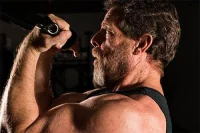
    Anthony D’Arezzo performing hammer curls

    How to Break World Records While Getting Ripped

    How to break world records while getting ripped.

    Bad to the bone dietary guru: 280-pound Anthony D’Arezzo, monster bodybuilder and 550-plus bench presser.

    Anthony D’Arezzo Joins Team Kirk

    Anthony D’Arezzo became part of Team Kirk, Kirk Karwoski, in the early 1990s. Anthony was our dietary expert. Why does an elite powerlifter, a world champion, need dietary advice? Kirk Karwoski wanted to take his game to the next level.

    The three-time world champion in the 275-pound class had a radical dream. He wanted to reduce his bodyweight downward to the 242-pound class, set world records, and win the national and world championship. Once he attained ripped-and-shredded condition at 240, Kirk would then switch directions and slowly add back 35 pounds of muscle, morphing into a gargantuan superfreak as a 275-pound lifter.

    He needed expert nutritional advice because he was impaled on the horns of a physiological dilemma: he needed to become stronger whileplumrocket

    Read more »
  2. Powerlifting Podcasts

    IRON COMPANY powerlifting podcasts graphic for Marty Gallagher article

    Man Does Not Live by Absolute Strength Training Alone

    Man does not live by absolute strength training alone.

    I once interviewed Bill Pearl for Muscle & Fitness magazine and he noted that “The hardest muscle for the bodybuilder / strength athlete to develop is their Mind.” Once you exhaust the contents of the box, to take your game to the next level, you must step outside the box.

    Why RAW Podcast Is Not Strictly a Powerlifting Podcast

    I am often asked why our podcasts are not strictly powerlifting podcasts. I have been a competitive lifter for just shy of 60 years. I am an IPF world masters champion and six-time national masters champion in three different weight classes. My closest friends are elite powerlifters. My training partners are competitive powerlifters.

    While my roots are deep and long in this, the world’s strongest sport, the ultimate secret in powerlifting is, past a certain point, to optimize power potential the lifter needs to step outside the limited confines of the powerliftingplumrocket

    Read more »
  3. My Long Road To The Top by Powerlifting Champion Hugh Cassidy

    Hugh Cassidy deadlifting at the 1971 world powerlifting championship

    Marty Gallagher’s Introduction to Hugh Cassidy’s 1972 Article

    Rawer than raw: Hugh Cassidy stiff-leg deadlifted the 790 pounds needed to beat Big Jim Williams at the inaugural world championships. No supportive suit or lifting belt was used. Hugh bench pressed 570 pounds with a 2-second pause on the chest. He buried an 800-pound squat and “felt confident of 840” had he been granted another squat attempt. He did not miss a single attempt, “not wanting any close misses.”

    Original Hugh Cassidy article first published in Muscular Development magazine, 1972.

    My friend Steven sent me a copy of an article written by my iron mentor, Hugh Cassidy, and first published in Muscular Development magazine in 1972. I hadn’t read this article in 50 years and the rereading sparked effervescent memory bubbles. Hugh had won the powerlifting world championships in November of 1971. I was not training with Cassidy during this period as I was living in Portland, Oregon; Olympic weightlifting remained my singularplumrocket

    Read more »
  4. Broadening the Strength Training Template

    David Rigert performing a power clean

    One Advantage to Minimalistic Absolute Strength Training

    One advantage to minimalistic absolute strength training: it leaves a lot of time for the other stuff.

    The Sunday Core Four Session

    Every Sunday from 9 a.m. to 11 a.m., we have our weekly strength training session. Ours is an organic group, sometimes expanding, sometimes contracting, a circle of like-minded hardcore strength athletes. We gather and classically, relentlessly, methodically, work through the “Core Four” progressive resistance exercises: squat, bench press, deadlift, and overhead barbell press.

    At each lifting platform, four to five men cluster and spot one another as each in turn steps up and does their warm-up sets leading to a top set. The others watch, exhort, and offer post-set technical critiques. Men lift better when lifting as other men watch.

    Afterwards, those so inclined might hang out and engage in some bodybuilder-style pump-’em-up arm training. Or not. The crux, the irreducible essence of these workouts,plumrocket

    Read more »
  5. Ori Hofmekler and Stress

    Ori Hofmekler for stress and hormesis article

    The Poison Is in the Dose

    The poison is in the dose.

    I happened to come across a copy of my old friend Ori Hofmekler’s book, The 7 Principles of Stress. Ori is one of the health and fitness world’s few original thinkers. An internationally known artist, his satirical political cartoons were featured in the London Times, New York Times, Der Spiegel, U.S. News & World Report and Washington Post, to name but a few.

    When Ori turned his full attention to fitness, he came at “fitness” from a radical perspective: Ori’s optimal physique and ideal performance profile was a military archetype, not an athletic archetype.

    Ori Hofmekler’s Warrior Archetype

    Ori posited that the ideal physique is best exemplified by the lightly muscled, highly conditioned, intermittently fed ancient Greek trireme rower or the common Roman foot soldier. A trireme was an ancient Greek warship used by fifth-century B.C. Greeks to project naval power. Each trireme had roughly 170 rowers. These men were not cartoon slavesplumrocket

    Read more »
  6. Why We Love Dumbbell Training

    IRON COMPANY solid steel urethane dumbbells for dumbbell training article

    In Resistance Training, Harder Is Better

    In resistance training, harder is better.

    The trend in resistance training is to create modes, machines, devices, and methods that make resistance training easier and therefore more sellable. For instance, a chest press machine has a payload that travels on a ball-bearing smooth motor pathway. The machine eliminates the “third dimension of tension,” the need to control side-to-side motion. The elimination of the need to control the payload from the pathway makes pushing and pulling easier — and easier is inferior.

    Smoothness and ease are insufficient to trigger the deepest adaptive response in serious lifters. The adaptive response occurs in response to stress. The more stressful the resistance training, assuming the stress is technically owned and recoverable, the greater the potential results. In resistance training, brutal and crude trump ease and smoothness.

    In a perfect world, all tools and modes would deliver equal results. That would be fairplumrocket

    Read more »
  7. Dorian Yates – Forged Passion: The Grit, Power, and Legacy of a Six-Time Mr. Olympia

    Dorian Yates in a bodybuilding pose

    The Relentless Journey of Dorian Yates

    Strength, grit, and the power-bodybuilding revolution.

    Writing for Weider at the Peak of the Muscle Magazines

    Dr. Jim Wright contacted me about coming to work for the Weider organization in the late 1980s. During my tenure I wrote 84 feature articles for Muscle & Fitness, Prime and Flex Magazine. I was flown to the Mr. Olympia and the Arnold Classic and sat in the front row to write about the shows, interview the winners and roam backstage gathering impressions. All of which was rather odd for a man that really didn’t like bodybuilding. You don’t have to be a great artist to be a great art critic and you don’t have to be a bodybuilder to write insightful pieces on bodybuilding and bodybuilders.

    My main area of expertise was training. I was also a real writer with passion and a voice and I knew training backwards and forwards. I became the go-to guy who wrote the bodybuilding training / nutrition articles for M&F when the Weider empire was at itsplumrocket

    Read more »
  8. Powerlifting Articles

    Young boy curling a barbell for powerlifting articles essay

    Strength Writers, Articles, and Columns That Changed My Life

    Strength writers, the articles, the columns they wrote, the impact they had on my life.

    Born Alpha: future NFL linebacker or Tier 1 special operations leader.

    I began reading the muscle mags at age 11 in 1961, long before any powerlifting articles came into existence. My Irish father, a decorated World War II Army sergeant, fourth wave, Omaha Beach, would drive my younger brother and me to the Wheaton newsstand every Sunday morning after Mass. My dad was highly literate and weekly would pick up a fistful of magazines and newspapers.

    My father would linger and talk with the newsstand owner and sole employee, his friend Alec Lysus, a World War I trench-warfare veteran. The two would talk for a solid hour while my brother and I would sit on the dusty floor and read comic books.

    Comic Books, Superheroes, and the Craving for Muscle

    Initially, my childhood reading interests ran to Donald Duck, Mickey, Goofy, Scrooge McDuck, Bugs Bunny,plumrocket

    Read more »
  9. Sustained Strength Mastery

    Jón Páll Sigmarsson performing a one-hand deadlift

    The Key to Stamina, Vitality, Leanness, Heart Health, and Vibrancy

    Sustained strength master Jón Páll Sigmarsson, shown in the featured image, demonstrates his absolute-strength credentials as he pulls 250 kilos, 551 pounds, with one hand. He has the time and presence of mind to hit a biceps pose with his unused left arm. I heard he had piled on 275 kilos, 606 pounds, using one arm and his fearsome hook grip.

    The Three Strength Types

    Whenever the discussion of strength arises, the first question should be: what kind of strength? Which type of strength? There are three definable strength types: absolute strength, explosive strength, sustained strength.

    Briefly, absolute strength, including isometric and isotonic strength, is best exemplified by an elite powerlifter moving massive poundage for short distances with no regard for velocity. Explosive strength is best exemplified by the Olympic weightlifter pulling a moderate, relatively speaking, payload over an extended range of motion usingplumrocket

    Read more »
  10. Stealth Muscle Soreness

    Muscle soreness and recovery diagram for DOMS article

    Recovery Can’t Be Rushed and Can Be Tricky

    Recovery can’t be rushed and can be tricky.

    Can anyone logically disagree with the premise that engaging in a strength training session before fully recovered from the previous strength training session will, necessarily, generate subpar results, compared to the identical session done in the identical way when fully rested?

    A 102% training effort undertaken when 100% rested is the surefire way to improve strength. Conversely, a 102% effort when 79% recovered will necessarily generate subpar results compared to the identical session taken when fully rested and fully recovered.

    How long does it take to fully recover from an effective, hypertrophy-inducing resistance training session? How do you know when recovery is complete? Are there telltale signs that betray incomplete recovery or lingering fatigue? Are there methods and modes, substances or nutrients that can help support recovery? The length of time needed to recover from a result-producingplumrocket

    Read more »
x