
 Call us today at 1-888-758-7527

My Long Road To The Top by Powerlifting Champion Hugh Cassidy
Marty Gallagher’s Introduction to Hugh Cassidy’s 1972 Article
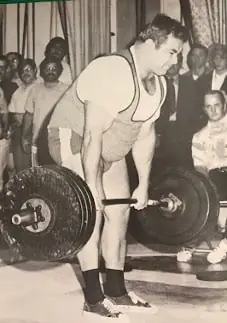
Rawer than raw: Hugh Cassidy stiff-leg deadlifted the 790 pounds needed to beat Big Jim Williams at the inaugural world championships. No supportive suit or lifting belt was used. Hugh bench pressed 570 pounds with a 2-second pause on the chest. He buried an 800-pound squat and “felt confident of 840” had he been granted another squat attempt. He did not miss a single attempt, “not wanting any close misses.”
Original Hugh Cassidy article first published in Muscular Development magazine, 1972.
My friend Steven sent me a copy of an article written by my iron mentor, Hugh Cassidy, and first published in Muscular Development magazine in 1972. I hadn’t read this article in 50 years and the rereading sparked effervescent memory bubbles. Hugh had won the powerlifting world championships in November of 1971. I was not training with Cassidy during this period as I was living in Portland, Oregon; Olympic weightlifting remained my singular focus. In 1972 the clean and press was dropped as one of weightlifting’s three official lifts. The press was my best lift, as a teenage lifter I had set age-group and weight-class national records in the press. I shifted my iron allegiance to powerlifting.
I had met Hugh Cassidy as a teenage Olympic lifter, one that also competed in powerlifting competitions. Hugh was great friends with an iron renaissance man named Glenn Middleton. Glenn figured big in my teen career and would periodically take 17-year-old Marty to training sessions at Cassidy’s home gym in neighboring Prince George’s County. In 1976 I happened to see a note in the Weekender section of the Washington Post announcing that Hugh would be putting on a seminar in College Park.
I attended, he remembered me, and invited me to become one of a select group of powerlifters that trained in the basement of his country home off Highbridge Road in Bowie, Maryland. I spent the next five years training in his dank basement. In 1981 I shifted my training to Mark Chaillet’s brand-new gym in Marlow Heights. We, me and three training partners, emigrated from Hugh’s to Mark’s with Hugh’s blessing: “You guys got too strong for the basement,” he told us.
My first published articles were co-authored with Cassidy, this in 1978. He always admonished me to stifle my natural “bombastic” tendencies. He threw Hemingway in my face a lot: “Use short, terse sentences, practice word economy.” He would repeatedly tell me. Meanwhile I was influenced by Hunter Thompson’s rock-and-roll gonzo stylings. I didn’t want to write in a terse, economical style. I wanted to throw literary hand grenades, write using explosive adjectives: “a tornado towing a circus purposefully set the orphanage on fire...” Cassidy slapped me straight, writing-wise. This article is a good example of his “just the facts told flat” writing style.
Hugh Cassidy’s Original 1972 Article
I was always interested in strength as a kid, mostly the pushup and chin-up variety. I didn't even see a barbell until I was twenty. In high school I used to do fifty pushups every evening before bedtime. I played soccer in high school as our school was too small for football.
First Barbell, First Lessons
I went out for football in college in my junior year weighing 155 pounds. After three practices I discovered that being jumped upon wasn't the type of exercise I wanted. A few days later, I went downtown to buy my first set of weights, a 110-pound barbell set. I remember having trouble taking it home on the streetcar as the box of weight plates weighed 85 pounds and the weight bar another 25. It took two trips, to my embarrassment, to get on the car as it was impossible for me to hold the box in one arm and the bar in the other for but a few feet at a time.
Like an idiot, I did all of the exercises pictured in the instruction manual for the first few workouts. Needless to say, this proved rather exhausting and really nixed the idea of lifting on a regular basis. With hit-or-miss workouts, I ended up one year later with the net gain of one pound, to a bodyweight of 156.
The YMCA Weight Room
I decided then to investigate the local YMCA as I heard they had free-weight equipment there. From out of the swinging door marked “Weight Room” lumbered the most muscular guy I'd ever seen. After a few sips of water from the fountain, he returned to the “Weight Room” and I followed him to the door. I must confess I was a little afraid to enter with beasts of the size I had just seen possibly lurking on the other side. I made myself go in and found myself in the midst of a well-equipped gym.
I joined immediately and asked numerous questions and made enough of a pest of myself to finally get a gaining routine together. In the following six months I gained to 185 pounds. I entered my first bodybuilding contest and luckily placed third in the Mr. YMCA. The following year I repeated and took third yet again.
A lot of things were holding me back, mainly my body. I must be one of the top contenders for the world's smallest calves. I was, and am still, occasionally known as Bird-legs or The Great Blue Heron.
Germany, Milk, and Weightlifting
Another year or two and my bodyweight reached 205. I joined the Army and went to Germany. While there I discovered a wonderful machine. It was a giant stainless-steel box with rubber tubes hanging out. One simply had to lift a weighted handle and milk came out! I put on 46 pounds in six weeks with that box, going from 196 to 242. I averaged seven quarts a day and often drank eight.
Needless to say, I burst out of my army greens, which, luckily, we were only required to wear once a week at a flag lowering. As the pants no longer zipped, I held everything together with a broad belt which was fortunately covered by the long army blouse. I had meanwhile joined a nearby German weightlifting club representing Bingen and was training hard.
I never did get the timing and footwork necessary for Olympic lifting, so my training partner Bill Sibole and I powered everything up. A total of 735 was my best via 260-pound clean and press, 200-pound snatch, 275-pound clean and jerk, all done in 1961.
Discovering Powerlifting
After my military service, I continued training, putting much emphasis on the bench press, which was fast becoming my favorite lift. I was searching for some way to compete in this lift when I heard about powerlifting. In 1965 I attended the National Powerlifting Championships in York and saw the exciting battle between Gene Roberson and Terry Todd in the heavyweight class. Terry Todd won with his final deadlift: he posted a 675-pound squat, a 475-pound bench press, and a 740-pound deadlift for a roughly 1,890-pound total. Gene Roberson was massive: he hit 705-480-700 for 1,885.
I met big Bob Weaver, 5-foot-8 and 340 pounds, and saw several of the other “animals” backstage. I was greatly impressed with the size and power of these men. It was also a memorable evening because on the car ride home I got two flat tires in the space of four miles and had to spend the night on the side of the road outside York.
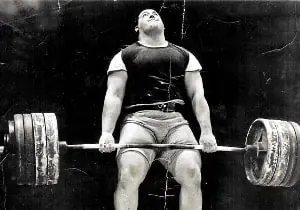
Robert “Big Bob” Weaver.
From First Meet to National Champion
The lifting bug had really bit me, hard. I began to train seriously on all three powerlifts. I entered my first meet in April of the following year in Phoenixville, Pennsylvania, weighing 245. I totaled 1,410 via a 415 bench press, the bench press was the first exercise done in competitions in those early days, a 475-pound squat and a 520-pound deadlift. I won first place.
As I began to progress, I kept training records and meet results, so as to plan my training better and to discover which routines seemed to work best. Much incentive has been given by lifting friends and acquaintances, such as Doug Ramsay and Gene Roberson; two of the biggest, strongest, most muscular guys I ever saw. My training partner, Bill Trueax, has been a big help also. The friends I've found in lifting generally all seem to encourage one another and exchange promising routines and information. That's a big part of lifting to me.
I began to get it all together at the 1969 Junior National Championships in Erie, Pennsylvania. I got lucky and won first with a 1,765-pound, three-lift total, this via a 475 bench, a 615 squat and a 675-pound deadlift. The following year I went up in bodyweight to 278. I took third place at the Senior National Championships at New Orleans. I totaled 2,010, via a 540 bench, a 730 squat and a 740-pound deadlift.
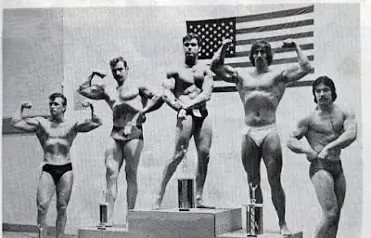
Hugh Cassidy, second from left.
The World Championship and the Cost of Being Big
In 1970 I finally got a big title with a win at the Senior National Championships in Dallas. The total was 2,060 via 560-745-755, this at a 291-pound bodyweight. The World Championships are now over. I'm still floating on cloud nine, somewhere up there with the pollution. I barely edged Big Jim Williams as we tied on totals of 2,160. I was the lighter man; I weighed 296 versus his 341-pound bodyweight. I made lifts of 570-800-790. It could have gone either way, as there are so many variables in a contest. Jimmy upped his world-record bench, 660 pounds, that ought to stand for a long time.
I still plan to continue training, although I'll be very happy to shed some of this excess bodyweight. Although I'm impressed with the “big guys,” I find it isn't easy to be one of them. It takes a lot of sacrifice.
There is the constant sweating, the rashes that last until cooler winter weather; there is frequent acid indigestion, and ever-present diarrhea from all the milk and eggs and protein powder. You have to walk like a duck, or your inner thighs grind each other into hamburger. There are the spinal erectors that go into spasm whenever you walk up a grade.
And of course, the food bill. And the clothes that no longer fit. Big men's sizes are about as tasteful as some guy wrapped up in an awning. Most of my shirts look like I'm still in pajamas. What with the extra naps and the shortness of breath, I've decided to reduce to the 242s again. I've been miserable these last two years, but also very pleased with the gains in power. My training prior to the World Meet was as follows.
Hugh Cassidy’s Pre-World-Meet Training Routine
Monday and again on Friday
| Exercise | Sets and reps |
|---|---|
| Bench Press | 135 x 15, 245 x 10, 345 x 6, 425 x 3, 475 x 3, 510 x 1, 530 x 1 or 2, 545 x 1 |
| Bench Press, paused | 470 x 5, 505 x 3, 525 x 1 or 2, 545 x 1 |
| Squat | 275 x 8, 435 x 5, 560 x 3, 650 x 3, 700 x 3, 725 x 3, 650 x 3, 670 x 3 |
| Deadlift | 335 x 8, 535 x 5, 670 x 2, 750 x 2 |
I don’t believe assistance work has much value for me, therefore I do none.
Wednesday and again on Saturday
| Exercise | Sets and reps |
|---|---|
| Upright Row, press grip, with straps | 185 x 20, 225 x 12, 275 x 8, 205 x 15 |
| Neck Work, with helmet, front | 40 x 25, 60 x 25, 75 x 20, 50 x 4 |
| Neck Work, with helmet, back | 40 x 25, 60 x 25, 75 x 20, 50 x 30 |
Diet, Bodyweight, and the “Hog-Body” Era
The upright rows and neck work are throwbacks to a primeval bodybuilding past. I have gotten my neck size up to 20 ¾ inches. Your neck is big when you sweat behind the ears. My current diet consists of extra cartons, one pint, of milk between breakfast, lunch, and supper. After supper the wife mixes up two eggs, one Carnation Instant Breakfast, two cups of powdered milk with a half-gallon of milk, this in a large container. I sip this mixture that evening while I read, or watch the tube. It's very hard for me to gain, but after I got my tonsils out this last summer and began drinking this concoction, the bodyweight began to move. The nickname changed from “Bird-legs” to “Hog-body” when I attained a 49-plus waist and 295-pound bodyweight. I plan to go back down in bodyweight. If I'm lucky, someday I'll see my belt buckle once again.
Postscript: Hugh reduced his bodyweight down to 195 pounds and stayed there. He went on to compete in physique competitions.
Safety Note for Historical Powerlifting Routines and Diets
This article preserves Hugh Cassidy’s 1972 first-person powerlifting article and Marty Gallagher’s RAW introduction. It is not individualized medical, nutrition, rehabilitation, coaching, or programming advice.
The lifting and diet practices described here belong to an elite historical powerlifting context. Heavy bench presses, squats, deadlifts, upright rows, neck work, maximal attempts, rapid bodyweight gain, large milk intake, and raw-egg mixtures are not automatically appropriate for modern readers.
Use modern safety judgment: appropriate warm-ups, suitable equipment, spotters or rack safeties when needed, secure barbell collars, proper flooring, progressive loading, recovery time, and coaching when appropriate. Raw or undercooked eggs can carry Salmonella; pasteurized products or cooked eggs are safer choices.
Stop or scale back for sharp pain, dizziness, chest pain, unusual shortness of breath, numbness, uncontrolled bar path, repeated technical collapse, severe gastrointestinal distress, rapid unexplained weight change, or any symptom that feels different from normal training effort.
Equipment Notes for Old-School Powerlifting Training
Hugh Cassidy’s story begins with a simple barbell set and ends with world championship powerlifting. The tools remain simple, but modern lifters have better options for safe setup, loading, and training-space protection.
For core barbell work, lifters and facilities can compare Olympic weightlifting bars, weight plates, weight benches, power cages and platform racks, and powerlifting equipment.
Specific tools such as SnapClips barbell collars, IRON COMPANY urethane Olympic grip plates, the Schiek 2006 wide weightlifting belt, IRON COMPANY heavy-duty deadlifting mats, and the IRON COMPANY Iron Cowboy Powerlifting Bar may fit certain modern strength rooms when the product, floor, load, lifter, and intended use align.
The equipment does not create Hugh Cassidy. The discipline, the logbook, the hard training, the recovery, the mentors, and the years under the bar create the lifter.
RAW with Marty Gallagher, J.P. Brice, and Jim Steel Podcast.
About the Author: Marty Gallagher
As an athlete Marty Gallagher is a national and world champion in Olympic lifting and powerlifting. He was a world champion team coach in 1991 and coached Black's Gym to five national team titles. He's also coached some of the strongest men on the planet including Kirk Karwoski when he completed his world record 1,003 lb. squat. Today he teaches the US Secret Service and Tier 1 Spec Ops on how to maximize their strength in minimal time. As a writer since 1978 he’s written for Powerlifting USA, Milo, Flex Magazine, Muscle & Fitness, Prime Fitness, Washington Post, Dragon Door and now IRON COMPANY. He’s also the author of multiple books including Purposeful Primitive, Strong Medicine, Ed Coan’s book Coan, The Man, the Myth, the Method and numerous others. Read the Marty Gallagher biography here.
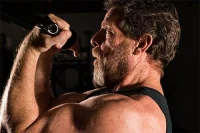
Marty Gallagher is a champion strength athlete, coach, author, and RAW Podcast host known for powerlifting, Olympic lifting, and serious strength training.
