
 Call us today at 1-888-758-7527


Revisiting the Home Gym - Back To Basics For Maximum Gains
Revisiting the home gym means getting back to basics: crude tools, hard training, intelligent floor protection, and a training space with a real purpose. A serious home gym can generate hypertrophy, melt off body fat, build strength, and turn the trainee into a physical monster — all without ever leaving the property.
Revisiting the Home Gym
Rural version of Powerhouse Gym: repping a 600-pound high-bar squat on a homemade wooden home gym outside at 7 a.m. on Saturday in the freezing cold. All that is missing is a lean-to, a sleeping bag, a campfire and a 2.5-pound can of Dinty Moore beef stew for the post-workout recovery meal. This eaten before taking a power nap next to the fire. I grow muscle just looking at this photo.
Most home gyms suck. They have no sense of purpose or focus. Most home gyms are patched-together afterthoughts, a collection of hi-tech cardio machines with burnt-out circuitry and fad resistance devices long since abandoned. Like the Island of Misfit Toys, most home gyms are a pathetic collection of mismatched junk that fell into deserved disuse on account of zero results.
A properly tricked-out home gym in the hands of an athlete that knows what they are doing becomes Vulcan’s Forge: a crude, sweaty laboratory used to recast the human body. The expert use of progressive resistance training triggers hypertrophy and triggers concurrent strength and power gains. The hardcore home gym is all about function and results. Many a world champion strength athlete has rolled out of a garage gym or basement gym already a fully formed world beater.
My mentor, world powerlifting champion Hugh Cassidy, trained himself, and later his national and world champion students, in a dark, dank, unheated basement of an 89-year-old country home. The subterranean gym was damp and claustrophobic with 7-foot ceilings and spiders and centipedes. Cassidy hand-welded squat racks and weight benches to save money. It was like lifting in a Finnish prison.
Why the Best Home Gyms Use Crude Tools
The best home gyms are stocked with raw and primitive tools — barbells and dumbbells — because of their cheapness and because of their effectiveness. Effective progressive resistance training is raw and primitive, and the hardcore elite use crude tools and brutal protocols to dig the deepest possible muscular inroad. The deeper the inroad, the better the results.
When it comes to creating lean muscle mass, no tool or device surpasses properly used barbells and dumbbells. No other tool or device inflicts a deeper muscular inroad than a full range-of-motion, compound, multi-joint exercise using free weights. For optimal results, exquisite techniques are combined with maximum payloads done for low reps using a limited exercise menu.
The inherent instability of a barbell or pair of dumbbells is an actual advantage: the more the athlete struggles to keep a barbell or pair of heavy dumbbells in a tight, strict motor pathway, the more muscle stabilizers are forced into action. From a muscle-building and strength-infusing perspective, the more muscle stabilizers are forced to fire, the better the benefits.
Free Weights vs Machines in a Serious Garage Gym Setup
Progressive resistance machine makers are too clever by half in that they create machines that are so well-constructed, so ball-bearing silky-smooth, so well-padded and downright comfortable that they are the progressive-resistance equivalent of a 6,000-pound Cadillac Escalade, an automotive marshmallow. While an Escalade will produce a test drive that is incredibly comfortable and fun, the actual results are necessarily subpar.
Hardcore kick-ass progressive resistance training is not a Cadillac Escalade. Hardcore resistance training is akin to a 2,200-pound, 427-cubic-inch, 550-horsepower Shelby Cobra. The Cobra is a single-purpose performance monster that will rip your head off if you space out while accelerating. 427 Cobras are not built for comfort; they are built for speed. In hardcore weight training, ease and smoothness eviscerate results. Escalade-like resistance machines are seductive and ineffectual.
Progressive resistance training is not supposed to be made lighter, easier and smoother. Hardcore training, by definition, needs to be brutal. The human body must be shocked into gains. A man does not grow muscle engaging in easy and fun lifting. The effort must be Herculean. Only by continually assaulting current limits and capacities are those limits and capacities extended and exceeded.
The glide-path of a frozen machine groove eliminates the need to control side-to-side movement. The machine user pushes or pulls; no need to apportion any strength toward controlling side-to-side sway. There is no side-to-side sway. This simple fact, that machines eliminate the third dimension of tension, lessens the depth of the potential muscular inroad.
Start with Dumbbells
The most unstable of all progressive resistance training tools are a pair of dumbbells. Begin creating a home gym by starting a serious dumbbell collection. A good collection of dumbbells allows the athlete access to an entire universe of truly effective free-weight exercises. No need to make your dumbbell collection exceed your strength limitations; most normal humans will never need to exceed a pair of 60s. If you outgrow a pair of 60s, then that’s a good day and a great problem to have.
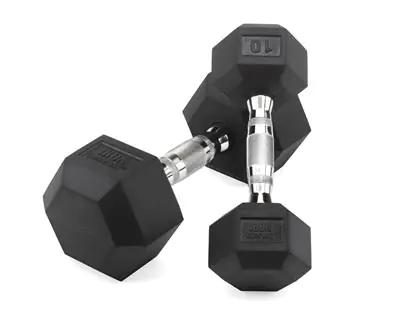
IRON COMPANY rubber hex dumbbells.
A good dumbbell selection would consist of 5, 10, 15, 20, 25, 30, 35, 40, 45 and 50 lb. pairs. Ten pairs can be purchased at once or over a period of time. Once you have your dumbbells, learn the proper technique for all the critical free-weight exercises.
- Legs: super-deep goblet squats, single-dumbbell calf raises done standing on a stair step, and dumbbell stiff-leg deadlifts for hamstrings.
- Delts: standing presses, alternating overhead presses, side laterals, front raises and bent-over lateral raises.
- Arms: curls and single-dumbbell triceps extensions.
- Back: dumbbell rows, dumbbell cleans and dumbbell shrugs.
Dumbbells teach you how to lift while standing on your two feet. Dumbbells teach rootedness and force each arm to carry its fair share. Dumbbells teach stability by being inherently unstable. Dumbbells teach you how to flex the glutes, hamstrings, thighs and abs to provide super-stability for dumbbell pushing and pulling.
Add an Adjustable Weight Bench
My next home gym purchase would be an exercise bench or weight bench, one that inclines. A bench that inclines quadruples the potential dumbbell exercise menu. Now we can do flat dumbbell bench presses, dumbbell flyes, dumbbell incline presses, steep incline presses, seated overhead presses with a back brace, seated laterals and seated dumbbell front raises. Arm exercises include seated dumbbell curls, steep incline curls, and lying and incline dumbbell triceps presses using differing bench angles.
A stable adjustable weight bench is one of the few pieces of equipment that can expand a small training area without turning it into a cluttered mess. In a serious home gym, a bench earns its floor space because it supports the big upper-body movements and dozens of productive assistance exercises.
Buy a Real Olympic Barbell Set and Protect the Floor
Those that want to take home gym training to the next level should then invest in a real barbell set, an Olympic barbell, a seven-foot bar with revolving sleeves. The classic setup is to lay a sheet or two of plywood on the basement or garage floor and set the 315-pound barbell set on the impact-absorbing plywood. Large rubber gym mats, the kind used in horse stalls, are an even better option for protecting your floors and fitness gear.
Good floor protection for heavy lifting is not cosmetic. It protects concrete, wood, equipment, and the lifter’s patience. A garage gym setup that includes an Olympic barbell set, dumbbells, an adjustable weight bench and rubber gym mats already has most of what a serious trainee needs to make progress.
Racks, Cages, and Safety for the Alone Home Trainer
Squats and bench presses require racks. You can get a weight bench with support racks and you can purchase squat racks. Neither comes with spotters: the optimal situation for the alone home trainer is to purchase a power rack. A power rack, or power cage, enables the home trainer to train alone and stay safe.
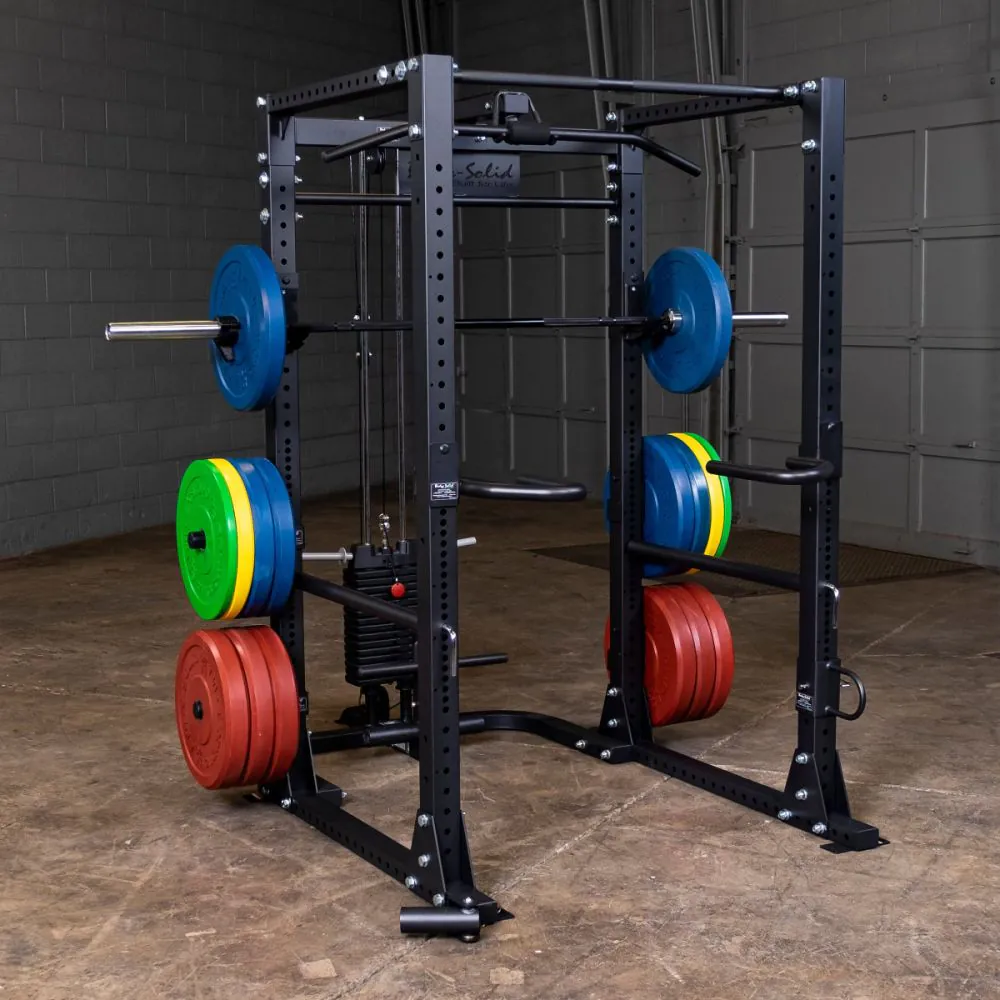
Commercial power cage and power rack for weightlifting.
The power rack or cage is the centerpiece, the altar, of any hardcore gym. The power rack exponentially expands the number of doable hardcore exercises and makes heavy training far, far safer. Hardcore trainers are going to occasionally miss limit-exceeding reps at the end of a ball-busting set of squats or bench presses.
Woe be onto the exhausted lifter that gets pinned beneath a 300-pound bench or 400-pound squat. The alternative is always playing it safe and never going for those questionable reps — which is where all the power, strength and muscle-size gains lay. Not doing questionable reps is throwing away muscle and growth. Doing them without spotters is deadly.
My Own Home Gym Setup
My own home gym occupies a 15 x 15 square-foot area in my unheated, detached garage. I have a barbell, an adjustable bench, a power rack and a good selection of dumbbells. I can front squat, back squat, perform various flat and incline benches, deadlift, overhead press, seated front and behind-the-neck press, chin, do pullups, rows, power cleans, rack work and shrugs. I can set the pins in the power rack and do limit squats and bench presses safely.
In the squat, I set the pins an inch or two below my descent turnaround point; in the bench press, I set the pins slightly below where the barbell impacts the torso. If I miss a squat, I ride the bar down to the pins and crawl out; if I miss a bench, I ride the weight down to my chest, deflate and wiggle out from underneath.
While my hardcore setup is ideal for a garage, a basement or even a ground-floor room in a single-family detached home, I wouldn’t be doing any deadlifts in an apartment or on an upper floor of a building. My current setup would be a little too much for an apartment dweller or someone on an upper floor.
I love my ultra-simplistic home gym and use it all the time. I can use it anytime I want, when I want, with no compromise in workout quality and no holding back for lack of spotters. I don’t have to get in a car and drive anywhere. I don’t have to interact with other humans. I can get centered and focused without interruption or distraction. I like the Zen of home-alone training. I like that ability to have a sudden urge to train and be able to scratch that itch without having to change and drive to a public facility.
I listen to music when I train. I use it as an attention-focusing device. I need total focus when I am tying into limit-exceeding top sets. When training at home, there is no danger of distraction.
Back to Basics for Maximum Gains
I would give home gym training a second look. The investment is minimal and crude tools — barbells, dumbbells, power racks — last forever. Those that are serious can obtain serious results without ever leaving the property. When you finally burn out training at commercial facilities, consider creating a serious home gym. Home gym training engenders highly focused training that uses real methods and real tools to obtain real results.
For readers comparing broader strength training equipment, keep the hierarchy clear: buy what supports hard, progressive training and avoid turning the room into the Island of Misfit Toys. Some trainees may want a more packaged station, such as the Body-Solid Series 7 Smith Machine Package, but the old-school lesson remains the same: tools only matter if they are used hard, safely, consistently and intelligently.
Shopping for home gym equipment? Consider IRON COMPANY for your next purchase.
Safety Note for Home Gym Training
Home gym training can be productive, focused, and convenient, but it also requires careful setup. Heavy squats, bench presses, deadlifts, overhead work, and limit attempts should be matched to the lifter’s experience, technique, flooring, ceiling height, spotter availability, and safety equipment. This article is educational and should not be treated as personalized medical, rehabilitation, or programming advice.
Frequently Asked Questions
What is the most essential home gym equipment?
The most essential home gym equipment starts with dumbbells, a stable adjustable bench, an Olympic barbell set, weight plates, rubber gym mats or other floor protection, and ideally a power rack or cage for safer squats and bench presses.
How do you build a home gym from scratch?
Start with a clear purpose. Marty Gallagher’s approach is to begin with dumbbells, then add an adjustable weight bench, then a real Olympic barbell set, proper floor protection, and finally a rack or cage that allows serious training without depending on spotters.
Are free weights better than machines for a garage gym setup?
For Gallagher’s old-school strength approach, free weights are the superior starting point because they require stabilization, balance, control, and full-body tension. Machines can have a place, but they should not replace the crude tools that build real strength.
What is the best floor protection for heavy lifting?
Heavy lifting needs flooring that can absorb impact and protect both the structure and the equipment. Plywood can work in a simple basement or garage setup, while heavy rubber gym mats are often a better long-term option for floor protection.
Do I need a power rack in a home gym?
A power rack is not the first item every person buys, but for a serious alone home trainer it becomes central. It allows squats, bench presses, rack work, overhead work, and missed reps to be handled far more safely than free-standing improvised setups.
Can a simple home gym build serious muscle?
Yes. A simple home gym can build serious muscle if the lifter uses basic tools with hard effort, sound technique, progressive loading, good recovery, and consistency. The equipment does not have to be fancy; it has to be useful and used correctly.
About the Author: Marty Gallagher
As an athlete Marty Gallagher is a national and world champion in Olympic lifting and powerlifting. He was a world champion team coach in 1991 and coached Black's Gym to five national team titles. He's also coached some of the strongest men on the planet including Kirk Karwoski when he completed his world record 1,003 lb. squat. Today he teaches the US Secret Service and Tier 1 Spec Ops on how to maximize their strength in minimal time. As a writer since 1978 he’s written for Powerlifting USA, Milo, Flex Magazine, Muscle & Fitness, Prime Fitness, Washington Post, Dragon Door and now IRON COMPANY. He’s also the author of numerous books including Purposeful Primitive, Strong Medicine, Ed Coan’s book “Coan, The Man, the Myth, the Method" and numerous others. Read the Marty Gallagher biography here.
Marty Gallagher is a champion strength athlete, coach, author, and RAW Podcast host known for powerlifting, Olympic lifting, and serious strength training.
