
 Call us today at 1-888-758-7527

Coaches Coach - Real Results
Real coaching requires real results for real people on a regular basis. Marty Gallagher’s point is blunt: a coach needs objective feedback from flesh-and-blood trainees, not theory, posturing, or a polished sales rap. Effective coaching methods are shaped, tested, corrected, and refined by results. If the trainee gets no results, the method has no report card.
Coaches Coach - Real Coaching Requires Real Results
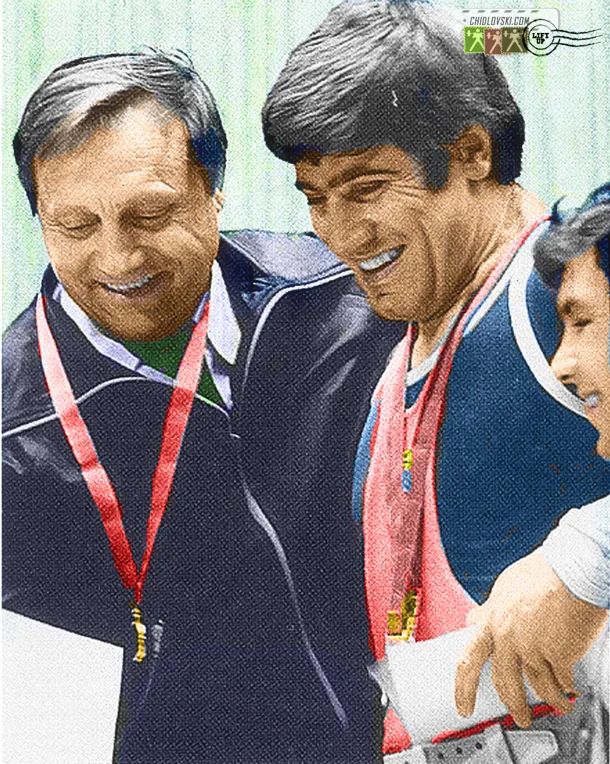
The greatest Olympic weightlifting coach of all time, shown above, was Rudolph Plukfelder. At his famous Trud Voluntary Sports Academy — as opposed to involuntary? — he created a succession of Olympic champions like Vasily Alexeev, David Rigert, Nikolay Kolesnikov, Aleksandr Voronin, Viktor Tregubov and Aleksey Vakhonin. As a competitor he won world titles in 1959 and 1961 and he was the Olympic champion in 1964. Alexeev set more world records than any man in history, 80.
The second highest is 63 world records — done by Rigert. What a tribute to Rudolph’s coaching.
Every Sunday I drive 30 miles to coach a bunch of local dudes for free. Part of it is giving back. When I first started out, I had a lot of high-level lifters take time with me and give me great information; they helped me when I was ignorant. My old martial arts coach Robert Smith used to run a free-to-the-public tai chi class every Saturday morning at 7 a.m. Smith figured only the serious would show up at 7 a.m. on a Saturday. He was right. I suppose I am carrying on some of that same tradition.
The knowledge I share is body changing and life changing. Or, more accurately, it can be if the trainee implements what we teach with the appropriate ferocity and tenacity. We teach highly specific techniques and our modes and methods, our techniques and tactics, plus empirical updates and subsequent modifications and innovations.
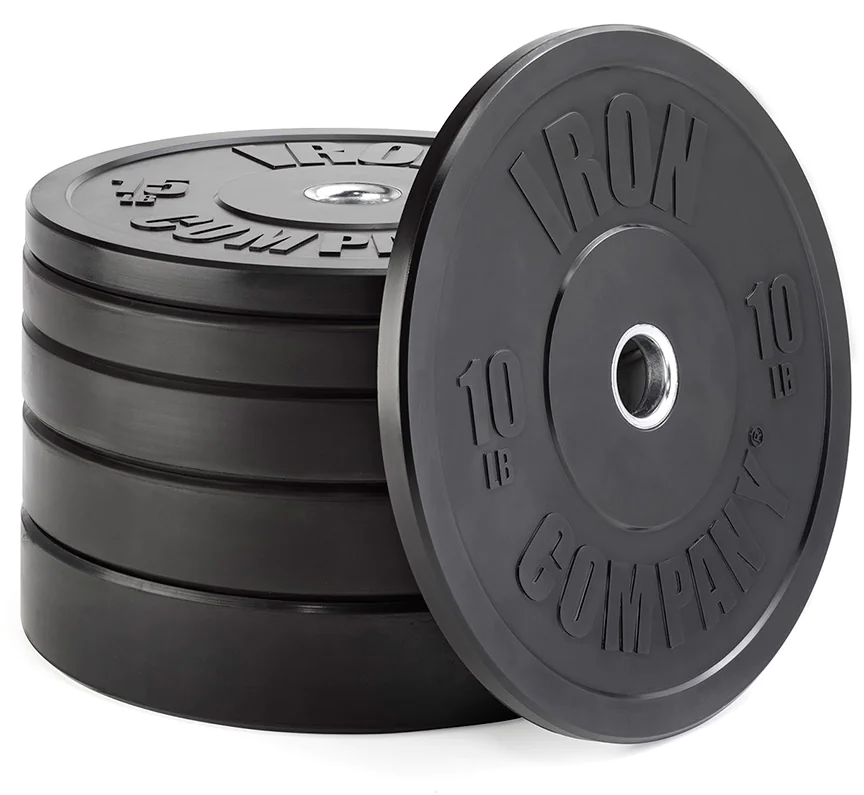
IRON COMPANY rubber bumper plates.
My old compatriot Kirk Karwoski, world champion and world record holder, joins in our Sunday morning sessions on a regular basis. Our goal is something quite profound: to radically transform the human body. This is done by establishing periodized, preplanned strategies in four distinctly different, yet interrelated disciplines: progressive resistance training, cardiovascular training, nutrition and “brain-train,” i.e., addressing the psychological aspects of the transformative process.
The Goal Is Always Improvement
The goal is always the same: to improve on our current physical state-of-being. By systematically implementing a periodized plan of attack in four areas, simultaneously, the human body can be molded and shaped, made stronger, leaner, healthier, and fitter. All at the same time. With time and methodical application, muscle is built and body fat is burned.
Good coaching is all about teaching battle-tested methods to athletes that will implement and adhere. Good coaching is all about what to do when progress comes to an inevitable screeching halt. A great coach has a huge trick bag full of stagnation-busting tweaks, tricks-of-the-trade that they’ve accumulated over the years and can be pulled out and used to unstick a progress logjam.
The four disciplines are pursued simultaneously and tweaked as needed. The eternal goal is the same: add lean muscle mass, lose body fat. Getting stronger in the core four — squat, bench press, deadlift, overhead press — adds muscle. Coordinating serious cardio with disciplined eating is a proven old-school way to help mobilize and oxidize stored body fat when the plan is performed properly and consistently.
Real Coaching Means Real Case Studies
To a man, the regular men I work with every Sunday get results and get them on a consistent and ongoing basis. Each man is a case study. I consider everything I know about them as a person as I plot the next move. I adjust their lifting, advise them what to do nutritionally, request they get serious about cardio, coddle them, kick their ass — whatever is appropriate.
I use elemental child psychology as I exhort them to continually storm the barricades of their current limits and capacities.
My coaching challenge is to offer the stalled athlete the right tweak at the right time. Because of my longevity, I have a big trick bag to select from. I have many potential progress stimulators to pick from.
The validation of your coaching is the radical physique and performance change of your students. Competitive formats are the best place to find out if methods are working. Our trainees enter powerlifting competitions to test strength. What better place to get your report card than in the cold competitive spotlight in front of judges? All types of formal competition are encouraged.
Peer Pressure and Weekly Accountability
Part of our athletes’ success is due to the dynamic of peer pressure. When we train, each man lifts as the others spot or watch. Everyone, regardless of level, is expected to equal or exceed last week’s effort. The eternal goal is to improve on what we did the previous week. The pressure to do well in front of other alpha males, whose opinions you value, is a surefire performance booster.
Like waves pounding on rocks, each successive week our lifters stack one quality workout atop another. Over time, and with constant and continual repetition, the body is transformed. The coaching feedback is critical: a real coach can consistently riddle ways to spark progress where none currently exists.
Real coaches need real feedback from regular people on a regular basis. Those that adhere to the tenets of what you preach are flesh-and-blood report cards: do the methods selected work in the real world? Yes or no?
The Difference Between Real Coaches and Faux Experts
Faux experts avoid real world coaching, preferring instead to write, speak or pontificate. That way there is no report card. If there is no report card, all methods are equal and those with the best rap, the biggest lie, the most exaggerated promises always win. When there are report cards this type is tapping out in ten seconds.
Real results matter and real coaches coach. The pro wants and needs the objective feedback that only comes when working with real people. Truly effective modes and methods are shaped, molded and refined by obtaining results. Results guide our efforts. If you get no results your efforts are never guided.
Effective methods need be fluid and evolving. Effective methods are always guided by results. Pedantic methods, dogmatic and frozen strategies are championed by fundamentalists. Those that champion dogmatic systems seek no new input: their methods are complete and perfect and in no need of any new data. Fundamentalists have no need of report cards or objective feedback.
For a real coach, someone working with dedicated people, results are everything — or they should be. The diligent trainee working with a coach should expect mild results within two weeks and tangible results in strength and body composition by the end of the first month. By the end of the second month of full-on adherence, friends and family will often notice and comment on the visible physical changes.

IRON COMPANY powder coated kettlebells.
Radical Physical Transformation
Those that are locked down and stay true to preplanned strategies in the four interrelated disciplines can experience what we term a radical physical transformation. What defines a radical physical transformation? A significant increase in lean muscle mass and an equally significant decrease in body fat.
Strength increases trigger muscle size increases. Disciplined power eating combined with systematic cardio exercise is the key to controlling body composition, i.e., shedding body fat while simultaneously retaining or, optimally, adding muscle. Adding muscle while shedding body fat is the highest form of the transformative arts and naturally requires the greatest and highest degree of discipline and perfection. No one casually builds lean muscle mass. No one casually sheds body fat.
Remote Coaching and Video Feedback
If you don’t have access to good local coaching, consider remote coaching. Modern hi-tech can put the coach in the gym with the lifter as they perform their gym efforts. I do a lot of remote coaching with folks in this country, Europe and Australia: the phone camera is the greatest advance in the history of remote coaching.
I have the athlete shoot a video of their gym efforts. With a video, I can draw my own conclusions, the same ones I would have drawn if I’d been in the gym with the athlete. Assuming the phone camera is positioned optimally on the various lifts, I can see everything I need to see. Video enables me to judge the degree of difficulty. I can plainly see how hard or easy the set was. I can assess technique and generate an overall impression that guides me in selecting next week’s rep and poundage targets.
With a new client, I establish a series of baselines and benchmarks. Each week I create goals to attain in a variety of categories. One example:
| Date | Front Squat | Dumbbell Bench | Kettlebell Deadlift | Dumbbell Overhead Press | Cardio | Bodyweight |
|---|---|---|---|---|---|---|
| 4-2-20 | 95 x 5 | 30s x 8 | 65 x 8 | 20 x 8 | 3 x week | 170 lbs. |
Each successive week the goal is to nudge performance ever-so-slightly upward in each category. Bodyweight is maneuvered downward or upward, depending on current body composition and overarching goals.
A typical cycle lasts 12 weeks, three full months, and allows the trainee to undergo a four-week initial phase of acclimatizing. The middle four weeks are when the real work begins. The final four weeks are when the big gains come to fruition as momentum is achieved and a physical synergy attained. During the final month, gains can exceed realistic expectations. This is not magic or alchemy.
Those interested in remote coaching with me can contact IRON COMPANY.
Safety Note for Coaching and Physical Transformation
Coaching, strength training, body-composition work, cardio, nutrition changes, and remote technique review should be scaled to the trainee’s experience, health profile, recovery capacity, training age, and current ability. A good coach should help select realistic goals, appropriate loads, sound technique, and sustainable progression. This article is educational and should not be treated as personalized medical, rehabilitation, nutrition, or programming advice.
Frequently Asked Questions
What does “coaches coach” mean?
“Coaches coach” means real coaches work with real people and accept real feedback from results. Marty Gallagher’s point is that coaching methods are validated by the progress of actual trainees, not by theories, promises or clever sales language.
Why are real results important in coaching?
Real results give a coach a report card. If trainees consistently improve in strength, body composition, performance and adherence, the coach has evidence that the methods are working. If there are no results, the method needs to be questioned.
What are the four disciplines in Marty Gallagher’s coaching model?
The four disciplines are progressive resistance training, cardiovascular training, nutrition and brain-train, meaning the psychological side of transformation. Gallagher views them as separate but interrelated disciplines that must be planned and adjusted together.
How does peer pressure help training progress?
Peer pressure can raise effort and focus. When a lifter performs in front of training partners who spot, watch and expect improvement, the session often becomes more serious and intense than solo training.
Can remote coaching work for strength training?
Yes, remote coaching can work when the athlete records clear training videos from useful angles. Gallagher uses video to assess technique, judge difficulty, and plan the next week’s rep and poundage targets.
What makes a good strength coach?
A good strength coach teaches battle-tested methods, adapts when progress stalls, studies the individual lifter, uses objective feedback, and keeps refining the plan based on results. The coach must be able to help real people progress in the real world.
About the Author: Marty Gallagher
As an athlete Marty Gallagher is a national and world champion in Olympic lifting and powerlifting. He was a world champion team coach in 1991 and coached Black's Gym to five national team titles. He's also coached some of the strongest men on the planet including Kirk Karwoski when he completed his world record 1,003 lb. squat. Today he teaches the US Secret Service and Tier 1 Spec Ops on how to maximize their strength in minimal time. As a writer since 1978 he’s written for Powerlifting USA, Milo, Flex Magazine, Muscle & Fitness, Prime Fitness, Washington Post, Dragon Door and now IRON COMPANY. He’s also the author of numerous books including Purposeful Primitive, Strong Medicine, Ed Coan’s book “Coan, The Man, the Myth, the Method" and numerous others. Read the Marty Gallagher biography here.
Marty Gallagher is a champion strength athlete, coach, author, and RAW Podcast host known for powerlifting, Olympic lifting, and serious strength training.
