
 Call us today at 1-888-758-7527

Torpor Jerking and the Fall Campaign
Alone Dieting, MCTs, and “Nothing but Explosive!”
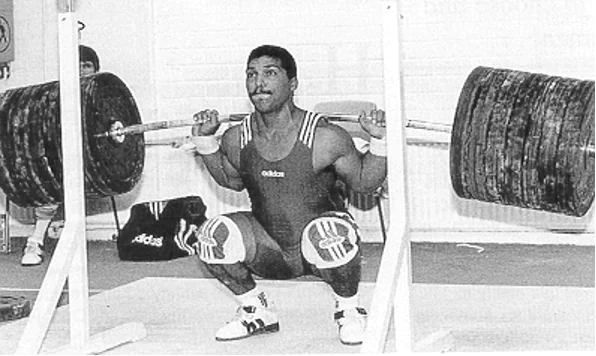
The original article identifies the featured photo as Cuban world champion Roberto “Tony” Urrutia squatting 644 pounds for a raw double, ass-on-heels, with no weightlifting belt. The plates on the whippy Olympic bar are about to reverse direction. He is bottomed out and about to latch onto the rebound, catch the upward momentum, and ride it to lockout, creating an explosive concentric. Note no spotters. Old Iron Game photo captions like this need to be treated as historical context, but the lesson is still spectacular: controlled eccentric, violent rebound, explosive finish.
Jerked Out of Torpor
As Picasso is often credited with saying, “Periodically, a man needs to be jerked out of his torpor.” The dictionary defines torpor as a state of mental and physical inactivity characterized by sluggishness or lethargy. A month ago, I sought ways to jerk myself out of my own self-diagnosed torpor. In transformational training, torpor is synonymous with inertia, stagnation, sameness, boredom.
I had a good summer insofar as training and progress, but summer was over, and I felt burnt out and bored. I needed something new, fresh, exciting. I wanted to set off in a new, radically different direction — but what was that direction? I had mined a particular vein of progress for months and it had now run dry. It was a great run while it lasted, but what was formerly productive was now played-out and stale. Change was in order — but change to what?
A confluence of events, a series of unrelated happenings, combined to inspire a new and wildly different approach for the fall campaign. I was mentally recharged and fired up about this strange new direction I would take.
Nutrition: The Alone Spark
My nutritional inspiration came from the most unlikely of sources, a reality TV show. I had been a fan of the survivalist reality TV series Alone for many years. Recently, it hit me like a thunderbolt that the show demonstrated, in extreme form, what happens when modern food choices vanish, daily activity becomes unavoidable, and the menu narrows to protein, fat, fiber, berries, and whatever nature grudgingly provides.
This was not a controlled diet study. It was a survival show. Still, the lesson was impossible to miss. Alone contestants live in harsh wilderness, self-document the experience, build shelters, hunt, fish, haul, gather, freeze, walk, work, and suffer. There is no drive-through, no pantry, no beer, no pizza, no chips, no convenience food, and no late-night grazing.
Alone contestants are forced to live far closer to our hunter-gatherer ancestors than to our modern supermarket selves. The food choices become radically restricted. Protein sources are prized. Fat sources are prized even more. Fiber carbs, berries, mushrooms, and wild plants can help, but they rarely provide enough energy by themselves.
The Soft Machine, the human body, can run on many mixtures of fuel. In the Alone environment, refined carbohydrates are gone and total calories crash. The body is pushed toward using stored body fat, but if the deprivation goes too far, strength, muscle, mood, and health all decline.
There is a definite exercise component. Alone contestants must bust ass every day, regardless of whether they have eaten. There can be no pause in chopping wood, hauling water, constructing a winter-proof shelter, improving that shelter, hiking for miles, hunting, checking snares, making time to fish, busting holes to go ice fishing, or building fires. The exercise never ends.
At the end of the 7th season, nearly 100 days in, three contestants remained. Temperatures were savage, food was scarce, and each survivor was deep inside a physical and psychological ordeal. Was there any way that I could replicate a civilized, safer version of this? Could I create my own Alone-inspired dietary template and hold the course for 45 days?
My Fall Campaign Nutrition Plan
My game plan was to shift from my usual carb-fed metabolism toward a lower-carbohydrate, higher-fat, higher-protein approach by reducing non-fiber carbs to 50 or fewer grams per day and doing all my eating within a four-hour window: from 3 p.m. to 7 p.m.
I would take MCTs in supplemental form twice daily, early morning and again around noon. I would revamp my weight training and continue using sprinting as my primary cardio.
This was my personal experiment, not a universal prescription. Low-carbohydrate dieting, time-restricted eating, and MCT supplementation are tools. They are not magic and they are not appropriate for everyone.
I would use my resistance training and cardio exercise to create a slight, continual exercise-induced caloric deficit. The idea was to make the body, deprived of easy carb fuel, draw down stored body fat. Taken too far, however, fat burning can morph into lean-tissue loss. What I call muscle-cannibalism is the horrific state wherein the starving body begins stripping muscle cells of amino acids to feed itself.
There is a catabolic tipping point where optimal fat loss tips over into loss of performance, energy and muscle. This is to be recognized and avoided. Adhere to Simple Simon tenets for 30 to 45 days, lean out, then bail out before catabolism and muscle loss take root.
The Sickness-Fast That Launched It
Right about this time, Stacy caught a wicked cold, brought it home and gave it to me. This particular strain knocked me down, and as is my habit when I get sick — which is exceedingly rare — my default strategy is to stop eating. I lose my appetite and go with it.
On the rare occasion I catch a cold, I usually shake it and normalize within 24 to 48 hours. This one hung on longer.
At the end of my third day with the cold, I realized I had not eaten solid food in 96 hours, and I had not really missed it. Food had been the last thing on my mind. I had a few protein shakes, one a day, but other than that, nothing but water, coffee, and some of Stacy’s tea remedies.
My light-bulb moment occurred when it hit me that I was four days into an Alone diet replication. I was sick and not noticing that I was barely eating. As I came out of the sickness at the end of day four, I used my sickness-fast to launch my Alone diet.
That was my circumstance, not a recommendation to deliberately get sick, stop eating for four days or use illness as a diet tool. The dietary tenets were simple: eat sparingly, eat narrowly, keep carbs low, and eliminate beer.
Three weeks, 21 days in, my bodyweight dropped from 208.5 to 197.2. My energy was incredibly good until about two hours before fueling up at 3 p.m., when I would have a predictable energy nosedive. I tried using MCTs to offset the afternoon drop. I was still fired up. I felt as though I was just getting started. I did not feel that I had totally shifted into a full-fledged fat-burning metabolism.
Weight Training: No More Grinding
I needed a fresh direction in my weight training. I saw video of myself and noted how sluggishly I was moving the reps on all my top sets. I would make my target poundage and my reps, but I had lost all my snap. All my top sets, regardless of the lift, were grinders.
I was stuck in low gear. I still had a lot of torque, but I had become a dump truck when I used to be a 427 Cobra.
My light-bulb moment occurred while watching Kirk Karwoski squat and deadlift. Despite being 54, Karwoski, six-time IPF world champion and world record holder, still ripped 650 from the floor to lockout in a split second. His squats were cookie-cutter: a tightly controlled, coiled descent, followed by an always-explosive concentric.
Look up the phrase “compensatory acceleration” in the dictionary and Kirk’s picture should be next to it.
Kirk Karwoski and Compensatory Acceleration
How does he do it? How is it that he is always explosive? As his lifelong coach, his only coach and the man who introduced him to the concept of compensatory acceleration, I feel uniquely qualified to comment: Kirk is always explosive because he has rewired his neuro-circuitry. He is programmed to explode at launch. Every rep he does is performed with characteristic explosiveness.
Over the past three years, Kirk and I have trained together in sixty or more weekly sessions and never once did I see him grind a weight or a rep. Nor did I ever see him perform more than five reps in the barbell squat, bench, or deadlift. Usually he did singles and doubles in the squat and deadlift, all done super-fast. He could move 650 faster in the deadlift than any of us could move 135.
I decided to go back to kindergarten in all my resistance training lifts. I took a vow that I would not allow myself to grind. I would explode the concentric on every single rep. The instant any grind appeared, that set was curtailed.
Naturally, my poundage took an ego-crushing plummet. I was good at grinding. But I was at a grinding dead end. I needed a radical change. If I were to rocket up reps Karwoski-style, I would be forced to use embarrassingly light weights.
The SPEED Cue
Still, it was exciting as hell and really different. My techniques, after 60 years of immersion, were fine, so I could dedicate 100% of my training focus to exploding the concentric.
This would be accomplished by staying 100% mindful during the set. On every rep, I would use an internal mental command, a single word yelled internally at that exact instant when eccentric becomes concentric. That single word, yelled at the top of my internal voice, was:
SPEED!!!
I would use perfect technique, a full range of motion, a coiled eccentric followed by an explosive concentric, always initiated with the Speed! command. No grinding allowed — for now.
Lighter poundage handled with greater velocity complemented the Alone eating strategy perfectly. Now the game was not grinding out massive poundage. The name of the game was moving lesser payloads as fast as humanly possible.
This type of training requires that I remain mindful on every rep of every set. The instant I space out or get distracted, I forget to give the Speed! command. This approach has reinvigorated my resistance training. I got it going on. I will post periodic updates. Three weeks in and results are making redoubling efforts easy.
Equipment Notes for the Fall Campaign
The fall campaign described here is built around two ideas: sharpen the nutrition and sharpen the bar speed. The nutrition piece is a personal experiment. The lifting piece requires dependable equipment, clean loading, and an environment that allows the lifter to move the bar with intent.
For barbell training, lifters can compare Olympic weightlifting bars, weight plates, and barbell collars. Explosive pulls, cleans and other dynamic barbell work are better matched with appropriate bumper plates, platforms, and collars than with loose plates and questionable flooring.
IRON COMPANY premium rubber bumper plates are one option for Olympic-style loading when used on an appropriate surface. A general-purpose bar such as the CAP Barbell 7-foot chromed Olympic weight bar should be used within its stated specifications. Lifters who use a belt can compare options such as the IRON COMPANY Best Fit leather powerlifting belt, remembering that a belt supports bracing skill; it does not replace technique.
The equipment does not create explosiveness. The lifter creates explosiveness. The tools merely give the lifter a place to practice it honestly.
Safety Note for Fasting, Low-Carb Dieting, MCTs, and Explosive Training
Low-carbohydrate dieting, time-restricted eating, MCT supplementation, fasting, sprinting and explosive resistance training are not appropriate for everyone. People with diabetes, kidney disease, heart disease, eating-disorder history, pregnancy, medication concerns, underweight status, major medical conditions, or unusual fatigue should seek qualified medical or nutrition guidance before making major changes.
Do not deliberately replicate a sickness-fast. Do not use illness as a fat-loss tool. Stop training or dieting aggressively if you experience fainting, chest pain, confusion, severe dizziness, heart palpitations, severe weakness, uncontrolled mood changes, rapid unintended weight loss, binge-restrict cycles, or training performance that collapses.
Explosive lifting should still be technically controlled. Stop a set when bar speed collapses or position breaks. The goal is not reckless speed; the goal is clean, mindful, aggressive acceleration.
About the Author: Marty Gallagher
As an athlete Marty Gallagher is a national and world champion in Olympic lifting and powerlifting. He was a world champion team coach in 1991 and coached Black's Gym to five national team titles. He's also coached some of the strongest men on the planet including Kirk Karwoski when he completed his world record 1,003 lb. squat. Today he teaches the US Secret Service and Tier 1 Spec Ops on how to maximize their strength in minimal time. As a writer since 1978 he’s written for Powerlifting USA, Milo, Flex Magazine, Muscle & Fitness, Prime Fitness, Washington Post, Dragon Door and now IRON COMPANY. He’s also the author of multiple books including Purposeful Primitive, Strong Medicine, Ed Coan’s book Coan, The Man, the Myth, the Method and numerous others. Read the Marty Gallagher biography here.
Marty Gallagher is a champion strength athlete, coach, author, and RAW Podcast host known for powerlifting, Olympic lifting, and serious strength training.
