
 Call us today at 1-888-758-7527

Chocolate-Covered Resistance Training Factoids
Marty Gallagher’s chocolate-covered factoids are short, hard-hitting observations on resistance training, nutrition, cardio, and the psychological side of physical transformation. The tone is old-school, the advice is direct, and the through-line is simple: serious results demand serious effort, basic tools, honest self-assessment, and time spent under free weights.
“The abdomen is the reason why Man does not easily take himself for a God.”
Even Friedrich Nietzsche craved ripped abs. The quote above appears in Nietzsche’s Beyond Good and Evil. It is the 141st epigram in Part IV of his philosophic treatise of factoids. It reveals a body-consciousness on the part of the 19th century’s most widely read philosopher that has, heretofore, been overlooked.
Nietzsche often thought in short, free-standing bursts that led to nothing further, yet he deemed them too insightful to throw away. The epigram section in Beyond Good and Evil contains reflections on subjects that caught his attention to the point that he wrote down his thoughts and observations in his journal.

Friedrich Nietzsche — Beyond Good and Evil
There are a lot of important transformational tips, techniques, and tactics that can be compressed into epigram soundbites. Norman Mailer called these shrunken topics “chocolate-covered factoids.” Here are a few chocolate-covered factoids of thought on a wide range of topics: strength, fitness, nutrition, psychological aspects, and ideas related to the transformative process.
Chocolate-Covered Resistance Training Factoids
1. Every Foodstuff Other Than Protein, Fat, or Fibrous Carbohydrate Is Undigested Sugar
Bodybuilders, the world’s greatest dieters, will center their regular food eating around lean protein and fiber carbs. Fat and natural starch carbs are manipulated, in conjunction with intense and frequent exercise, to help push the body toward using stored body fat. The lesson is not fancy. The lesson is control. Know what you eat, know why you eat it, and make nutrition serve training instead of letting appetite drive the bus.
2. Learn to Love Dumbbells
The elite transformational athlete periodically burns out on the classical exercises. One surefire remedy is switching to dumbbells. This is a proven stagnation buster. If a man hits the wall barbell benching, a 4 to 6-week dose of dumbbell-only flat benching is a proven way to overcome inertia.
Dumbbells force each arm to carry its fair share. Dumbbells cause maximum activation of muscle stabilizers. Dumbbells are narrow grip, ergo, maximally beneficial for building bench press finish power. Dumbbells can be used on all upper-body movements: flat and incline pressing, seated and standing overhead presses, rows, curls, and triceps exercises standing, seated, or lying. Dumbbells allow for left-right alternating reps. Learn to love dumbbells.
3. Make Room for Overhead Pressing
Too many progressive resistance trainees don’t do any overhead pressing. If they do, it will be on a press machine. Overhead or incline pressing on a machine is the lite beer of progressive resistance training. Standing or seated overhead barbell or dumbbell pressing is scotch whiskey.
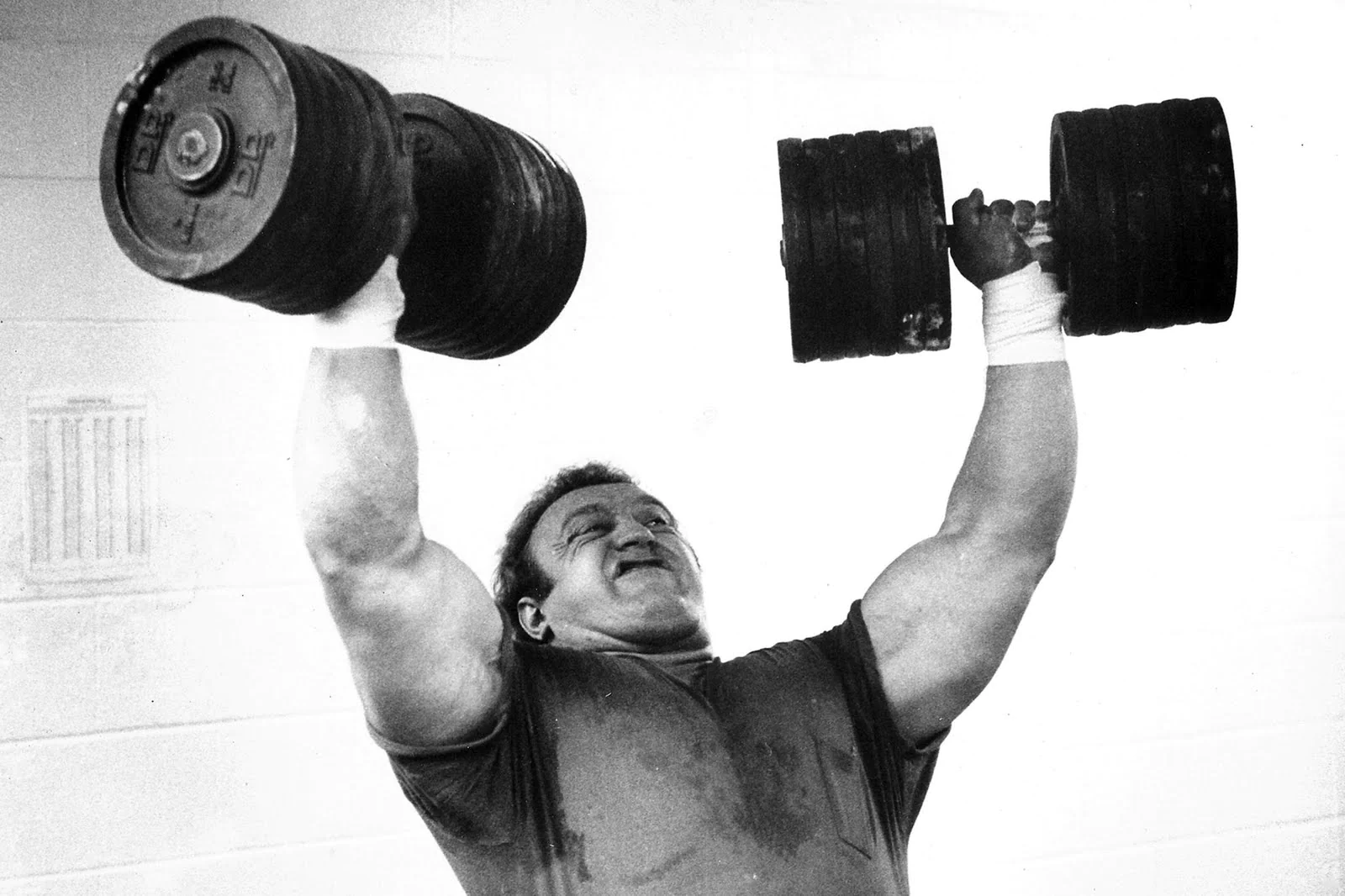
Guys like Kaz, Pat Casey, and Terry Todd could do seated barbell front presses with 400-470 pounds. The press-behind-the-neck is another proven shoulder builder. Ed Coan could do 400 lbs. in the power bar press behind the neck. Dumbbell pressing, seated and standing, is also highly recommended.
4. Strength Training and Cardio: Not One, Not the Other, Both
Two distinctly different exercise formats need to be included in every serious transformative training regimen: strength training and cardio. One taxes the external musculature while the other taxes the internal organs. These two intense exercise types are underpinned and supported with nutrient-dense eating.
Beware of those that tell you they have a system that allows the athlete to train strength and endurance simultaneously. These “hybrid” systems are invariably ineffectual. Make room in your life for two distinctly different types of exercise.
5. Prison Training Can Teach Us a Lot
One incredibly successful control group is the American prison population. When it comes to building muscle, power, and strength, inmates are leading the way, obtaining incredible results, far superior, demonstrably superior, to the vast majority of high-paid, elite personal trainers.
The prisoner is confined to raw tools: barbells, dumbbells, a weight bench, maybe a squat rack, pull-up bar, dip bars, and for cardio, your feet, running the yard. This forced minimalism turns out to be an advantage. Secondly, prisoners are consistent: they never miss workouts. They train often and in short bursts.
They have the worst nutrition in the world, yet they create monster physiques eating bologna sandwiches and ramen noodles. The astute modern trainee should take a lesson from these master trainers, men that transform themselves training outside in February in Ohio, lifting hard and heavy every day, using nothing but Old School exercises in short intense sessions. Psychologically, the inmate gives 110% in every session because they train in front of men whose opinions they value.
6. Don’t Waste a Lot of Time on Dinky Exercises
Too many trainees fall in love with certain exercises, and 90% of the time they fall in love with the wrong exercises. No one ever built a monster body doing lateral raises, lying leg curls, triceps kickbacks, cable crossovers, leg extensions, pec-dec, or the curl machines.
Men have gotten massively muscular, and continue to do so, performing squats, bench presses, deadlifts, overhead presses, rows, dips, and power cleans. Yet, head to the local YMCA or Health Club on a packed Saturday morning and what exercises are the mob performing? All the useless movements, with the most favored being the comfortable exercise machines the members can sit or lie down on while “strength training.”
7. Don’t Be Talked Out of Real Results
Anyone that listens to an expert, hires a personal trainer, or purchases a fitness book touting a system has a right to expect the promised results. Every fitness system or expert has front-end promises: “use my system and see sensational results.”
It is reasonable to expect that if you adhere to the expert’s protocols with due diligence for the prescribed period, the results promised will be delivered. 95% of all fitness-related systems, including diet, over-promise and under-deliver. Hold experts accountable for their promises.
How do you determine if a system or expert is legitimate ahead of time? Check the expert’s credentials. Does the expert have any academic credentials? Does the expert have any athletic credentials? Has the expert created any champions? Does the expert have a long list of transformed clients?
8. Learn How to Cook
An athlete cannot depend on mom, the girlfriend, or restaurants to provide the continual stream of power food needed to fuel the human body. Learn how to grill or pan-sauté a steak, roast or pan-fry chicken, make vegetables that taste good, and create nutrient-dense power foods, all in your own kitchen.
Seize control of your own culinary destiny. You have the ability to YouTube up simplistic cooking techniques on everything from how to make a perfect 3-egg omelet to how to roast a duck. Never before have these visual tools and aids been so available, so avail yourself.
9. Use Music to Get Centered and Psyched
Before and during a workout, many top athletes use music as a way to shut out the outside world and get focused and psyched. Leading up to a workout, most elite athletes will select a milder brand of music. Putting on the headphones before the workout is actually the start of the workout.
The music goes on during the ride to the gym or training facility. When the music goes on, extraneous thoughts and regular life problems are suppressed. All thought is now focused on the particulars of the about-to-happen workout.
During the workout, the elite will shift to the most evocative and frenzied music as an aid to attaining the berserker mindset, a prerequisite for optimal performance. Use music to recalibrate the mind and, in doing so, improve the quality of the workout.
10. Train Hard Enough to Trigger the Adaptive Response
The reason the vast majority of the general populace never obtains results from their training efforts is they exert insufficient intensity. Regardless if the training is progressive resistance or cardiovascular, the degree of pure physical effort must be high enough to cross the intensity threshold and trigger the adaptive response.
Hypertrophy, muscle growth, is a dramatic event. On the cellular level, a hardcore progressive resistance training session traumatizes muscles, and in that trauma lie the gains. The hard-training experience is often accompanied by a flood tide of powerful internal chemistry: adrenaline, growth hormone, endorphins, dopamine, norepinephrine, serotonin. In Gallagher’s hardline view, those that exert in the 60-85% range will never train with the 102% effort and sheer intensity needed to grow muscle or melt off body fat.
We could go on and on; eternal epigrams and chocolate-covered factoids. These nuggets are excellent appetizers to the full-blown articles, the meat and potatoes main course. The best factoids inspire the writer to expound and expand.
Top photo credit: Powerlifter Bill Kazmaier.
Practical Equipment Pairings for Old-School Resistance Training
Gallagher’s core message is not that equipment does the work for you. It doesn’t. The work is still the work. However, a serious training space should make hard, basic exercise easier to execute consistently. For lifters who want to apply these resistance training factoids in a home gym, school weight room, tactical facility, or commercial strength room, the basic pairings are simple.
- For dumbbell-based pressing, rowing, curls, and unilateral work, consider durable options such as rubber hex dumbbell sets or American Barbell Series 1 urethane dumbbells.
- For barbell-based squats, presses, rows, deadlifts, and power cleans, a dependable bar such as the Body-Solid black oxide Olympic weightlifting bar supports the basic lifts Gallagher champions.
- For squat and press work in compact spaces, a Body-Solid SPR250 commercial squat stand can support old-school barbell training without turning the room into a maze.
- For facilities that need more structure, half racks and quarter cages, including the Defiant Strength TKO half rack, can anchor serious free weight work.
- For conditioning, exercise bikes such as the Assault Bike Elite and treadmills such as the Spirit Fitness CT850 treadmill give athletes practical ways to keep cardio distinct from strength work.
Frequently Asked Questions
What is resistance training?
Resistance training is exercise that makes the muscles work against resistance, such as body weight, dumbbells, barbells, machines, racks, or other loaded tools. In this article, Marty Gallagher uses the idea in an old-school way: hard, progressive work aimed at strength, muscle, toughness, and physical transformation.
Why does Marty Gallagher recommend dumbbells?
Gallagher recommends dumbbells because they expose left-right weakness, force each arm to do its own work, activate stabilizing muscles, and can break a stale training cycle. He sees dumbbells as a proven way to refresh pressing, rowing, curling, and upper-body assistance work.
Should resistance training and cardio be done together?
The article argues that both belong in a serious training plan, but they should not be watered down into one vague hybrid workout. Strength training and cardio serve different purposes, and Gallagher’s point is that each deserves its own focused effort.
Are machines useless for building strength?
No, but the article warns against making comfortable machines and small isolation movements the center of a strength plan. Gallagher favors basic exercises such as squats, presses, deadlifts, rows, dips, and power cleans because they demand more total-body effort.
What equipment is most useful for old-school resistance training?
The most useful equipment is simple and durable: dumbbells, barbells, plates, a weight bench, a squat stand or rack, a pull-up bar, dip bars, and practical cardio tools. Gallagher’s point is that basic tools, used hard and consistently, can build extraordinary results.
How hard should a resistance training session be?
A resistance training session should be hard enough to demand focus, effort, and recovery, but not reckless. Gallagher’s message is that most people fail to make progress because they never cross the intensity threshold required to force adaptation.
About the Author
As an athlete Marty Gallagher is a national and world champion in Olympic lifting and powerlifting. He was a world champion team coach in 1991 and coached Black's Gym to five national team titles. He's also coached some of the strongest men on the planet including Kirk Karwoski when he completed his world record 1,003 lb. squat. Today he teaches the US Secret Service and Tier 1 Spec Ops on how to maximize their strength in minimal time. As a writer since 1978 he’s written for Powerlifting USA, Milo, Flex Magazine, Muscle & Fitness, Prime Fitness, Washington Post, Dragon Door and now IRON COMPANY. He’s also the author of numerous books including Purposeful Primitive, Strong Medicine, Ed Coan’s book “Coan, The Man, the Myth, the Method" and numerous others. Read the Marty Gallagher biography here.
Marty Gallagher is a champion strength athlete, coach, author, and RAW Podcast host known for powerlifting, Olympic lifting, and serious strength training.
