
 Call us today at 1-888-758-7527

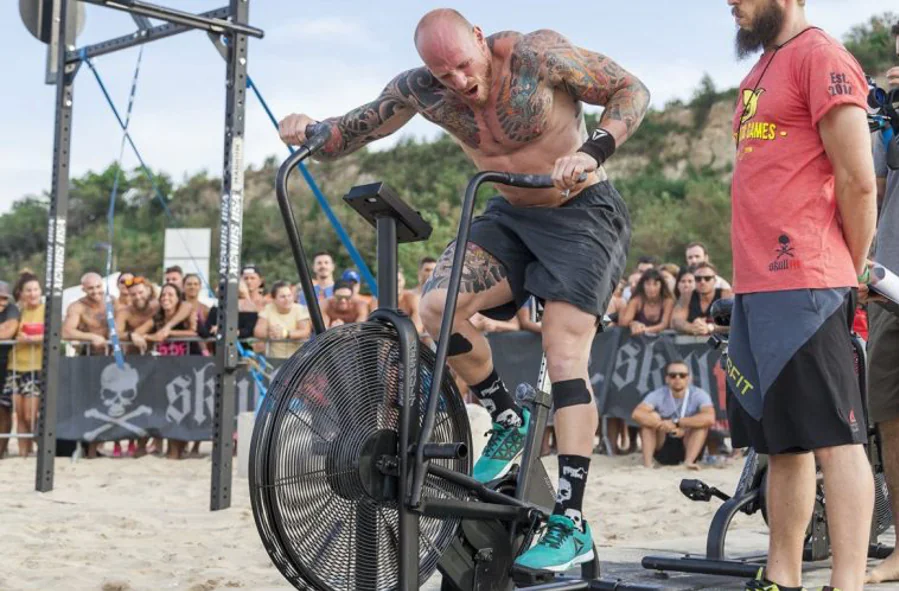
Fan Bike - The Ultimate Cardio Training Tool
Fan bike benefits are rooted in one brutally simple idea: arms and legs can work together, forward and backward, with intensity that is measurable. Marty Gallagher’s fan bike protocol turns a rugged old-school cardio tool into a quad-limb conditioning weapon for athletes who want more than a bored, legs-only ride on standard cardio equipment.
Why the Ancient Fan Bike Blows Other Cardio Equipment Devices Into the Weeds
The Fan Bike has been around for decades. This iconic cardio equipment device has stood the test of time. A Fan Bike is the technological equivalent of a Wild West steam locomotive, all mechanical; its harshness, hardiness and surprising multidimensionality have made it the favored aerobic training device of the athletic elite.
The Fan Bike is rugged and raw, unpolished and primal. It has the obvious advantage of being able to work all four limbs, arms and legs, equally and simultaneously. Less known and equally important: a Fan Bike can be pedaled and pulled backwards, effectively and instantly doubling the exercise menu.
The Fan Bike makes the arms and legs equal partners in creating the sum-total of the aerobic effort.
A Fan Bike can be pedaled and pulled backwards, thereby working the posterior chain. All of which is totally lacking in legs-only, forward-only cardio equipment devices.
The modern Fan Bike has an LED display that shows the rider RPMs and Watts generated. These two expressions of effort make it possible for the user to create cardio personal records, performance best efforts in each Fan Bike training drill. These PRs are expressed numerically, the highest WATTS reading generated, or highest number of RPMs generated during a drill.
The Fan Bike enables the trainee to stress one, two, three or all four limbs, individually or together, forwards or backwards. The cardio effort can be “shuttled” around the body in a very strategic and calculated fashion.
Quad-Limb Fan Bike Core Protocol
For each Fan Bike drill, our procedure is the same:
- Warm-up gradually.
- Pick a drill, begin light and easy, slowly elevate core temperature.
- Gradually pick up the pace, warm-up to 50% of capacity.
- Allow the body to acclimatize at each subsequent intensity level.
- Move to 70% of capacity: the body is now completely awake and alert.
- Move to 85% — do a quick check — does every muscle feel fine? If so…
- Push the accelerator to the floor: 100% of what you are capable of.
- Hold 100% until you fade.
- 100%+ efforts are very short, 5-10 seconds max.
- Shut the sprint down at any hint of pain or discomfort — live to fight another day.
- Intensity has a report card: highest WATTS generated, or highest RPMs attained.
- Be cognizant that intensity/capacity is a shifting target, differing session to session.
- Some days capacities are enhanced, other days normal, other days diminished.
- Regardless if capacity is diminished, enhanced or normal, we work to 100%.
- Gains occur by repeatedly generating all-out effort, safely and consistently.
- Sweat is a positive indicator of real effort.
- Log workout performance: seek to exceed current limits.
- Continually assault the barriers.
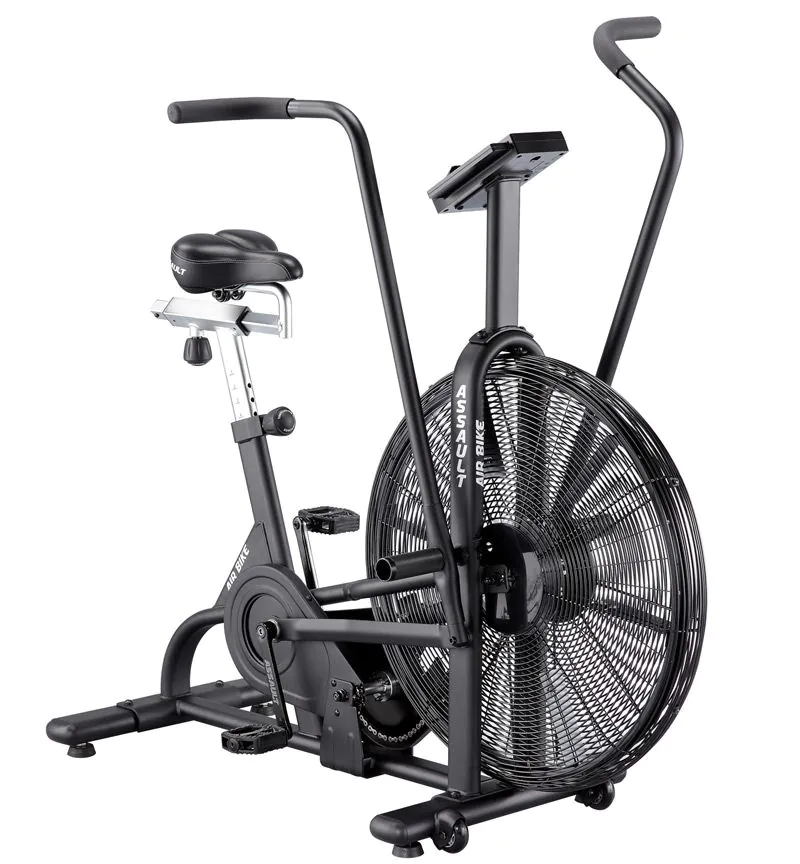
Assault fan bike for quad-limb cardio training.
Rotate the Exertion, Rotate the Recovery
Once a 100% all-out max effort in a drill is attained, decelerate, then shift into the slowest, easiest warm-up iteration of the next sequenced exercise. Now take this drill to 50%, then 70%, then 85%, then mash the accelerator to the floor and go all out, 100%+ as long as possible — which is not long.
One example: with feet resting on the Fan Bike footrest pegs, work up to 100% effort in an “arms-only, push only, going forward with an over-grip” drill. Attain 100% of capacity and generate a 29 WATTS readout.
The athlete then segues into an “arms-only, pull only, going backwards with an under-grip” drill. Attain 100% of capacity and generate a 27 WATTS reading. Both peak WATTS readings are noted and later logged. After going 100% using just the arms — all-out forward and all-out backwards — now what?
Legs only forwards, then legs only backwards. Then you could do arms and legs together going forward while standing. Then backwards. You get the idea. Rotate the effort. While one part of the body is generating a 100% sprint-style effort, other parts of the body are resting, waiting their turn at bat.
Rotate the exertions and rotate the recovery. Specific body parts are maximally taxed, then rested. Other body parts are brought online and taxed maximally in turn. This strategy enables repeated maximum exertions.
Fan Bike Drills and Air Bike Workouts
Here are a few different Fan Bike drills. These are not casual distractions; they are measurable drills. Each one can be logged by WATTS, RPMs, time, perceived effort, and recovery response.
- Arms and legs, forward
- Arms and legs, backwards
- Arms and legs, forward — standing up
- Legs only, forward
- Legs only, backwards
- Arms only push, over-grip, “bench press” the handles
- Arms only push, under-grip
- Arms only pull, over-grip row
- Arms only pull, under-grip row
- Arms only push and pull, burn it out, fast as possible
- Left leg, forward
- Right leg, forward
- Left leg, backwards
- Right leg, backwards
- Right arm, forward push
- Left arm, forward push
- Right arm, backwards pull
- Left leg/right arm, forwards or backwards
- Right leg/left arm, forward or backwards
Fan Bike vs Treadmill, Stationary Bike, and Legs-Only Cardio
Why would anyone purchasing a cardio training device select an aerobic tool that can only go in one direction, forward, and uses legs alone to generate 100% of the cardio effort? Aerobic equipment tools that depend on legs alone to create the totality of the exercise effort are woefully inadequate when compared to the astounding possibilities of quad-limbed, forward-backward cardio.
Comparing a contemporary stationary bike, a standard treadmill, or any legs-only/forward-only cardio device to a Fan Bike is akin to comparing checkers to chess. Why be purposefully stuck with a single-dimensional cardio workout tool when you can explore cardio training in four dimensions?
This is the overlooked genius of the dual action exercise bike: it allows the athlete to distribute the workload across the body, then relocate the work when one area fatigues. That makes it a nasty and useful piece of HIIT cardio equipment for trainees who want short, measurable, brutally honest conditioning.
Intensity, Hormones, and the Cardio Training Effect
Consistent and intense cardio, cardio exercise with a purposeful muscular effort — sprinting — builds locomotive-like endurance while infusing muscles with additional mitochondria. Intense cardio can trigger the release of hormones: adrenaline, endorphins, growth hormone, serotonin, dopamine, norepinephrine and others. These hormones flood the bloodstream and are a telltale precursor of the adaptive response. The hormonal release is a positive indicator that the training effort has been productive.
Intense cardio training can help build and strengthen internal systems when performed properly and progressed intelligently. The heart muscles and lung muscles accelerate and send fresh blood coursing to working muscles. Enriched blood delivers nutrients and carries away waste products. The harder and more honest the effort, the more the body must respond.
Equipment Notes for Fan Bike Training
For athletes, first responders, tactical teams, commercial gym operators, garage gym owners and strength athletes looking for a rugged conditioning tool, a fan bike belongs in the conversation. It can be used for warm-ups, finishers, sprint intervals, recovery-style movement, HIIT sessions, and quad-limb conditioning drills.
Readers comparing options can review upright exercise bikes and fan-bike-style conditioning tools. A commercial option such as the Throwdown HIIT Bike Pro fits the type of rugged, measurable air bike workouts discussed in this article.
To shop fan bikes, exercise bikes and other conditioning tools, visit IRON COMPANY’s cardio equipment and upright exercise bikes pages.
Safety Note for Fan Bike Workouts
All-out fan bike efforts should be scaled to the trainee’s current ability, conditioning, health profile, recovery status and training age. Warm up gradually, stop at any sharp pain or unusual discomfort, and progress intensity over time. This article is educational and should not be treated as personalized medical, rehabilitation or programming advice.
Frequently Asked Questions
What are the main fan bike benefits?
The main fan bike benefits are quad-limb conditioning, forward and backward movement options, measurable WATTS and RPM output, scalable resistance and the ability to rotate effort around the body. It is a rugged tool for athletes who want intense, focused cardio.
How is a fan bike different from a regular stationary bike?
A regular stationary bike usually relies on the legs moving forward in one pattern. A fan bike uses arms and legs together, can be driven forward or backward, and allows arms-only, legs-only, single-limb and quad-limb drills.
Are fan bikes good for HIIT cardio equipment?
Yes. Fan bikes are commonly used for HIIT-style training because resistance rises as effort rises. The harder the athlete pushes and pulls, the harder the fan bike pushes back.
What are the best air bike workouts for fat loss?
Many trainees use short sprint intervals, WATTS-based drills, arms-only/legs-only rotations and repeated 100% efforts followed by easy recovery. Fat-loss results still depend on the full plan: training consistency, nutrition, recovery and adherence.
How do you track progress on a fan bike?
Track the highest WATTS generated, highest RPMs attained, drill selection, total session time, recovery time and how the effort felt. The report card is numerical, which makes progress easy to compare over time.
Is fan bike training better than treadmill training?
It depends on the goal. A treadmill is useful for walking and running. A fan bike offers quad-limb, push-pull, forward-backward, low-impact conditioning that can be especially useful for athletes who want intense cardio without relying only on the legs.
About the Author: Marty Gallagher
As an athlete Marty Gallagher is a national and world champion in Olympic lifting and powerlifting. He was a world champion team coach in 1991 and coached Black's Gym to five national team titles. He's also coached some of the strongest men on the planet including Kirk Karwoski when he completed his world record 1,003 lb. squat. Today he teaches the US Secret Service and Tier 1 Spec Ops on how to maximize their strength in minimal time. As a writer since 1978 he’s written for Powerlifting USA, Milo, Flex Magazine, Muscle & Fitness, Prime Fitness, Washington Post, Dragon Door and now IRON COMPANY. He’s also the author of numerous books including Purposeful Primitive, Strong Medicine, Ed Coan’s book “Coan, The Man, the Myth, the Method" and numerous others. Read the Marty Gallagher biography here.
Marty Gallagher is a champion strength athlete, coach, author, and RAW Podcast host known for powerlifting, Olympic lifting, and serious strength training.
