
 Call us today at 1-888-758-7527

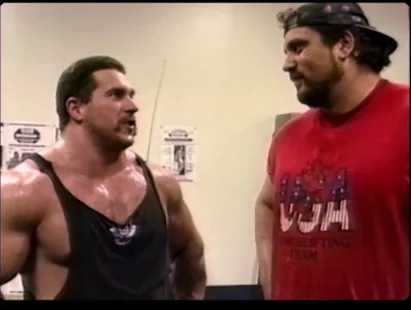
Training Partners - Indispensable in the making of a legend
Bonds for a Lifetime
Training partners can become indispensable ingredients in the creation of legends. At the highest level of strength sports, they are not optional scenery. They spot, load, wrap, yell, correct, travel, calm, provoke, protect, and sometimes save the lifter from himself.
Kirk Karwoski and Bob “Nacho Del Grande” Myers: at the highest level of strength sports, training partners are invaluable, indispensable, critical. Bobby became Kirk’s training partner when Kirk began training at Ian Burgess’ Maryland Athletic Club in College Park. Bob was a midwife for Kirk’s glory years, when the boy prodigy became a full-blown dominator. Bob was there for every training session, and Kirk’s rate of progress and physical maturity in this period was astounding and, in large part, due to Bob. Whether it was using his incredible hand strength to wrap Kirk’s knee wraps past a human’s ability to withstand pain — Kirk is not a human being — or yelling with his stentorian voice at ear-shattering volume right before a Karwoski limit attempt, Bobby’s presence took everything to the next level. You could not have designed a better training partner.
Lifters lift weights to transform themselves from what they are into what they want to be. A certain type of lifter has an inherent yearning to become bigger, stronger, leaner, faster, healthier, more capable, more dangerous in the athletic sense — they want it all. These lifters naturally gravitate toward the superhero ethos and admire the superhero physique.
The tools and protocols needed to successfully ignite a dramatic physical makeover have been around since the early Iron Game. Hard and heavy resistance training has been growing massive amounts of muscle on hard-training athletes for generations. Basic barbell movement patterns, performed repeatedly with slightly heavier payloads and supported by enough food and recovery, increase strength. Increased strength often begets increased muscle size.
Iron pioneers discovered long ago that if they became exponentially stronger at certain benchmark resistance-training exercises, the muscles used in those movements grew exponentially larger. Hardcore resistance training done consistently makes lifters stronger, more powerful, and more muscular. For these reasons, hardcore resistance training done right, done with barbells, dumbbells, weight plates, racks, benches, and intelligent loading, will never die.
Transformation Training Eventually Becomes a Team Sport
At the higher levels of resistance training, transformational training becomes a type of team sport. When a lifter handles super-heavy poundage in the squat or bench press, at some point a rep is going to be missed.
What does a lifter training alone do when he misses a rep in the bench press with 405 pounds and has to ride it down to his chest? He had better think of something quick.
What does a lifter training alone do when he misses his fifth rep with 585 in the squat? Throw 600 pounds off his back? What if it is too heavy to be thrown? It rides him down to the basement in less than a second. Better think of something quick.
Great lifters need training partners, good ones, to spot them when they attempt their result-producing, limit-exceeding reps on top sets. A competent training partner is not a cheerleader. A competent training partner is a human safety system, a technical witness, a psychological amplifier, and a co-conspirator in progress.
Research has even caught up with the old gym truth. A bench-press study on spotter presence found that visible spotters improved total repetitions, total weight lifted, and self-efficacy in recreationally trained participants. The lifter performs differently when serious people are standing there, watching, ready, and expecting success.
The Shared Template: Same Movements, Different Payloads
Training partners are people who throw in with you. Training partners follow the same identical training format. The best lifter leads and the others follow. The only thing that changes for each workout participant is the payload.
Everyone performs the same exercise movements, using the same techniques, for the same number of reps. The top-set poundage varies athlete to athlete.
If a hypothetical group of five hardcore, drug-free, raw powerlifters gathered to train and their best squats ranged from 450 to 600 pounds, the squat sequence might look like this:
| Set | Weight | Group Use |
|---|---|---|
| 1 | 135 pounds | All five lifters rep the 135 as needed to warm up |
| 2 | 225 pounds | Second warm-up set; each lifter steps in and reps 225 |
| 3 | 275 pounds | Third set for whoever wants it |
| 4 | 315 pounds | Fourth warm-up set |
| 5 | 365 pounds | Fifth warm-up set |
| 6 | 405 pounds | First training partner’s top rep set; he is done, then continues to spot |
| 7 | 455 pounds | Second training partner’s top rep set |
| 8 | 495 pounds | Third training partner’s top rep set |
| 9 | 545 pounds | Fourth training partner’s top rep set |
| 10 | 585 pounds | Top rep set of the day, done by the 600 x 1 squatter |
Everyone adheres to the same training template. Each of the five lifters spots, assists, loads, and exhorts whoever is up. No distracted conversations. No phone calls. No texting. You give each other the same undivided attention they gave you while you performed your set.
Lifting in front of a group, being the center of attention, ups a lifter’s game.
Why the Presence of Training Partners Matters
A good training group creates a pressure chamber. Each man knows what the others have done. Each man knows what the plan calls for. Each man knows he is being watched by people who know the difference between a true effort and a fake one.
That pressure cuts both ways. It can make a lifter attempt something stupid if the group culture is stupid. It can also make a lifter transcend his ordinary level if the group culture is technically sharp, ruthless, supportive, and safety-conscious.
Spotting itself is a skill. The spotter must know where to stand, when to help, when to stay out of the lift, how to communicate, and how much assistance to provide. For squats and bench presses, especially heavy or maximal attempts, more than one spotter may be needed. A single weak spotter behind a superheavy lifter is not bravery. It is bad planning.
Good spotters do not casually hover. They assume every rep might fail. They watch bar speed, body position, depth, lockout, facial expression, and the first hint that the payload is heading in the wrong direction.
What Makes a Great Training Partner?
There is an art and science to being a responsible and effective training partner. Good training partners enable the champion to obtain results the champion would have been unable to attain without help. The champions will be the first to tell you so, because really good training partners are rare.
- Show up: the first rule is to never miss a training session. Missing sessions indicates that you are either not serious or do not have the life situation required to be consistent. Others are depending on you. Step up or step off.
- Become absorbed in the process: training partners become more knowledgeable as they adopt the elite lifter’s approach. The acolyte learns how to create customized strength-training templates, how to periodize, and how to base the plan on realistic and ruthless self-assessment.
- Be strong enough to help: a weak training partner, no matter how knowledgeable or clever, is of limited use to a super-strong elite iron athlete. If you are not strong enough to help pull a failed bench press off a struggling lifter, then you put the lifter at risk.
- Know what to say: good lifters want feedback after a set. Technically, how did it look? Was my depth good? Were my benches locked out? Any hitching or stalling on the deadlift or overhead press? Specific feedback matters. Cheerleading does not.
- Know when to shut up: please say less. Make your words specific. No one cares about your observations expressed in ten-minute monologues. The lower on the group totem pole you are, the fewer words are needed from you.
- Become an expert spotter: the first rule of spotting is fierce attention. Assume the lifter might fail with every rep. If at any point the bar stalls and starts to go backward, the rep is over and the spotter takes control.
- Become an expert forced-rep giver: the lifter goes to positive failure, the spotter steps in, and the partner offers just enough assistance to keep another rep moving smoothly and steadily toward lockout. The training partner does not let a forced rep stall or stop.
- Attend competitions and assist: the training partners travel to competitions and assist their stablemates. At a meet, the training partner’s job is to help with warm-ups, keep the athlete on schedule, get the athlete onstage warm and focused, and reduce every unnecessary distraction.
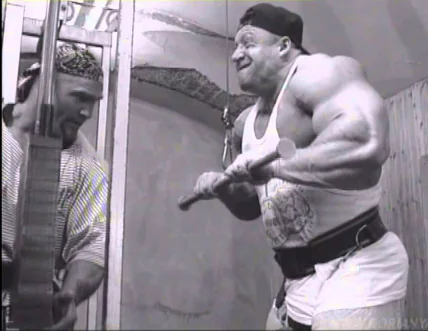
A great training partner understands when to help, how much to help, and when to get out of the way.
Leroy Davis, Dorian Yates, and the Forced-Rep Ballet
Leroy Davis and Dorian Yates: never were training partners more critical than in the Yates/Davis partnership. Dorian’s strategy depended on massive weights taken to positive failure and then adding a forced rep or two — never more. How the forced rep was administered was critical. Too much help lessens the depth of the muscular inroad. Too little help allows the payload to stall and is injurious, unproductive, and unacceptable.
Davis and Bob Myers had four critical talents.
- They understood exactly what the champion was doing: they knew the training strategy because they trained seriously themselves. They understood their role because they had lived the same process from the other side.
- They were strong as hell: if a weight were missed, the hawk-eyed partner could pull a massive weight off the champion. Davis spotted assuming every rep would fail. Heightened vigilance is critical when spotting those who push the envelope.
- They were loud as hell: both Leroy and Bob had operatic voice volume. It makes a difference when a ferocious monster man is a foot from your head screaming at you to finish a rep. The sheer volume was shocking and effective. When they screamed, the world stopped.
- They succeeded: Yates and Karwoski became legends. Would they have been as good without their training partners? No freaking way — and Dorian and Kirk would be the first to tell you so.
It is one hell of an accomplishment to have been an indispensable training partner in the making of a legend.
Equipment Notes for Serious Training Partners
A serious training group needs more than enthusiasm. It needs a stable environment, reliable loading, safe handoffs, secure collars, enough plates, and a bench or rack setup that can handle repeated hard use.
For foundational loading, serious groups can compare Olympic weightlifting bars, weight plates, and barbell collars. Heavy partner-assisted training is not the place for questionable bars, loose plates, missing collars, or unstable flooring.
A dedicated bench station such as the Legend Fitness 3150 flat Olympic bench press with plate storage can support the kind of heavy bench training where liftoffs, handoffs, and skilled spotters matter. TKO solid rubber bumper plate sets can support dynamic barbell work when used on appropriate flooring and with the correct barbell setup.
For heavy barbell work, the Iron Grip OB-7 industrial chrome Olympic weightlifting bar belongs in the conversation. Training rooms also need durable rubber gym flooring rolls that can withstand traffic, dropped implements, plate changes, and the daily grind of a serious strength room.
The equipment does not create the training partner culture. The lifters do that. But good equipment gives serious training partners an honest place to work.
Safety Note for Training Partners, Spotting, and Forced Reps
Training partners make hard training safer only when they know what they are doing. Heavy squats, heavy bench presses, forced reps, and top-set attempts should use competent spotters, properly set rack safeties where appropriate, secure collars, clear communication, and conservative judgment.
Forced reps are an advanced method. They should be used sparingly and with experienced partners who know exactly how much assistance to provide. Do not use forced reps on lifts where interference is more dangerous than helpful. Olympic lifts, heavy deadlifts, and fast explosive movements generally should not be “spotted” in the same way a bench press is spotted.
When training alone, use a rack, safety arms, or other equipment specifically designed to catch a missed lift. A training partner is not a replacement for common sense. This article is educational and historical; it is not individualized coaching, medical, or rehabilitation advice.
RAW with Marty Gallagher, J.P. Brice, and Jim Steel Podcast.
About the Author: Marty Gallagher
As an athlete Marty Gallagher is a national and world champion in Olympic lifting and powerlifting. He was a world champion team coach in 1991 and coached Black's Gym to five national team titles. He's also coached some of the strongest men on the planet including Kirk Karwoski when he completed his world record 1,003 lb. squat. Today he teaches the US Secret Service and Tier 1 Spec Ops on how to maximize their strength in minimal time. As a writer since 1978 he’s written for Powerlifting USA, Milo, Flex Magazine, Muscle & Fitness, Prime Fitness, Washington Post, Dragon Door and now IRON COMPANY. He’s also the author of multiple books including Purposeful Primitive, Strong Medicine, Ed Coan’s book Coan, The Man, the Myth, the Method and numerous others. Read the Marty Gallagher biography here.
Marty Gallagher is a champion strength athlete, coach, author, and RAW Podcast host known for powerlifting, Olympic lifting, and serious strength training.
