
 Call us today at 1-888-758-7527

Longevity and Late-In-Life Functionality
Longevity - Ready or Not, Life Plunges Relentlessly Into the Future
With so many Baby Boomers still alive and kicking, longevity is a hot topic. As someone who has been immersed in the pursuit of longevity for decades, I would suggest that longevity is useless unless it is accompanied by a high degree of physical function.
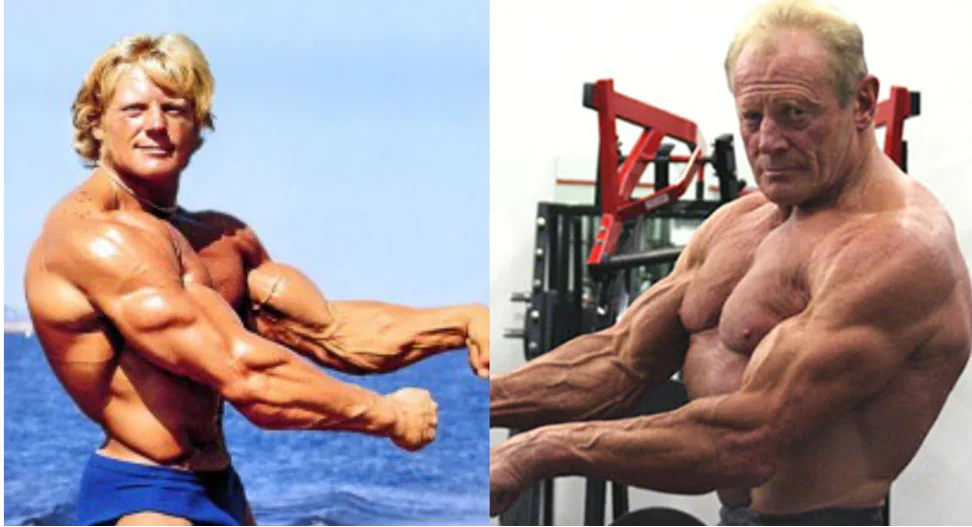
Bodybuilder Dave Draper, shown above in his mid-20s and again at age 70, is a dramatic visual reminder that the body can carry strength, shape, and dignity far deeper into life than the untrained public assumes.
It is not enough to extend life. It is critical that an extended life be faced with a body capable and a Mind unimpaired. If functional longevity is the goal, and we know how to define longevity — live long — how do we define a fuzzy word like function?
Functional Longevity: I Know It When I See It
Supreme Court Justice Potter Stewart was once asked to define pornography. He responded, “I know it when I see it.” I would echo that sentiment when attempting to define functional longevity: I know it when I see it.
I knew functional longevity when I first saw it in action as a 12-year-old spectator at an Arkansas baseball game. My favorite uncle’s father, my great uncle, then 66, was drafted into a pickup baseball game. There were two local high schools, one in town and one a few miles outside of town. After baseball season ended, members of each high school team would gather on weekends at the town baseball park to play pickup games against one another.
On this particular weekend, the spry old man volunteered to play shortstop when, at the last minute, it was discovered they were a player short. The boys laughed and said, sure thing old man. Someone handed him a glove.
He was, by trade, one of our town’s three garbage men. One man drove the garbage truck while the two others trotted alongside slinging garbage and assorted refuse into the moving truck ten hours a day, five days a week.
My great uncle jogged, hoisted, and flung garbage into the relentlessly moving truck all day, every day. He got the job at age 28. He neither smoked nor drank, a rarity for men his age in our town at that time, and was told that as long as he showed up, as long as he could keep up, he had a job. He quit at age 70 to spend more time fishing, his lone passion.
He was tanned and leathery and had difficulty expressing himself. He smiled eternally in a beatific way that put children, strangers, and animals at ease. His body was whippet lean. Quiet and painfully shy, he rarely talked.
The Great-Uncle Standard
On that day, he smiled beatifically as he effortlessly shagged every line drive, caught every fly ball, and routinely threw out runners by making pinpoint rocket throws to first base. He went three for four at bat with singles and doubles, including laying down a bunt and beating the throw to first base.
He could run, really run. Not “he runs really good for an old man.” He could outrun all but two of the eighteen players on the field that day. He was Mr. Miyagi come to life. He was balletic and poetic. Best of all, it was effortless; there was no strain or sense of overperforming. He was egoless. As soon as the game was over, he faded back into the silent background as quietly as he had emerged from it.
I will never forget it. He became my late-in-life role model when I had barely begun my life. At 66, he was a way better athlete than 15 of the 18 high school baseball players on the field that day.
Sixty Years Later, I Understand What I Saw
Decades later, I understand that man. At age 70, I could routinely outlift good high school lifters in my weight class, this despite being on the far downside of my strength bell curve. Even in diminished old age, I could outlift, and in a lot of cases out-sprint, many of the high school athletes I trained. I could make mincemeat out of untrained teens. I was strong and I could move.
And I did not work on a garbage truck.
My great uncle built his physique and capabilities through hard physical labor, clean living, and hardscrabble rural nutrition. Every day doing his job was a sustained-strength, or strength-endurance, training session. Farm-to-table was his nutritional reality. He ate simple, minimally processed, nutrient-dense food and never in excess because they never had excess.
My great uncle sustained his capabilities and capacities late into life by, firstly and most importantly, not retiring from the work that made him what he was. I am fond of quoting Aristotle, who once noted, “We are what we do repeatedly.” The nature of my great uncle’s job and his eating habits created his physique and sustained his function.
He would not have been able to match the capabilities and capacities he had at age 30, yet even his diminished capacities were more than enough to ensure functional longevity.
The Modern Functional-Longevity Template
How does modern man, someone on the wrong side of 50, obtain the apparently elusive goal of functional longevity?
Modern man must skillfully blend exercise and nutrition to create body-changing stresses sufficient to build or preserve lean muscle mass, maintain useful strength, improve cardiovascular capacity, and reduce excess body fat when needed. Any human who successfully increases lean muscle mass, improves cardiovascular fitness, and reduces unnecessary body fat improves the raw materials of function.
Do not let anyone tell you that past a certain age strength and muscle gains are impossible. Improvement is always possible, though the rate of progress, safe starting point, and recovery needs vary dramatically from person to person.
Public-health guidance now echoes the old iron truth. Older adults need more than one kind of activity. Aerobic work, muscle-strengthening work, and balance work all matter. The CDC recommends adults 65 and older perform at least 150 minutes of moderate-intensity aerobic activity or an equivalent amount of vigorous activity, add muscle-strengthening activity on at least two days per week, and include balance activity.
To obtain functional longevity, to extend life and improve the quality of that extended life, the serious trainee needs to implement and adhere to a resistance-training plan. For the healthy and capable trainee, free weights remain magnificent tools: barbells, dumbbells, and kettlebells are brutally honest. They demand balance, control, coordination, tension, and concentration.
That said, free weights are not the only useful option. Machines, bodyweight movements, cables, bands, sleds, loaded carries, and carefully selected cardio tools can all support the larger goal when they are used intelligently. The tool must match the trainee’s current ability, injury history, skill, and environment.
Combine resistance training with frequent cardiovascular exercise. Sync this two-pronged training approach with a nutrient-dense nutritional strategy, one that complements and augments the training effort.
Nutrition Either Amplifies or Undercuts Training
Nutrition either amplifies or undercuts training. There are many acceptable dietary approaches. Regardless if you are vegetarian, a keto advocate, or someone with religious restrictions or strong personal preferences, above all else, stress food quality.
Seek out high-quality proteins and produce. Local and seasonal food can be magnificent for flavor, freshness, and adherence. Organic food can be a valid choice when budget and preference align. But do not turn the idea into superstition: organic food is not automatically more nutritious than conventional food, and frozen vegetables can be a tremendous tool for the serious trainee who needs reliable, affordable, repeatable meals.
Powerhouse natural foods eaten in appropriate amounts can amplify results derived from consistent training. Nutrient-dense foods support repair and recovery after hard training. The balance must be struck between precision nutrition and intense exercise.
For the older trainee, protein matters. So does total food intake, hydration, fiber, micronutrients, and meal consistency. The underfed older athlete cannot recover well. The overfed older athlete can undo much of the body-composition benefit of training. Food is fuel, raw material, and medicine only when it is matched to the goal.
It Is Never Too Late to Start
It is never too late to start. The more out of shape an individual is, the faster and more dramatic the early rate of progress can be, assuming they train right and eat right. Nutrition can be your best friend or worst enemy. A steady diet of pizza, beer, chips, ice cream, and empty-calorie fast food will undo and undermine the finest training effort.
Clean up the quality of your food-fuel.
The eternal triumvirate of transformation consists of two exercise formats, aerobic exercise and resistance training, synchronized with a sophisticated approach toward nutrition. Want to live longer? Want to improve your current degree of function? Get onboard with some version of the transformative triumvirate. It is never too late.
We can always improve upon the shape and condition of our current physique and improve our current limits and capacities. Any effective system for improving functional longevity needs a strength-training element, a cardiovascular-training element, and a nutritional element.
When all the elements are in place and practiced in a balanced, holistic fashion for an extended period, a physiological synergy can occur. A metabolic sweet spot can be attained wherein actualized results exceed realistic expectations.
For a related age-specific discussion, read Marty Gallagher’s article on fitness over 40, 50, 60, and 70.
Equipment Notes for Functional Longevity Training
Functional longevity training does not require a circus of equipment. It requires repeatable tools that help the trainee build strength, preserve muscle, improve conditioning, and train safely.
For strength training, a pair of IRON COMPANY urethane dumbbells and a set of IRON COMPANY powder coated kettlebells can support presses, rows, squats, deadlifts, carries, swings, get-ups, and dozens of functional patterns. Larger training rooms can build out with full dumbbell, barbell, and kettlebell categories.
For conditioning, exercise bikes and treadmills can help older trainees control intensity, duration, and progression when outdoor conditions are poor. The AssaultBike Pro X and Star Trac 8TR commercial treadmill are examples of cardio tools that can be used intelligently when they match the athlete and facility.
Training space matters. Stable, clean, forgiving floor surfaces reduce chaos and help define the training area. Interlocking rubber gym tiles can support a safer, more durable environment for serious home, garage, or facility training.
The equipment does not create functional longevity. The habits do. The equipment merely gives those habits a place to live.
Safety Note for Late-Life Training
Older trainees, deconditioned trainees, and anyone with medical conditions, joint replacements, cardiovascular disease, neurological issues, balance problems, unexplained pain, or medication concerns should scale training to current ability and seek qualified guidance when appropriate.
Start with conservative loads, clean technique, and manageable cardio. Add intensity gradually. Stop for chest pain, faintness, sudden shortness of breath, sharp pain, neurological symptoms, or loss of balance. The goal is not to prove toughness in one heroic workout; the goal is to build a body that can keep proving itself for decades.
About the Author: Marty Gallagher
As an athlete Marty Gallagher is a national and world champion in Olympic lifting and powerlifting. He was a world champion team coach in 1991 and coached Black's Gym to five national team titles. He's also coached some of the strongest men on the planet including Kirk Karwoski when he completed his world record 1,003 lb. squat. Today he teaches the US Secret Service and Tier 1 Spec Ops on how to maximize their strength in minimal time. As a writer since 1978 he’s written for Powerlifting USA, Milo, Flex Magazine, Muscle & Fitness, Prime Fitness, Washington Post, Dragon Door and now IRON COMPANY. He’s also the author of multiple books including Purposeful Primitive, Strong Medicine, Ed Coan’s book Coan, The Man, the Myth, the Method and numerous others. Read the Marty Gallagher biography here.
Marty Gallagher is a champion strength athlete, coach, author, and RAW Podcast host known for powerlifting, Olympic lifting, and serious strength training.
