
 Call us today at 1-888-758-7527

The Anabolic Burst: creating Metabolic Amnesia
Anabolic Burst - Success Lies in Meeting the Preconditions
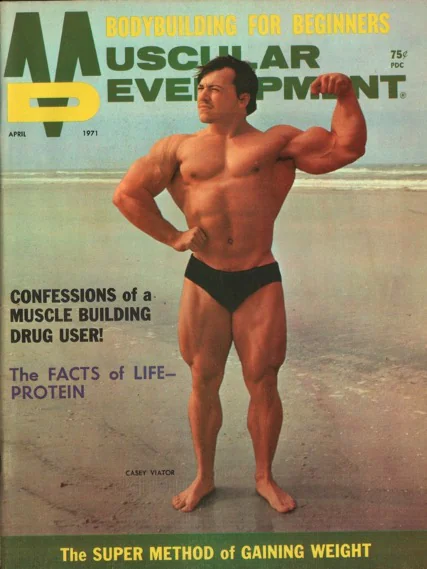
Look at all the muscle Casey Viator built before the invention of Nautilus machines. In the old article referenced by this piece, Arthur Jones attributed the muscle you see here to classical barbell and dumbbell training. Viator did classic exercises using pristine technique and mind-blowing poundage. Later, Nautilus machines were credited, sometimes slyly, with creating a physique that had already been built.
The anabolic burst is a mythical, mystical resistance-training experience wherein the athlete or bodybuilder appears to add a significant amount of size, muscle fullness, and power in an incredibly short amount of time. Pro bodybuilders coming off a major competition can add ten to twenty pounds of scale weight within days and look dramatically bigger, thicker, and healthier.
A starved-down 185-pound bodybuilder that competes at a contest-level body-fat condition can weigh 200 pounds 36 hours later, now looking monstrous, twice as big, twice as strong, twice as healthy looking — and still ripped. This is the anabolic burst personified.
The anabolic burst is real in the old bodybuilding sense. I have experienced it many times over the course of my long career in resistance training. The anabolic burst is defined as packing on an inexplicable amount of size, fullness, and power in a ridiculously short amount of time: a matter of days, perhaps a week.
What needs clarifying is this: not every pound gained during a burst is brand-new contractile muscle tissue. Some of the rapid gain is glycogen, water, food volume, regained fullness, inflammation, and muscle memory expressing itself after depletion. The look is real. The scale jump is real. The performance jump can be real. The old claim that every ounce is pure new muscle needs to be handled carefully.
The Bodybuilding Rebound
The defining characteristic of the anabolic burst is rapid weight gain that is not immediately laden with an unacceptable amount of body fat. During the true burst, the athlete’s metabolism seems to blaze, on account of establishing certain metabolic preconditions. The successful anabolic burst is predicated on what came before it.
Optimally, ideally, truthfully, the greater the deprivation leading into the burst, the greater the magnitude of the rebound and the more profound the short-term visual result. Indeed, the dirty little secret of the anabolic burst is that the biggest ingredient in success is the depth and degree of deprivation leading up to the burst.
The burst itself is easy, a veritable feast. The bursting bodybuilder engages in free-for-all, no-holds-barred eating. He acts like a famished man taken to a Vegas buffet.
The genesis can be traced to the competitive bodybuilder of the 1970s and early 1980s. The men dieted down hard, right up to and through the “show,” the competition. Predictably, these IFBB pros would party and gorge themselves the instant the show was done and the photo shoots completed.
A funny thing happened. Despite gorging on beer, scotch, ice cream, pie, pasta, pizza, and whatever guilty pleasure they wanted, as much as they wanted, for a short period of time, the early rebound often made them look better, not worse.
Competitive bodybuilders discovered that coming off a period of prolonged and intense deprivation, supercharging flattened muscles with calories of all types and kinds caused the muscles to swell like dry sponges dunked in scalding water.
Deprivation, Supercompensation, and Spillover
Man to man, the length of time for a successful anabolic burst varied. The burst was over when the body remembered how to process and store body fat. A depleted bodybuilder uses supercompensation. He overwhelms the deprived body with calories. These men had been living on fat-free protein, controlled calories, low carbohydrates, and water for months, all in pursuit of stripping off the last vestiges of body fat.
When they stuffed themselves, they were supercompensating. Muscles grew exponentially bigger very rapidly. This swelling could go on for upwards of a week for some, though for most, spillover occurred after 48 to 72 hours of overeating. Spillover ended the party.
A competitive bodybuilder might attain a brutally low body-fat level to be competitive. This is not sustainable. It is a temporary state, often bought by forcing the body to walk a razor’s edge: burn body fat without cannibalizing hard-earned muscle.
Despite indiscriminate piggery, two or three days later, many pro bodybuilders looked better than they had at the show: nearly as ripped, but now 10 to 15 pounds heavier, full, thick, and powerful looking. They looked healthier too, instead of being one step away from fainting, as many are on competition day.
Metabolic Amnesia Is a Metaphor
The way the elite explain it to one another is logic-cubed: for a short period of time, the body “forgets” how to construct fat. During this short period of metabolic amnesia, calories are preferentially used to refill, restore and rebuild. Excess calories do not immediately appear as visible body fat. The fat-storage machinery seems sluggish, coming off a long period of underuse due to intense and prolonged deprivation.
That is old bodybuilding language. It is metaphor, not endocrinology lecture. More precisely, depleted muscle can refill glycogen, pull water into the muscle, restore training capacity, and regain tissue that was flattened or lost during hard dieting. The bodybuilder looks dramatically bigger and harder before the spillover becomes obvious.
The idea is to create an anabolic burst by overeating, then stopping before the body “remembers” how to shuttle excess calories into the fat-storage depots that dot the body. Spillover is when the body recommences with a vengeance. Open for business, sleeper fat cells reawaken, sucking dietary energy into fat storage like turbocharged Dyson vacuum cleaners.
The optimal ploy is to jump off the caloric party train before spillover occurs. When muscle fullness and power are occurring on a daily basis, it is easy to stay too long at the muscle-beach, stuff-your-face carnival.
Casey Viator Before Nautilus
One of the biggest sleight-of-hand moves in the history of fitness involved an anabolic burst. In the early 1970s, Arthur Jones met a young 19-year-old bodybuilder named Casey Viator. Jones was so taken by Viator’s physique, built with barbells and dumbbells, that he penned a long article that appeared in the April 1971 issue of Muscular Development.
The 19-year-old wunderkind had already built the physique you see in the photo at the top of this article. Casey stood 5-8 and weighed around 215 pounds, with a realistic 8% to 10% body-fat level in the old Iron Game assessment.
Jones noted in the article that Casey, all on his own, built the physique pictured. Jones related Casey’s barbell-dumbbell strategy: in all exercises, Casey trained for strength, correctly feeling that strength increases correlate to muscle-size increases. Casey did not need Jones to tell him this. All the muscle later attributed, however slyly, to Nautilus training, was already built by barbell and dumbbell training using classical strength-training methods.
The reason Viator had incredible thighs was not the Nautilus leg press, which was yet to be invented. It was because he performed savage, strict, heavy squats. The old account says that in a workout Jones observed firsthand, after warming up, Viator squatted 435 pounds for 20 reps, rested three minutes, hit 455 for 14, rested three more minutes, then blasted out 535 for 6. His squats were terrific: deep, narrow stance, very upright. He was strong as hell in every lift he cared to do.
All Casey’s mass building was largely done by this point in his career, constructed with basic free-weight exercises, strict technique, and mind-boggling poundage. Within a year or two of this Muscular Development article, Jones launched his new fleet of Nautilus machines. To gain attention, he created the Colorado Experiment.
The Colorado Experiment and the Sleight of Hand
Casey got down to a reported 166 pounds in bodyweight to kick the experiment off. Drawn down, depleted and underweight for him, he zoomed back up to roughly 212 pounds in 28 days. Arthur Jones attributed the reported results to Nautilus machines and their revolutionary one-set-to-failure-plus-forced-reps-and-negatives protocol.
The inference was that a 166-pound man added an astonishing amount of muscle and lost fat in 28 days because of a revolutionary new training tool and system: Nautilus machines and Nautilus protocols. Jones announced that his breakthroughs would make barbell and dumbbell training obsolete. Jones always beat us up with his “uncontestable” science.
The Colorado Experiment inference was that an average 166-pound man could train for 30 minutes three times a week and add slabs of solid muscle. Don’t tell us it can’t be done. Look at Casey!
To say that Casey was maximally depleted going into the experiment and had a lot of dormant size capacity would be a gross understatement.
Factually, the hard part was getting the nominally 200-plus-pound Viator starved down to 166. After that, Casey basically engaged in a 28-day anabolic burst. Pass the gravy.
The Nautilus training was better than nothing, but it had little to do with the dormant size capacity built into Casey’s muscles. The calories, the continual eating, the ample rest, the lack of stress, the supervision, the prior muscle, the genetic marvel of Casey Viator himself — all were critical factors working in Casey’s favor.
The drug question has followed the Colorado Experiment forever. I cannot verify drug use during those 28 days and will not present speculation as fact. The context alone is enough: Casey was not an average man, not a beginner, not a normal test case. He was a once-in-a-generation bodybuilding prodigy rebuilding a physique that had already been constructed through brutal free-weight training.
Take away the calories and Casey would have continued to weigh a starved 166, regardless of how many Nautilus pullovers he did.
What does all this have to do with normal humans?
My Own Three-Day Beach Burst
One way I used the anabolic burst was to sync up bursting with a vacation, trip or event. Stacy and I would routinely head to the beach in the summer when our daughter was doing cheerleader mega conventions. We would be there for three days. My strategy was to get on a tight diet starting six weeks prior to a beach trip. Each successive week leading up to the beach mini-vacation I would tighten up my eating and up my cardio.
I used my upcoming beach gorge-fest as a discipline incitement to hang tough in those final tough weeks.
“Only eleven days until you get to go buck wild,” I would tell myself.
I would plan and replan my blitzkrieg of gluttony.
For breakfast: Billy’s on the Beach by 7 a.m. for steak and eggs, hash browns with a side of buckwheat pancakes, and real maple syrup. Later that day, hit the boardwalk for Thrasher’s Fries, Bull on the Beach for sliced beef, Nico’s Pizza, and funnel cake, all pit stops as we hiked the length of the boardwalk. That night, Phillips for crab cakes and the seafood tower. Nick’s for ribs and hush puppies the next night. And don’t forget Jimmy’s Seafood bistro, down where the bay meets the ocean at the point. Flounder is in season.
Everything tasted incredible. One trip I weighed 197 the Friday morning we left. By Tuesday morning I weighed 208 and looked ready to burst through my skin. I jumped off the metabolic party train before it crashed. In an interesting physiological and psychological twist, after three days of steady slamming trash calories indiscriminately, I got sick of it. The day we got back, I had no problem backing off trash food. I was sick of it and sick from it.
What Normal Humans Can Learn
The anabolic burst is real, but the price of admission is stiff. Unless you establish the requisite preconditions, an anabolic burst is unabashed gluttony. You must earn the right to burst. Success is predicted by the severity of the lead-up. Anyone successful in depriving can be successful at bursting, assuming burst eating does not become the new norm.
The lesson is not “starve, then binge.” That is a dumb and dangerous reading. The useful lesson is that a disciplined training and eating phase can create a powerful rebound when the athlete temporarily raises calories, restores glycogen, rests, and times the jump off the party train before the rebound turns into fat gain.
For normal humans, the safe version is modest and controlled: train hard, diet intelligently, tighten food quality, improve cardio, then use a short planned refeed, vacation meal window, or controlled calorie bump as a reward and a reset. The experienced athlete knows the difference between a strategic rebound and a lost weekend of self-sabotage.
Metabolic amnesia is not magic. It is a useful old-bodybuilder metaphor for a short-lived state of depletion, recovery, fullness, glycogen restoration, and appetite release. Use it carefully or do not use it at all.
Equipment Notes for Free-Weight Muscle Building
The Casey Viator lesson is not a machine lesson. It is a free-weight lesson. Before the Nautilus marketing thunder rolled in, Viator’s base was built with basic barbells, dumbbells, squats, presses, pulls, and brutally hard progressive resistance training.
Lifters and facilities building around that lesson can compare Olympic weightlifting bars, weight plates, IRON COMPANY urethane dumbbells, and broader dumbbell options. For serious power work, a bar such as the CAP Barbell Rebel Olympic Power Bar can support heavy squatting, benching, and deadlifting when used within its stated specifications.
The equipment does not create an anabolic burst. The lifter, the preconditions, the training history, the food, the recovery, and the timing create the result.
Safety Note for Depletion, Rebound Eating, and Rapid Weight Gain
Severe dieting, contest-level dehydration, binge-style rebound eating, rapid weight manipulation, very low body-fat targets, and extreme restriction / overfeeding cycles are not appropriate for most people. They can be especially risky for people with diabetes, kidney disease, heart disease, eating-disorder history, underweight status, pregnancy, medication concerns, gastrointestinal conditions, or significant medical issues.
This article preserves old-school bodybuilding history and Marty Gallagher’s personal experience. It is not a recommendation to starve, dehydrate, binge, crash diet, force feed, or attempt a contest-style rebound without qualified guidance.
Stop or seek help if a diet produces fainting, confusion, chest pain, severe weakness, uncontrolled binge-restrict cycles, obsessive food behavior, rapid unintended weight gain or loss, or distress around eating. This article is not individualized medical, nutrition, dietetic, rehabilitation, or programming advice.
Related Pathways for Strength and Nutrition Readers
Readers interested in the tools behind classic free-weight muscle building can compare barbells, dumbbells, and weight plates. The nutrition side of the anabolic burst should be approached with far more caution than the barbell side.
RAW with Marty Gallagher, J.P. Brice, and Jim Steel Podcast.
About the Author: Marty Gallagher
As an athlete Marty Gallagher is a national and world champion in Olympic lifting and powerlifting. He was a world champion team coach in 1991 and coached Black's Gym to five national team titles. He's also coached some of the strongest men on the planet including Kirk Karwoski when he completed his world record 1,003 lb. squat. Today he teaches the US Secret Service and Tier 1 Spec Ops on how to maximize their strength in minimal time. As a writer since 1978 he’s written for Powerlifting USA, Milo, Flex Magazine, Muscle & Fitness, Prime Fitness, Washington Post, Dragon Door and now IRON COMPANY. He’s also the author of multiple books including Purposeful Primitive, Strong Medicine, Ed Coan’s book Coan, The Man, the Myth, the Method and numerous others. Read the Marty Gallagher biography here.
Marty Gallagher is a champion strength athlete, coach, author, and RAW Podcast host known for powerlifting, Olympic lifting, and serious strength training.
