
 Call us today at 1-888-758-7527

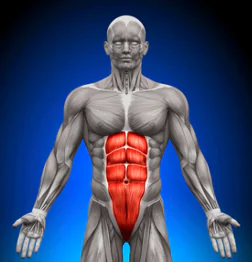
Exploding Fitness Myths: why we avoid endless ab exercise
Ab Exercise and the Myth of the Visible Six-Pack
Beltless squats and deadlifts create strong, defined abs. Those abs remain invisible if they are obscured by body fat.
The “ab plate” runs from solar plexus to crotch. An ab exercise such as the crunch contracts the top rows of abs. Leg raises attack the pelvis and lower abs. Heavy barbell squats and deadlifts dig a deeper, more extensive muscular inroad, causing the ab plate, external obliques, serratus, intercostals, erectors, lower lats, and the entire circle of torso muscles to contract hard as a unified structure.
Some myths die hard. Every ab exercise tool or device you have ever seen advertised on TV wants you to believe that abdominal exercise will melt off the fat that obscures your ripped six-pack. This myth cannot be killed. Just last night I saw an ad for a device “guaranteed” to give you “the fat-free waistline you’ve always desired.” And all that was needed, once you purchased their device, was “three, 10-minute sessions per week!” We were discrediting this schlock back in the 1980s when the first wave of “ab buster” devices hit the airwaves.
The title and subtitle of this article tell you everything you need to know about our approach toward abdominal training: we do not waste time doing endless crunches, leg raises, or direct ab exercise because our abs are strong as hell, highly developed and athletically functional. The problem is not building bigger, stronger ab muscles. We’ve got them. The problem is melting away the body fat that obscures the strong, developed abs we already have.
The Spot-Reduction Myth Will Not Die
A layer of body fat obscures otherwise defined abs from view. Abdominal exercise, at best, builds and strengthens the muscles of the abdominal region. Ab exercise does not, in any practical fat-loss sense, preferentially melt off the fat that lies atop the abdominals.
Spot reducing is the myth that falsely asserts you can magically melt body fat off a region of your choosing. Getting ripped abs is not about endless ab exercise. Getting ripped is about the skillful balancing of precision nutrition and intense exercise, including cardiovascular work that jacks up the heart rate and helps create the needed energy deficit.
There is no procedure, tactic, gadget or “ab buster” humans can invoke to force the body to draw down body fat from one chosen region. That is pure biological hubris. The athlete creates the prerequisite conditions that force the body to drain stored body fat. This is done through the coordinated juggling of nutrition, cardio, resistance training, and recovery. Once the necessary prerequisites are established and put into play, the body decides what region, what fat depot, to draw down.
Strong Abs Are Not the Same as Visible Abs
To get shredded abs, the solution is not adding hanging leg raises to your daily ab workout. The solution lies in getting control of nutrition and using metabolism-spiking exercise to create a sustained fat-burning environment.
For many men, ripped abs appear when body fat drops toward the low double digits. That is a rough visual marker, not a universal rule. Sex, genetics, fat distribution, age, skin thickness, muscle size, and lighting all matter. If you are holding a high body-fat percentage, you can do sit-ups, crunches, leg raises, broom-handle twists, and hanging frog kicks from dawn to dusk and never see defined abs.
We all have abdominal musculature. We all have the potential to show serratus, intercostals and ab ridges if enough body fat is removed without sacrificing the muscle underneath. We can shed love handles and saddlebags, but this is a matter of reducing total body fat, which depends on the expert combining of precision nutrition, sweaty aerobic exercise, and intelligent resistance training.
Fat Loss Comes From Nutrition, Cardio, and Total Training
Reduce portion sizes, clean up food content, remove or radically reduce junk foods and easy-to-overconsume carbohydrates, do a lot of cardio and lift weights. Fat loss is not caused by abdominal exercise. Fat loss occurs when the body is repeatedly placed in a sustained energy deficit while protein, training and recovery are handled well enough to preserve muscle.
Low-carbohydrate eating can be a useful tool for some lifters because it simplifies choices and reduces insulin-spiking food and drink. It is not the only way to lose body fat. The body does not care about slogans; it responds to energy balance, food quality, training stress, protein intake, sleep, hormones, adherence, and time.
Fasted cardio can be useful. It is standard operating procedure among many elite bodybuilders seeking to strip off body fat. Early-morning cardio, done before breakfast, is simple, repeatable and psychologically clean. You wake up, get it done and let the rest of the day unfold.
But fasted cardio is not magic. Fasted cardio may change what fuel is emphasized during the session, yet long-term fat loss still depends on the entire diet and training plan. If fasted cardio makes you dizzy, weak, binge-prone, miserable, or unable to train hard later, it is the wrong tool.
Why Starving Is Not the Answer
It is unacceptable to simply starve. Crash dieting often destroys too much lean muscle mass while failing to create the look the athlete actually wants. When the athlete crash diets, the body may sacrifice precious muscle tissue — what old gym culture calls muscle cannibalism — while clinging to body fat as a last line of defense against real or perceived starvation.
Muscle mass needs to be retained while attaining maximum leanness. The fat must be dissolved without cannibalizing existing muscle, a razor’s-edge proposition. This is why smart bodybuilders never rely on one magic trick. They manipulate food quality, calories, protein, cardio, resistance training, recovery, meal timing, and patience.
Old-School Bodybuilders and Endless Ab Work
Old-school bodybuilders erroneously thought direct ab work resulted in ripped abs. The more ab work you did, the more ripped your waistline would become. Bill Pearl would do 15 to 20 minutes of abs before each of his six weekly lifting sessions. Frank Zane, three-time Mr. Olympia, was famous in bodybuilding lore for marathon ab work, often hundreds upon hundreds of reps.
Retrospectively speaking, much of this was a colossal waste of time if the goal was fat reduction. The caloric expenditure associated with conventional ab exercise is wildly overestimated. Any calories burned doing even 1,000 daily ab reps could be undone by eating a burger and fries on the car ride home from the gym.
Once ab exercise is shorn of the myth of spot reducing, what should be the true goal of ab training? The ab-training goal is the same progressive resistance training goal as for any other muscle: build and strengthen the muscle or muscle group targeted. Period. Build and strengthen.
What Ab Training Is Actually For
Direct ab work can build and strengthen the abdominals. It can teach trunk control. It can be useful in specific rehabilitation, bodybuilding, gymnastics, combat-sport, or athletic contexts. The issue is not that all direct ab work is worthless. The issue is that endless ab exercise is a laughably inefficient way to reveal abs hidden under fat.
If you want to build and strengthen the abdominals in the way we value most, get really good at squats and deadlifts done without automatically relying on a weightlifting belt.
Squats, Deadlifts, and Real Core Strength
The deadlift is a massive, weighted, reverse sit-up — only way more intense, efficient and effective for our purposes. A heavy deadlift forces the deadlifter to uncoil, open, and expand compressed abs. The abs and erectors must work together to lock out a limit deadlift or keep a limit squat from collapsing the lifter forward.
The depth and degree of measurable contraction created by deadlifts and ultra-deep high-bar beltless back squats can be enormous when compared to puny ab isolation exercises. The trunk must brace, stabilize, and transmit force. The abdominals, obliques, and spinal erectors are not decorative. They are the living lifting belt.
Another fantastic ab strengthener is the high-bar squat done without a lifting belt. The idea is to perch the squat bar high on the traps, purposefully precarious, then squat ultra-deep with a wide stance and upright torso. Pull yourself down on the squat descent. Bottom out and come erect, ramrod straight. The abdominals must contract through every inch of the controlled descent and contract even harder on the ascent.
Each beltless deadlift or high-bar back squat rep forces the abs to stabilize a massive payload that wants to pull the deadlifter downward or force the squatter forward. The entire waist region — upper and lower abs, spinal erectors, external obliques, lower lats — contracts mightily and fights against a poundage wanting to destabilize the lifter. To stabilize the torso, the abs, obliques and erectors, the muscle circle, must act as a unified whole.
None of our lifters waste time doing endless direct ab work. A man with a 400-pound no-belt, ultra-deep squat and a 400-pound no-belt deadlift will have super-strong, maximally useful abs. He has attained the ab goal of resistance training.
High-Bar Beltless Squats and the Ab Plate
Beltless lifting is not a religion. A belt can be a useful tool for trained lifters. The point is that beltless work, used intelligently, forces the lifter to generate internal pressure and torso stiffness without leaning on external support.
A good beltless squat or deadlift is a total-body ab exercise, not because the lifter curls the spine like a crunch, but because the trunk must prevent collapse. The abs do not merely flex. They brace, resist, stabilize, and transmit force from the lower body to the barbell.
If you are the possessor of strong, rock-hard, athletically functional abdominal muscles, and you want to see those muscles, melt away the body fat that obscures them from view. That is the hard truth. Liberate yourself from the horror of endless, mindless, fruitless ab exercise. Stop laboring under a delusional myth. Redirect time previously spent doing endless ab exercises toward intelligent cardio, tightened-up eating, and real progressive resistance work. Settle in for 2 to 3 months. Some mythological bubbles need repeated puncturing.
Equipment Notes for Squats, Deadlifts, and Core Strength
Real ab strength, in this system, is built with basic iron and an honest training area. Lifters and facilities can compare Olympic weightlifting bars, weight plates, power cages and platform racks, and rubber gym mats.
A serious squat and deadlift setup might include a rack such as the TKO Defiant Strength Power Rack, a bar such as the Body-Solid Black Oxide Olympic Weightlifting Bar, loading such as TKO Solid Rubber Bumper Plate Sets and appropriate impact flooring such as Ecore PaveSafe Big E Tile, depending on the room, load, facility, and training style.
The equipment does not reveal abs. The plan does. The equipment simply gives the lifter a safer place to squat, deadlift, and build the trunk strength that endless floor crunches never deliver.
Safety Note for Heavy Beltless Lifting, Fasted Cardio, and Fat Loss
Heavy beltless squats and deadlifts are advanced enough to deserve respect. Beginners should learn technique, bracing, hip hinge, squat depth, warm-up jumps, and recovery before chasing heavy beltless numbers. Use proper rack safeties, collars, clear space, suitable flooring, and competent coaching or spotters when needed.
Stop or scale back for sharp pain, dizziness, numbness, loss of position, repeated technical collapse, unusual shortness of breath, or any rep that no longer resembles the lift being trained.
Fasted cardio, low-carbohydrate dieting, aggressive fat loss, and high training volume are not appropriate for everyone. People with diabetes, eating-disorder history, pregnancy, underweight status, medication concerns, cardiovascular disease, kidney disease, major injury history, or significant medical conditions should seek qualified medical or nutrition guidance before making major changes.
This article preserves Marty Gallagher’s RAW strength-training and fat-loss philosophy. It is not individualized medical, nutrition, rehabilitation, or programming advice.
Related Core Strength Reading
For a deeper companion piece on Marty Gallagher’s core-strength philosophy, read Want More Core Strength? Get to squatting and deadlifting!
RAW with Marty Gallagher, J.P. Brice, and Jim Steel Podcast.
About the Author: Marty Gallagher
As an athlete Marty Gallagher is a national and world champion in Olympic lifting and powerlifting. He was a world champion team coach in 1991 and coached Black's Gym to five national team titles. He's also coached some of the strongest men on the planet including Kirk Karwoski when he completed his world record 1,003 lb. squat. Today he teaches the US Secret Service and Tier 1 Spec Ops on how to maximize their strength in minimal time. As a writer since 1978 he’s written for Powerlifting USA, Milo, Flex Magazine, Muscle & Fitness, Prime Fitness, Washington Post, Dragon Door and now IRON COMPANY. He’s also the author of multiple books including Purposeful Primitive, Strong Medicine, Ed Coan’s book Coan, The Man, the Myth, the Method and numerous others. Read the Marty Gallagher biography here.
Marty Gallagher is a champion strength athlete, coach, author, and RAW Podcast host known for powerlifting, Olympic lifting, and serious strength training.
