
 Call us today at 1-888-758-7527

Fitness Training - Ready for Anything
Training for Competition vs. Training for Life
Training for a competition as an adult is wonderful. Whether it’s a strongman competition, a bodybuilding show, a powerlifting meet, or a Spartan Race, all of it has merit because you now have a goal, where your fitness training means something, where there is an end point to display the fruits of your hard work.
Training for all of that is great, no question about it. But what about training for LIFE? What about fitness training for any situation that you may face? What about overall “readiness” in everyday life? Can you protect yourself and your loved ones? Can you sprint at the drop of a hat? Are you in shape enough to survive a fight that lasts for more than thirty seconds? That stuff is important, it may make the difference between keeping your life or losing it and it may mean the difference between keeping your loved ones safe or in harm’s way. I’m talking about situations where it’s just you, without a weapon.
So how do you train for life, to develop a bunch of different physical qualities instead of preparing for just one competition?
Building Strength, Speed, and Conditioning
First off, in this program, you train with free weights. You must be strong and explosive. You also must train your fighting skills, so martial arts are a must, and finally, you must train to be fast and to be able to sprint for an extended period of time.
I’ve drawn up a sample week on how your program may look, with explanations and notes on setting the week up correctly.
Start Slowly and Build Into the Program
First off, if you have never done any of this or you are coming off of a big layoff from all types of fitness training, start slowly. Cut everything in half if need be. And if you have been totally sedentary, get a physical first, then start slowly.
This is the full version of the sample week. There is a lot going on here—free weights, Olympic lifts, jumps, sprints, sled work, martial arts and conditioning—so scale the workload to your training background and ability to recover. If you don't already know how to perform technical lifts such as the clean and snatch, learn those lifts properly before trying to use this exact version of the program.
How to Use the Weight-Training Percentages
Weights: Where you see % signs, use the percentage of your one rep max. If you don’t have a max, estimate on the light side and use the percentages off of that number. You don't need to perform a true maximum lift just to establish a number for this program.
If you don’t have weightlifting chains for the bench press, add 5-10% to the number that I have written with chains. On all sets without % signs, work up in weight each set until the last set is very hard, a max set of the number indicated.

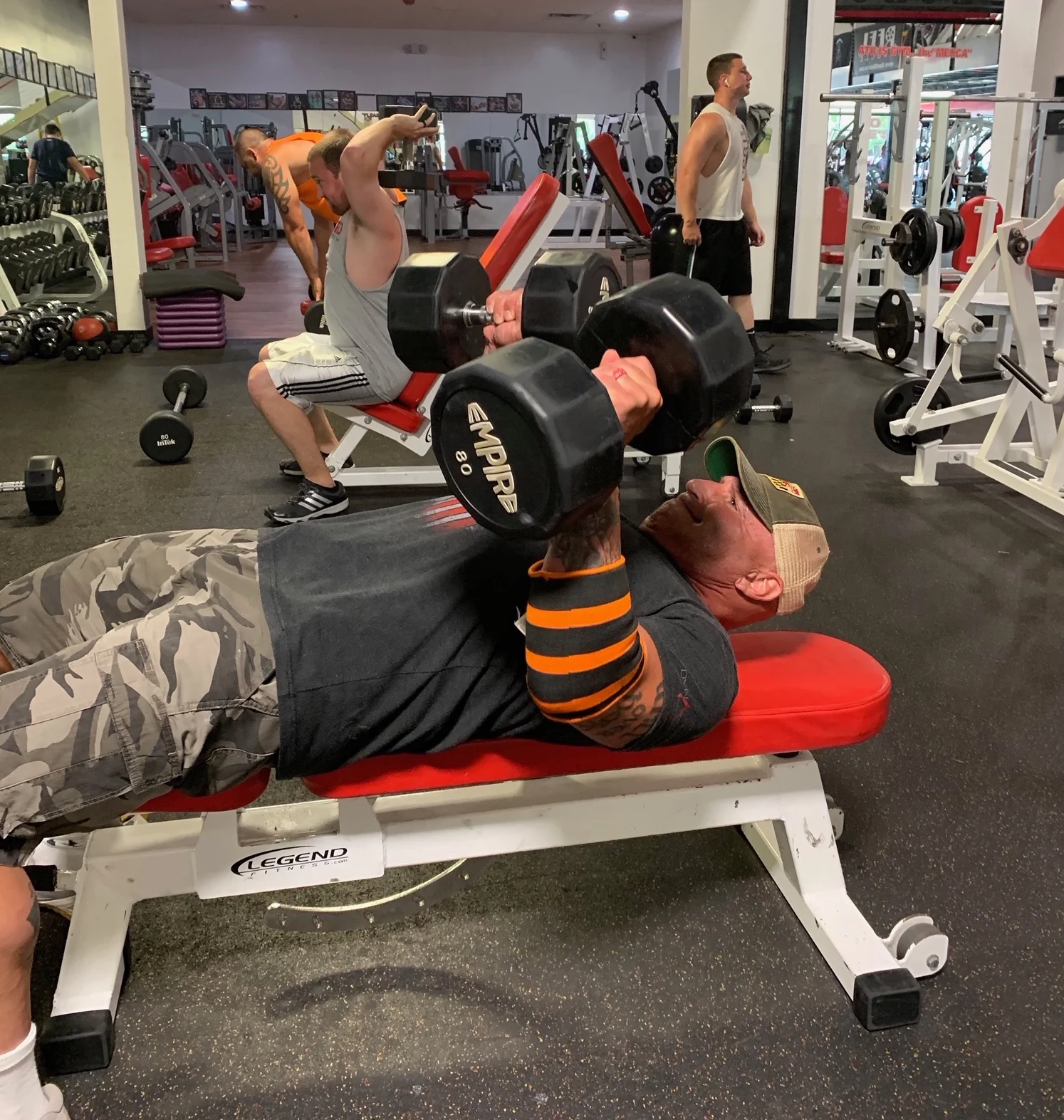
Fitness Training with free weights including barbells, dumbbells, and kettlebells
Martial Arts Training and Sparring
As far as the martial arts go, I like Muay Thai Kickboxing, because it teaches your whole body to be used as a weapon. There is nothing wrong with Jiu-Jitsu, but if you do it, I like including striking skills also.
If you have never done Muay Thai, take lessons. Look for an instructor that has fought before, preferably at a high level, and who can actually teach. I also like training in a place that offers appropriate sparring because everything changes when another person is actually responding to you.
Gauging distance, answering punches and kicks and being able to spot openings changes when you are sparring. You also learn how differently timing, distance and composure feel when you are under pressure. In my setup, some of the Muay Thai work is done with an instructor and some on your own.
Sprint and Sled Training
Also—find a football field to train your sprints. Some gyms have a prowler and push/pull sleds and a place to push them indoors. If not, use the football field for that fitness training also. Hill sprints (and stadium steps) can be done for time, for instance, performing as many reps as you can in 10 minutes (as listed in the program).
Also-perform everything as hard as you can, that means that the sprints are 100%, the Muay Thai is 100%, everything is focused, and you are supremely determined to push yourself.
Ready for Anything Fitness Training Program
Here is a sample week of fitness training:
Day 1 Monday – Fitness Training
- Box jumps: 3 sets x 5 reps.
- Squats: use % of one rep max here – 50% x 5, 60% x 5, 70% x 5, 75% x 5 sets of 5 reps and rest enough to keep bar speed fast.
- Bent over rows: 4 x 6.
- Chin ups: 3 sets, one rep short of losing form.
- One arm rows: 4 x 5.
- Glute ham raises: 3 x 8.
- Dumbbell hammer curls: 3 x 12.
- Prowler pushes: 4 sets x 20 yards, light and fast, rest period is walking 20 yards up and back. Go immediately after the rest period.
Day 2 Tuesday – Fitness Training
- Cleans: 50% x 5, 60% x 2, 70% x 2, 80% x 1, 85% x 4 sets of 1 rep.
- Push press with barbell: 6 x 2. Last set should be a max set of 2.
- Bench press with chains: 50% x 5, 60% x 5, 70% x 5. Move bar fast!
- Power shrugs with barbell: be explosive here, 4 sets x 5 reps.
- Lateral raises: 3 x 12.
- Weighted pushups: 3 sets, one rep short of losing your form.
- Triceps extensions: 3 x 12.
- Thai Pad training: 4, 3-minute rounds with a 1-minute rest. If no one is available to hold pads, hit the Thai bag instead. Move and kick and punch and knee.
Day 3 Thursday – Fitness Training
- Overhead squats: 4 sets x 5 reps.
- Snatch: 50% x 3, 60% x 3, 70% x 2, 75% x 6 sets of 3 reps.
- Front squats: 60% x 5 and 70% x 4 sets of 5 reps.
- Deadlifts: 60% x 5, 70% x 5, 75% x 6 sets of 3 reps. Move bar fast on the deadlift. Take as much rest as needed to keep bar speed high.
- T-bar rows or bent over rows: 4 x 6.
- Chin-ups: 3 sets, one rep short of losing form.
- Dumbbell curls: 3 x 12.
- Hill or stadium sprints: 10 minutes of as many as you can finish.
- Shadow boxing: 3 x 3-minute rounds with a 1-minute rest.
Day 4 Friday – Fitness Training
- Consecutive vertical jumps: 3 sets of 10 reps with a 30-second rest in between sets.
- Cleans: 50% x 5, 60% x 4, 70% x 2, 75% x 1, 80% x 6 sets of 1 rep.
- Standing press: 5 x 2, last set should be a max double.
- Bench press with weightlifting chains: 50% x 5, 60% x 4, 70% x 3 and 80% x 7 sets of 2 reps.
- Dumbbell incline bench press: 4 x 6.
- Weight plate raises for front delts: 3 x 8.
- Dumbbell shrugs: 3 x 6.
- Dips: 3 sets as many as possible with a 1-minute rest between sets.
- Sled runs: light weight here, light enough that your running form doesn’t change. 6 rounds x 40 yards with a walk back rest.
Saturday – Gassers
Start at the goal line and sprint 20 yards. Sprint back to goal line and then back 20 yards again. That is one rep. Do 3-8 reps depending on your fitness level. Walk slowly to the 20-yard mark and back for your rest period.
Sunday – Shadow Boxing and Cardio
This should be a shadow boxing day, 3-5 rounds just working up a good sweat. And walk or ride an exercise bike for 30 minutes.
There you have it, a sample week of Ready for Anything fitness training! Build into it, train it with focus, and work on becoming an all around badass—stronger, faster, better conditioned and more capable.
Recommended Products and Categories
This program uses a mix of dumbbells, barbells and Olympic lifts, so a basic free-weight setup can cover a lot of the training. Here are three relevant equipment options to consider:
- American Barbell Series I Urethane Dumbbells – A fixed dumbbell option for rows, presses, curls, shrugs and other free-weight exercises in the program.
- IRON COWBOY Powerlifting Bar – A barbell option for the squat, bench press, deadlift and other barbell strength work.
- IRON COMPANY Premium Rubber Bumper Plates – An Olympic plate option for facilities performing cleans, snatches and other barbell training.
For more equipment options, browse dumbbells, barbells, Olympic weightlifting bars, weight plates, half racks and quarter cages, and weight benches.
For more on matching equipment to the type of training you want to do, read Fitness Equipment for Fitness Goals.
RAW with Marty Gallagher, J.P. Brice, and Jim Steel Podcast
About The Author: Jim Steel
Jim Steel has been immersed in athletics and the Iron Game for most of his life. He has been a college football player and coach, powerlifter, Muay Thai fighter and is currently a competitive bodybuilder. In 1999, Steel was named Assistant Strength and Conditioning Coordinator at the University of Pennsylvania, and moved up to Head Strength and Conditioning Coordinator in 2004. He is the owner of the blog basbarbell.com, and is a motivational speaker, frequent podcast guest and the author of two books, Basbarbell Book of Programs and Steel Reflections. Steel is a Certified Strength and Conditioning Specialist with the National Strength and Conditioning Association.
Jim Steel is a strength coach, writer, RAW Podcast co-host, and IRON COMPANY contributor focused on strength training, powerlifting, and bodybuilding.
