
 Call us today at 1-888-758-7527


Larry Pacifico: Part II
Larry Pacifico and the Old-School Powerlifting Persona
Larry Pacifico was the dominant powerlifter of the 1970s. He is commonly credited in the iron world with 54 world records and nine straight world championships, and archived powerlifting results confirm his long world-title run from 1971 through 1979. Only political intrigue and injury, according to the old strength-culture retellings, kept him from winning more.
Short and athletic, Larry stood about 5-5 and had been a high school gymnast. Even at the peak of his power career, Larry could walk on his hands and do a standing backflip. He was capable of this type of athleticism even when weighing 220-plus pounds. He once, allegedly, injured himself backstage at a power competition performing a round-off back handspring in front of a gaggle of gob-smacked powerlifters, men so muscled-up that they could not scratch the middle of their backs on a bet or touch their toes without ripping a hamstring.
In competition, Larry Pacifico had an aggressive personality. He was very much taken with Muhammad Ali and Ali’s smack talk. Once at the national championships, he wandered over to my training partner, the fearsome Mark Dimiduk, who was competing against Larry in the 220-pound class.
“Hey Mark!” Larry yelled in front of a bunch of hard-ass lifters. “You look in shape — too bad you travelled all this way to finish fourth! Ha Ha Ha!”
Dimiduk was not a man easily rattled, and for a moment it looked as if Pacifico’s joke might create an entirely different competition. The beatific Don Mills stepped in and cooled Dimiduk down.
On another occasion, Larry Pacifico thought his long-running feud with a rival topflight lifter might get out of hand backstage at one of Larry’s national championship competitions. I was standing with Mark Chaillet, who had mentored under Larry, when Pacifico rolled up and said, “Mark, if ______ gets in my face, watch my back. If he ties into me, take him down!”
Mark stood up, cracked his knuckles, and nodded. Thank God that never went down. The guy Larry wanted Mark to take down had been the U.S. Army freestyle wrestling champion.
The Greatest Powerlifting Meets in the Sport
Larry Pacifico was a two-fisted American entrepreneur who, along with his brother Dick, put on the greatest powerlifting competitions in the history of the sport. These incredible strength festivals were held at the Dayton Convention Center, a beautiful facility connected by skywalk to the excellent meet hotel. The competitions were run with Swiss-watch efficiency. Larry had his people pick lifters up at the airport, and top lifters got airfare paid and free rooms.
They had a $12 lobster buffet on Sunday at the posh hotel restaurant. One year, Larry imported Klaus, the blind Hammond B-3 organ player from Austria. Klaus would get the packed house rocking, playing Groove Holmes soul riffs between lifts.
That same year, Larry had a steam-table buffet set up next to the lifting. Women with hair nets sold heaping platefuls of delicious American diner food. A bottle of beer cost a dollar. It was powerlifting Valhalla.
High Volume, High Intensity, High Recovery
As a lifter, Larry Pacifico was the last and best of the old-school high-volume, high-intensity trainers. Larry thought nothing of training his balls off three or four times a week, handling incredible poundage, body-breaking poundage, in every session, then recovering quickly and doing it again and again and again.
He trained heavy, hard and often, world without end. He trained continually, this while living an incredibly busy and demanding life. His frequency bordered on obsessive-compulsive, yet when a competition occurred, he routinely exceeded his massive training poundage by a country mile.
For example, before an August 1978 competition sequence described in Larry’s training diary material, the most he handled in the bench press was 530 for a triple, mind-blowing for a raw 220-pound bencher. In competition, he pushed the number far beyond what most lifters would expect from that training triple. Pacifico was no one-lift specialist.
He would have similar performance leaps in the barbell squat. Before that meet window, the most he squatted was 735 for a double in training, yet he could rise to the occasion under meet conditions. Larry was a meet lifter, a natural extrovert. Like Kirk Karwoski, he drew energy from an audience and used that energy to exceed realistic expectations.
From 1970 to 1986, Larry Pacifico religiously logged and notated every lifting session. He would also write a post-competition review after every competition. He created a book, Champion of Champions, a compilation of his training diary and blow-by-blow reportage of his competitions. This is a book of numbers. If you are a coach and speak the idiom, it makes for fascinating reading. You see his mind work.
Like a scientist, he made tweaks and changes. I followed his in-flight corrections and observed that he had a thoughtfulness to his brutality.
Since I speak and read fluent powerlifting, the book was a treasure trove, a guidebook on how the greatest power-volume trainer of all time did it: exactly, precisely. I might be the only man on the planet to have read this book twice. Allow me to walk you through a typical week of training with Larry. We start on Monday, July 12, 1978. Pacifico takes seven workouts over the next ten days.
A Ten-Day Window Into Pacifico’s Training Log
The sets and poundages listed below were done after Larry had completed the appropriate warm-up sets for the squat, bench press, and deadlift. As you read, keep in mind this was a 220-pound man.
| Date | Main Work | Assistance Work |
|---|---|---|
| July 12 | Squat: 615 x 2, 670 x 2, 700 x 2 Bench press: 325 x 6 for 4 sets, 415 x 3, 510 x 2 |
Triceps press with E-Z curl bar: 325 x 3 for 3 sets |
| July 14 | Deadlift: 615 x 2, 685 x 1, 735 x 1 | Pulldowns: 4 x 8 Shrugs: 425 x 8 for 3 sets Rows: 245 x 6 Triceps prones: 210 x 4, 225 x 4, 235 x 4 for 2 sets |
| July 16 | Squat: 615 x 2, 705 x 2, 725 x 1 Bench press: 415 x 4, 505 x 3, 530 x 3, 415 x 16 |
None listed here beyond the main work |
| July 18 | Chins: 4 x 10 Rows: 245 x 5, 315 x 4 |
Shrugs: 315 x 10 for 2 sets Wrist curls: 4 x 12 |
| July 19 | Squat: 615 x 2, 685 x 2, 725 x 1 Bench press: 415 x 4, 505 x 3 |
None listed here beyond the main work |
| July 20 | Deadlift isometric pulls: two levels | Four pulls, six seconds per pull |
| July 22 | Deadlift: 615 x 2, 700 x 2, 700 x 1 | Rows: 245 x 5 for 3 sets Chins: 3 x 10 Pulldowns: 4 x 10 |
At an August 6 competition, Larry Pacifico was listed in the old material as squatting 800, bench pressing 570, and deadlifting 740 while weighing 220.
- He squatted and bench pressed three times in ten days, always pairing the squat and bench press.
- He deadlifted and performed lying triceps presses twice in ten days.
- He used a wide range of assistance exercises, especially triceps, pulldowns, rows, chins, shrugs, and wrist curls.
- Squat and deadlift reps stayed brutally low: singles and doubles.
- Bench work lived in the 4-, 3-, 2- and 1-rep range, with the notable exception of 415 x 16 after 505 x 3 and 530 x 3.
Mark Chaillet mentored under Larry Pacifico and related that Larry had a huge appetite for food. Mark said Larry could eat three steak dinners for lunch at Sizzler Steakhouse. It took a lot of calories for Pacifico to push his bodyweight up to his massive maximum. At around 235 pounds bodyweight, Larry is remembered in the old iron world as having raw bench pressed 600 pounds.
Larry was a good deadlifter, a great squatter and one of the best bench pressers in the world, right there with Mike McDonald and Mel Hennessy. In competition, Larry would squat with the leaders before blowing away the rest of the world in the bench press. He had a good deadlift, and for a decade his three-lift total was almost untouchable.
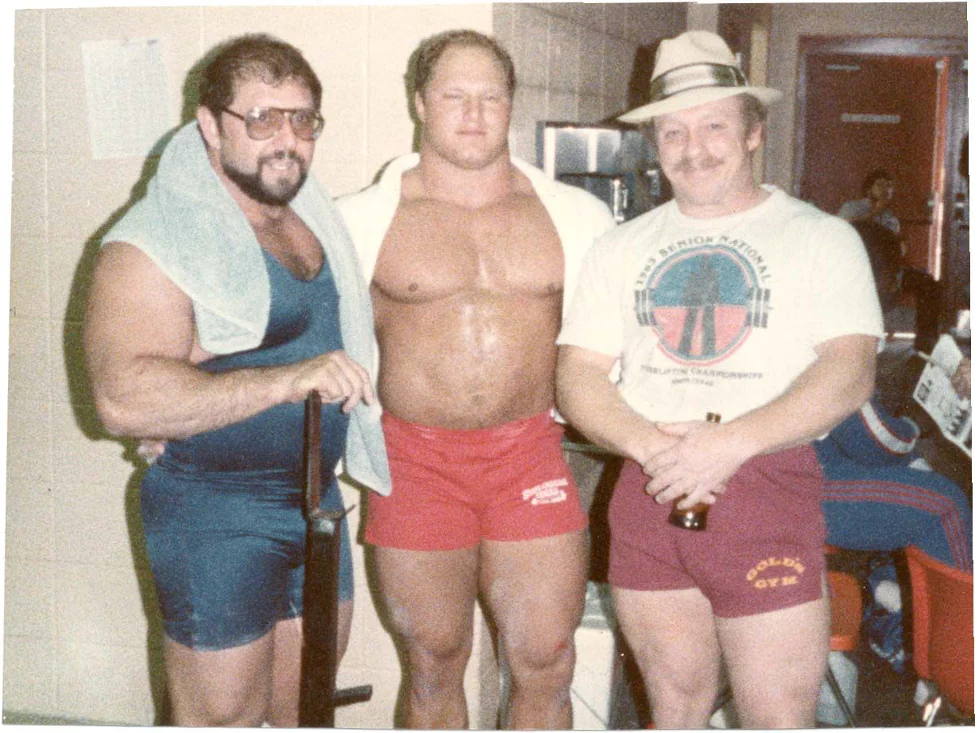
Powerlifters Larry Pacifico, Joe Ladnier, and Fred Hatfield.
Larry Pacifico, Joe Ladnier and Fred “Dr. Squat” Hatfield stand backstage after competing in the 220-pound class at the 1984 nationals. Larry still has on his deadlift suit. Joe was 20 years old at the time. Archived results list Fred Hatfield squatting 837.7 pounds at 220.2 pounds bodyweight in that meet. I was with Mark Chaillet talking to these guys when this photo was taken.
Larry Lessons for the Modern Trainee
I think much of Pacifico’s dominance lay in his inherent athletic ability, his great natural structural leverages for benching and squatting, his tremendous work ethic, a stupendous ability to recover — and his big brain. He was a student who learned and adapted.
One huge takeaway for me: though he trained a lot, his reps were always low, singles and doubles in the squat and deadlift. In the bench press, he would work up to a 4-, 3- or 2-rep set. The notable exception being when, at the end of the bench workout on July 16 — after benching 505 for a triple and 530 for a triple — he hit 405 for 16 reps.
Are there any Larry Lessons for the modern trainee?
Do you have the hunger for low-rep squatting and benching twice a week? Now add to that weekly heavy single- and double-rep deadlifts. Plus, add quite a bit of assistance work: triceps extensions, pulldowns, rows, chins, shrugs, wrist curls, and the rest of the powerlifting support menu.
Are you ready and willing to fire down the requisite calories needed to establish anabolism and accelerate recovery? If you do not fire down enough quality calories, you will not survive this kind of training. Can you take power naps and get great sleep? Can you stay hungry for big eating and big weights, relatively speaking, all the time?
It takes a certain type of lifter, with a certain type of situation and a certain type of motivation, to cope with this degree of continual pounding.
This type of training — volume and intensity — traces its roots back to Paul Anderson, Marvin Eder, Doug Hepburn, Reg Park, Norbert Schemansky and all the other greats of the pre-steroid 1950s. Regular food, and lots of whole milk in the old playbook, was used to establish anabolism. Muscle growth was the prerequisite to strength and power gains.
His approach worked for him. That much is unquestionable. The modern question is different: is the adherent willing and able to go to the outer limits needed to survive the severity of the pounding? If not, give Larry’s volume / intensity approach a wide berth.
Larry’s book, Champion of Champions, is a handbook of fanaticism. Unfortunately, this oldest of old-school approaches seems doomed to exile on the Island of Broken Toys: effective, yet ignored.
Equipment Notes for Old-School Powerlifting Training
Pacifico-style powerlifting requires simple but serious tools: a dependable bar, enough plates, stable benches, secure rack supports, strong collars, and a training room that can tolerate repeated heavy loading.
Facilities and home gyms building around the squat, bench press, and deadlift can review powerlifting equipment, Olympic weightlifting bars, weight plates, weight benches, and power cages and platform racks.
A rack such as the Arsenal Alpha-11 Power Rack, a utility bench such as the Legend Fitness 3103 Three-Way Utility Bench, a bar such as the Body-Solid black oxide Olympic weightlifting bar, and durable urethane Olympic grip plates are examples of tools that can support hard barbell training when matched to the lifter, facility, and stated specifications.
The equipment does not create Pacifico’s appetite for work. It only gives that appetite a place to express itself.
Safety Note for Pacifico-Style Volume and Intensity
Larry Pacifico’s training was an elite, historically extreme blend of high volume and high intensity. It should not be copied blindly by beginners, injured lifters, deconditioned trainees, or anyone without strong technique, recovery capacity, competent spotters and appropriate equipment.
Heavy squats, benches and deadlifts require properly set rack safeties, secure collars, conservative warm-up jumps, honest technical standards, and training partners who know how to spot. Aggressive calorie surplus, whole milk, heavy assistance work, and repeated low-rep pounding should be scaled to the athlete’s goal, bodyweight class, health, digestion, recovery, and training age.
Stop for sharp pain, dizziness, numbness, repeated technical collapse, or any symptom that changes normal movement. This article preserves Marty Gallagher’s historical powerlifting analysis; it is not individualized medical, nutrition, rehabilitation, or programming advice.
Related Larry Pacifico Reading
For a broader Pacifico profile, read Larry Pacifico: The Great White Shark of Powerlifting.
About the Author: Marty Gallagher
As an athlete Marty Gallagher is a national and world champion in Olympic lifting and powerlifting. He was a world champion team coach in 1991 and coached Black's Gym to five national team titles. He's also coached some of the strongest men on the planet including Kirk Karwoski when he completed his world record 1,003 lb. squat. Today he teaches the US Secret Service and Tier 1 Spec Ops on how to maximize their strength in minimal time. As a writer since 1978 he’s written for Powerlifting USA, Milo, Flex Magazine, Muscle & Fitness, Prime Fitness, Washington Post, Dragon Door and now IRON COMPANY. He’s also the author of multiple books including Purposeful Primitive, Strong Medicine, Ed Coan’s book Coan, The Man, the Myth, the Method and numerous others. Read the Marty Gallagher biography here.
Marty Gallagher is a champion strength athlete, coach, author, and RAW Podcast host known for powerlifting, Olympic lifting, and serious strength training.
