
 Call us today at 1-888-758-7527


Conquering Workout Stagnation
Conquering workout stagnation means understanding why the body stops responding to a routine that once worked. Marty Gallagher’s answer is not timid tinkering. His answer is contrast: new stresses, new variables, new demands, and a willingness to drop a mother-of-all-bombs on stale progressive resistance training. For lifters wondering how to break a weightlifting plateau, the lesson is simple: the body adapts, so the serious trainee must learn how to rotate, contrast, and attack.
Drop a Mother Of All Bombs on Workout Stagnation
The only constant in progressive resistance training is workout stagnation. The human body seeks stagnation; it seeks sameness, homeostasis. Modern man has a body that wants to stay the same. The body especially doesn’t like hardcore free weight training. Hardcore weight training is so traumatic that the body is forced, literally, to reconfigure itself to cope with the sustained strain and struggle that is effective weight training.
Building muscle is purely a defensive measure; when a muscle or muscle group is repeatedly subjected to stresses of a certain intensity in your workout, stress that continually and repeatedly exceeds its capacities and limits, the body builds new muscle to cope. These stresses need to exceed momentary current capacities in some manner or fashion. The body does not and will not construct new muscle to cope with stresses within its current capacities. Why would it?
Why New Lifters Make Fast Gains
Trainees new to progressive resistance training experience a predictable progressive resistance workout phenomenon: they obtain fantastic results for a short period of time. A virgin body, meaning a body that has never been subjected to progressive resistance training with a urethane barbell set, dumbbells, or kettlebells, has a low threshold for hypertrophy. Muscle and strength gains come easy — but only for the first four to six weeks. When the virgin body is no longer virgin, it takes ever greater stresses and ever more intense stimulus to trip the hypertrophy switch and replicate those wondrous, one-time virgin-body gains.
Another predictable workout phenomenon: trainees new to progressive resistance training assign magical attributes to whatever half-ass routine they happened to be using when they made virgin-body gains. The flawed thinking goes, “Don’t tell me that routine isn’t kick-ass — I got incredible gains using it!” Yeah, but that was four years ago! Factually, just about any lifting routine that causes the virgin trainee to exceed their current capacities, not hard, will be enough to trigger hypertrophy.

Gains Journal for keeping track of strength and muscle gains for maximum resistance training results.
Every Workout Routine Has a Shelf Life
Once this initial burst of workout progress subsides, the smart trainee rotates in another routine. Instead, the misguided trainee turns their favored flawed routine into a religion, sticking with it for months, if not years. Once the initial burst of virgin progress ends, there will be no more measurable gains, not from this regimen.
As soon as a trainee begins using a new body-shocking workout routine, the body begins trying to figure ways to neutralize the shock. Over time, the body acclimatizes, and once it does, what was once new and shocking morphs into familiar and is defanged of that which created critical mass.
Yet, for a variety of reasons — familiarity, laziness, comfortable sameness, and lack of knowledge — the dogged trainee doggedly sticks to the workout they know and love. The routine that was once shocking and traumatic is now fun and familiar, and worthless.
No matter how sophisticated or effective a workout routine, every training routine has a shelf-life. When the expiration date comes due, no more progress will be forthcoming. This is not to say that this routine can’t be used at some point in the future, but only after the body has “forgotten” it. Like suits hanging in a closet, use a routine, wring every ounce of progress out of it, then retire it for use at some point in the far-flung future.
The Elite Lifter Keeps a Repertoire of Routines
The elite progressive resistance trainer has a fistful of workout routines, ones used in the past and already proven effective. When searching for a progress-inducing routine to replace one that has run out of gas, the pro selects a new regimen that contrasts dramatically from the current routine that has run dry.
The common intermediate-level mistake is to recognize the need for change yet select a new workout routine that insufficiently contrasts the current routine. When the body finally finds a way to neutralize the current routine’s training effect, something radically new and different — something shocking — is needed to bust up the stagnation logjam. Again, the human body does not construct new muscle in response to stresses it is already used to; the body constructs new muscle tissue only in response to the self-inflicted trauma that is effective progressive resistance training.
The elite progressive resistance trainer anticipates workout stagnation before it has a chance to take root. Classically, typically, the hardcore trainee will stick with a program for 4-6 weeks. If progress is occurring, the pro doesn’t arbitrarily stop; they keep rolling. Experience has shown that most veins of progress lose their productiveness after a month, or two at the most.
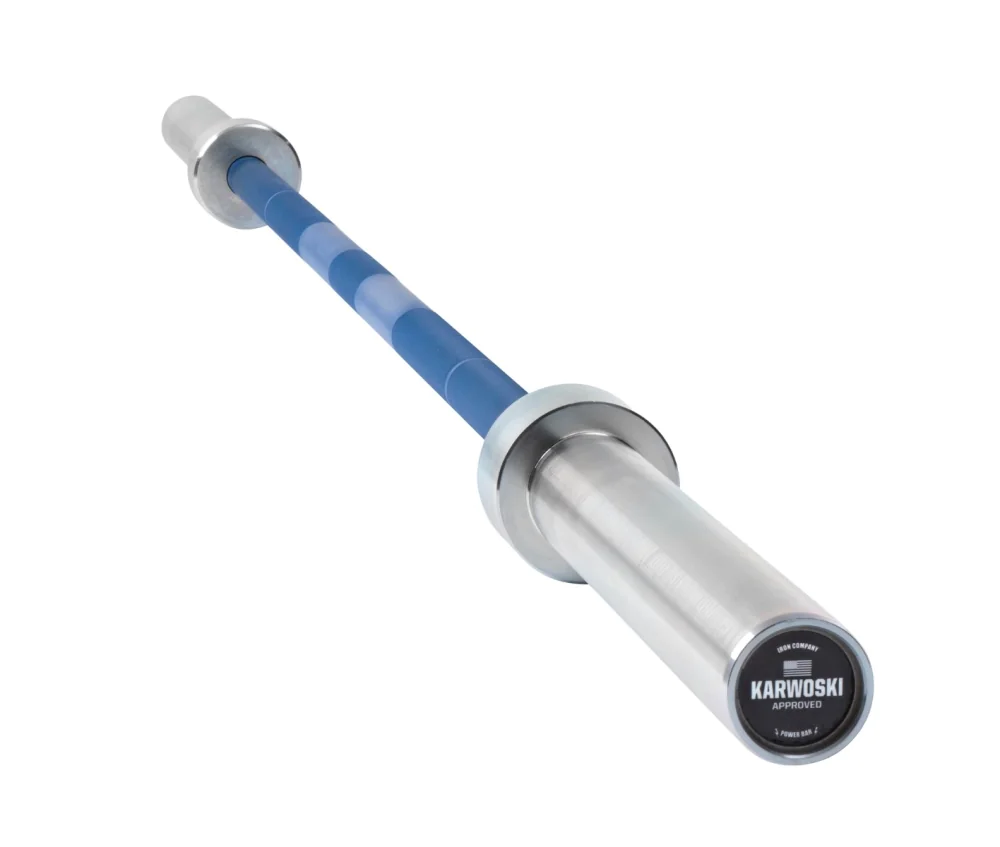
Karwoski Approved IPF Power Bar for squats, deadlifts, and bench press.
Master Change and Contrast
What to do then? Master change and contrast. Develop a repertoire of workouts akin to the 40 songs a band must know in order to play four sets a night at a nightclub. What constitutes contrast in progressive resistance training? Consider the variables.
- Frequency: how often does the trainee train each week?
- Duration: how long are the sessions?
- Intensity: how hard is the trainee training? Volume biased? Or intensity biased?
- Exercises: which movements are selected?
- Technique: what specific techniques are paired with what exercises?
- Rep speed: how are the individual reps of a set performed? Slow? Medium? Fast?
- Rest: how much time between sets? Between exercises?
- Recovery: what recovery techniques are used? Nutrition? Heat? Ice? Hydro?
Once you can identify these eight progressive resistance training variables, you can create its opposite. Establish a thesis and then construct its contrasting opposite, the antithesis.
Workout Variables That Can Break a Strength Plateau
| Current Training Thesis | Proposed Contrasting Change |
|---|---|
| Frequency: 3 times weekly | Shift to 5-6 shorter sessions |
| Duration: each session lasts one hour | Cut sessions to 30 minutes |
| Intensity: bodybuilding-biased | Powerlifting-biased |
| Exercises: lots of different exercises | Concentrate on a few select exercises |
| Technique: full range-of-motion | Purposeful partial reps |
| Rep speed: purposefully slowed reps | Purposefully speeded-up reps |
| Rest: short, timed rest periods | Long rest periods between sets |
| Recovery: power naps after training | Hydrotherapy: steam, sauna, ice bath |
Progress can be stimulated on a multitude of levels using a variety of tools, techniques, and tactics, both inside and outside the weight room. When workout stagnation takes root, only extraordinary effort will break you free. You don’t talk your way out of stagnation, you don’t ease your way out of stagnation, you blow your way out of stagnation by dropping a Bunker Buster MOAB, a mother-of-all-bombs on the thesis.
Sensible, modest, reasonable changes to your sensible, modest, comfortable training regimen will not create the critical mass required to reignite progress where none exists. Contrast is King. You don’t have to change everything simultaneously. The more stuck you are, the more variables you can goose.
For example, you could ditch your current bodybuilding-style, 5-day-a-week workout program using a high-rep moderate intensity program for a low-rep, three-day-a-week, mass-building power program. Want to lose body fat while retaining as much strength as possible? Stress the nutrition, up the cardio, and complement this lighter, leaner goal with a high-volume, moderate-intensity, high-frequency, long-session progressive resistance approach.
The Iron Elite try to get into an organic ebb and flow, back and forth, between extremes. Progress is a pendulum that swings wide between two extremes. Don’t get stuck at the narrow range at the bottom of the pendulum stroke: this is a comfortable place with little motion that leads nowhere; this is static, comfortable homeostasis. Instead, ride the pendulum to its extremes. Don’t avoid the extremes. Celebrate and master the extremes. That is where the gains lie.
Practical Equipment Notes for Workout Variation
Equipment alone does not break a strength plateau. The trainee creates the shock. Still, basic tools make it easier to rotate routines and create real contrast without turning training into a gimmick hunt. A barbell can support low-rep power work, heavy squats, rows, presses, and deadlifts. Urethane hex dumbbells can shift the stress toward unilateral work, hypertrophy training, stabilizer demand, and altered ranges of motion. Powder-coated kettlebells can add dynamic movement, grip work, conditioning, and a different training rhythm.
For home gym owners, garage gym lifters, coaches, and commercial facilities, the point is not to own every possible tool. The point is to own enough useful tools to change the training thesis when stagnation sets in. Used properly, workout variation can help restart progressive overload, rebuild momentum, and restore the hard edge that a stale routine has lost.
Frequently Asked Questions
What causes workout stagnation?
Workout stagnation occurs when the body adapts to a routine that once created progress. A workout that was once shocking eventually becomes familiar. Once the body can handle that stress, it has less reason to build new muscle, strength, or work capacity.
How do you break a weightlifting plateau?
To break a weightlifting plateau, change the training stress in a meaningful way. Marty Gallagher’s preferred method is contrast: alter frequency, duration, intensity, exercise selection, technique, rep speed, rest periods, or recovery practices so the body is forced to adapt again.
How often should you change your workout routine?
Many productive routines last 4-6 weeks, though a lifter should keep rolling if measurable progress is still occurring. The key is not the calendar alone. The key is whether the routine still produces progress in strength, muscle hypertrophy, conditioning, or the intended training goal.
What are signs of workout stagnation?
Common signs of workout stagnation include stalled strength numbers, no measurable muscle gain, boredom with the routine, reduced training drive, and a sense that the workout feels familiar but no longer productive. The routine may still feel comfortable, but comfort is often the problem.
Should every training variable be changed at once?
Not always. The more stuck the trainee is, the more variables may need to change. A lifter can start by changing the biggest limiting variables first, such as switching from high-rep bodybuilding work to low-rep power training, or from long sessions to shorter, more frequent sessions.
What equipment helps with changing workout routines for muscle growth?
Useful tools include barbells, dumbbells, kettlebells, benches, plates, and racks. These allow a lifter to change loading style, exercise selection, rep speed, range-of-motion, and training emphasis while staying rooted in serious progressive resistance training.

About the Author
As an athlete Marty Gallagher is a national and world champion in Olympic lifting and powerlifting. He was a world champion team coach in 1991 and coached Black's Gym to five national team titles. He's also coached some of the strongest men on the planet including Kirk Karwoski when he completed his world record 1,003 lb. squat. Today he teaches the US Secret Service and Tier 1 Spec Ops on how to maximize their strength in minimal time. As a writer since 1978 he’s written for Powerlifting USA, Milo, Flex Magazine, Muscle & Fitness, Prime Fitness, Washington Post, Dragon Door and now IRON COMPANY. He’s also the author of numerous books including Purposeful Primitive, Strong Medicine, Ed Coan’s book “Coan, The Man, the Myth, the Method" and numerous others. Read the Marty Gallagher biography here.

Marty Gallagher is a champion strength athlete, coach, author, and RAW Podcast host known for powerlifting, Olympic lifting, and serious strength training.
