
 Call us today at 1-888-758-7527


Yury Vlasov: Weightlifter, Writer, Politician
Another strength giant you’ve likely never heard of
At age 25, Yury Vlasov was the epitome of the new Soviet Superman. He came out of nowhere to crush the best in the world. He had only been lifting five years when he won the Olympics. In this photo, Vlasov looks incredible: muscled up, extremely lean, and possessing farm boy good looks. He stands 6’1” and at the time weighed 280 pounds. He set three world records at the Olympics and became the first man to break the magic 200-kilo barrier when he clean and jerked 440 pounds. For anyone interested in free weights, Olympic weightlifting, powerlifting history, barbells, and the rise of organized strength training, Yury Vlasov is one of the great figures hiding in plain sight.
Yury Vlasov and the Small World of Strength
In an interesting side note, the 2nd place finisher is DC native Jim Bradford, the second man in history to clean and press 400. Jim, along with Mickey Collins, was an early training partner of my mentor Hugh Cassidy. Hugh for a time tried his hand at Olympic lifting. The 3rd place finisher is Norbert Schemansky. Ski was a world and Olympic champion. He mentored Glenn Middleton in Detroit. Glenn moved to DC and taught Hugh Norb’s methods that Cassidy adapted for powerlifting. Glenn mentored me as a teen lifter. Damned small world.
Yury Vlasov’s Soviet Elite Background
Yury Vlasov led an incredible life. He was born in 1935, just in time for World War II. He was born in the Ukraine, though his parents were Russian, this is a critical distinction. Yury Vlasov’s father, Pytor, was a Comintern secret agent. The Comintern were a cadre of secret agents sent abroad, usually as diplomatic attaches assigned to the Russian embassy in foreign countries. Their real job was to whip the local communist parties in foreign countries into shape, using muscle, money, expulsions, and murder to ensure the locals understood Moscow was the boss.
Vlasov’s father posed as a military journalist working out of Soviet embassies and was eventually promoted to the Russian General Consul in China. He was stationed in Shanghai and oversaw a squad of Comintern Chinese agents. His father was awarded and promoted yet again: he became the Russian Ambassador to Burma.
Young Yury Vlasov, though he looked like a farm boy, was highly educated and a child of the Soviet elite. He was groomed for a career in the military, specifically the air force. As soon as the Second World War concluded, 11-year old Yury was sent to military school. He graduated at age 16 and was sent to the Air Force Academy. He graduated with honors at age 21. He came to weightlifting rather late in life, at age 20. Within five years he would be the Olympic champion. Young Yury Vlasov was ungodly strong but a rough technician, likely due to his late start.
From Soviet Master of Sport to Olympic Champion
Within two years of commencing training he had won the prestigious Soviet Master of Sport designation, unheard of for someone so new to a sport. In 1958 the 23-year old finished in 3rd place at the national weightlifting championships. His raw-boned physique and raw talent caught the eye of the national coaches. Yury Vlasov became a draftee: he was selected to be a state-sponsored athlete living and training with the national team in Moscow.
Keep in mind that back in the heyday of the Soviet Union, athletic supremacy had been decreed as a paramount goal by the political leadership: it was critical that Soviet athletes beat athletes from capitalist countries in order to demonstrate how socialism was superior in every way and communism was creating a new breed of superman and superwomen. The pressure was on the coaches, administrators and medical personnel to deliver gold medals at world and Olympic championships. The country was combed for genetic marvels and pre-teens were packed off to state-supported sports facilities.
The best of the best was eventually sent to Moscow to live and work with the national teams. This was also the beginning of the doping era; Russian athletes were treated like patients and guinea pigs. They were given substances, they were injected and prodded without explanation. No one was allowed to ask questions. Any infraction, deviation, or questioning would get an athlete cast out.
The Russian sport authorities would find genetically gifted children and test them in standardized ways. Those that had the genetics and scored high on benchmark tests were packed off to regional sport facilities to work under paid coaches. This was the first cut. Those that made the national team were the apex of huge pyramids. In 1968 there were less than 1,000 registered, competing weightlifters in the United States. That same year in Russia they had over 10,000 registered competing lifters in the 242-pound class alone. That is a big pyramid.
In Yury Vlasov’s day the best of the best were unknowingly “doped,” given injectable testosterone. Yury’s tall frame filled out. Lifters on the national team ate well, rested well and lived a pampered life. The competition for team slots was fierce. Young Yury muscled-up and started kicking ass: within two years of making the national team, Vlasov was the Olympic champion. At the Rome Olympics he set three world records and became the first man in history to lift 200 kilos, 440 pounds, overhead. He was proclaimed “Best Sportsman,” champion of champions, of the entire games.
Yury Vlasov went on to capture six European championships, four world championships and a gold and silver medal at the 1960 and 1964 Olympic games. He set 34 world records. At his peak he was a Soviet God. He had farm boy looks and was super smart. His physique was amazing. To me, perhaps his most amazing accomplishment was when he clean and jerked 402 pounds weighing 240 at age 69, and no, that is no typo.
Yury Vlasov as Olympic Flag Bearer
Because of his perfection, because he exemplified the Soviet ideal man, and because he was the strongest man in the world, Vlasov was selected by the premier to be the Soviet flag bearer leading the Russian delegation at two Olympics.
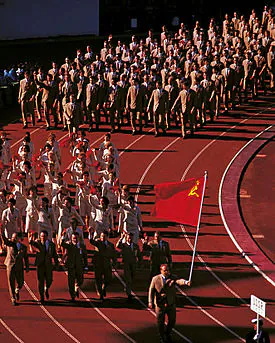
Yury Vlasov Olympic games flag bearer
Cold War Soviet Olympic officials expected the flag bearer to be the ultimate exponent of socialism: the flag bearer was expected to carry the flag through the Olympic ceremony in one hand. The flag weighed 35 pounds and sudden wind gusts increased the load. Woe be onto any athlete that bobbled, floundered, or let that flag dip. Try holding one end of a 35-pound weight plate or dumbbell out front with one hand. Vlasov had to hold it for five full minutes.
Nikita Khrushchev was a huge lifting fan. He had Yury Vlasov to the Kremlin often and regularly included Yury as part of Khrushchev’s entourage when he greeted leaders like Fidel Castro and Charles de Gaulle. His brainpower was so respected that Soviet Premier Leonid Brezhnev used Vlasov as a personal advisor on China. A third Soviet Premier, Yuri Andropov, supervised the editing of a Vlasov book, The Vladimir Diaries: Yenan, China, 1942 to 1945. The book was loosely based on his father’s espionage efforts in China. Which leads into the next fascinating fact: Vlasov was a writer of note.
Writer Yury Vlasov
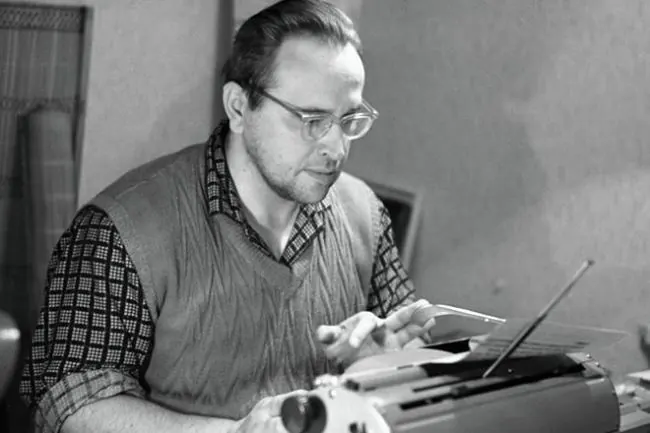
Since age 29, Yury Vlasov had been a professional writer and journalist. His short stories were published by Soviet newspapers starting in 1959. In 1961 he won a prize for best sports story from the Union of Soviet Writers. Starting at the 1962 European Championships, he began attending international competitions not only as a weightlifter, but also as a special correspondent for the major Soviet newspaper, Izvestia. Before the 1964 Olympics he published his first book, a collection of short stories titled Overcoming Yourself.
After retiring from competitions and from the military service in 1968, Vlasov dedicated himself to writing. He published fifteen novels, most notably the Flaming Cross trilogy, 1991–93, about life during and after the Russian Revolution. He published ten short story collections and his books were translated into several languages. In 1973 he edited and published his father's diaries titled The Vladimirov Diaries: Yenan, China, 1942–1945, which were translated into six languages, including English and Chinese. In that book, Vlasov uses the pen name of his father, Vladimirov.
Politician Yury Vlasov
History finally caught up with totalitarianism in 1989. The Berlin Wall fell, followed by the quick disintegration of the Soviet empire as the countries under the Soviet boot rebelled. Then the Soviet Union suffered its own implosion. It all happened with incredible rapidity: each new day saw the populace of some police-state country rise up and overthrow the gangster despot. At age 55, Yury Vlasov decided to get into politics. Vlasov had name recognition and brains and was widely urged to enter the political arena. Vlasov was elected to the Congress of People's Deputies for the Lyublyansky district of Moscow in 1989. A longtime and oftentimes enthusiastic communist, he formally and publicly broke with the communist party in 1991.
In 1993 he was elected to the State Duma, senate, of the Russian Federation. Vlasov's tenure in the Duma saw him shift his politics radically: he was elected as a liberal reformer and during his early tenure he was highly supportive of liberal reforms. When he first entered the Duma, Vlasov was a member of the liberal Inter-regional Deputies Group that included Boris Yeltsin, Andrei Sakharov and Anatoly Sobchak. He then totally abandoned his liberal brethren and adopted the politics and policies of extreme nationalists and Christian Democrats.
In 1996 Vlasov ran as an independent in the Russian presidential campaign: he was resoundingly trounced, gathering only a tiny percentage of the vote. His vision and message were tainted by his historic association with Khrushchev, Brezhnev, Andropov and the fact that his father was a covert agent and hardcore communist. He was perceived as part of the former establishment everyone was trying to get away from. He didn’t help his case by espousing blatant antisemitism. He felt much of Russia’s woes were due to a massive Zionist conspiracy that caused the disintegration of the country. He retired from politics. The complicated totality of Yury Vlasov remains: Olympic champion, Soviet icon, writer, politician, strength giant, and sport legend.
Strength Training Lessons from Yury Vlasov
The Vlasov story is not a simple “how to train” article. It is a reminder that strength history is not confined to modern powerlifting, bodybuilding or social media lifting clips. The great Olympic lifters trained with Olympic weightlifting bars, heavy pulls, cleans, presses, squats, and repeated full-body practice. The methods fed directly into the American powerlifting world through men like Schemansky, Middleton, Cassidy, and the lifters that followed them.
Modern lifters can still take the useful part of the lesson: build strength with basics, respect the barbell, and understand that the best powerlifting and weightlifting methods often share the same roots. A lifter outfitting a home gym, school weight room, commercial strength facility, first responder training room, or military fitness space should start with serious tools: a dependable bar, accurate plates, dumbbells for assistance work, and a floor that can handle hard training.
Equipment Notes for Barbell and Free Weight Training
For Olympic lifting, powerlifting-style strength training and general barbell work, IRON COMPANY customers can compare the CAP Barbell 7' Chromed Olympic Weight Bar and the Iron Cowboy Powerlifting Bar when selecting a bar for the intended training style. For loading options, urethane Olympic plates with grips and Deep Dish Olympic Plates can support repeatable progressive loading.
For assistance exercises, pressing, rows, curls and unilateral strength training, dumbbells remain essential. Commercial and high-use facilities can compare TKO rubber encased solid steel dumbbells and IRON COMPANY urethane hex dumbbells. Under the platform, rack or dumbbell area, rubber gym flooring, interlocking rubber gym tiles, or Performance UltraTile high-density flooring can help create a more durable free weight training environment.
Training and History Note
This is Marty Gallagher’s historical strength commentary, not medical advice or a modern Olympic lifting prescription. Heavy barbell training, cleans, jerks, presses, squats, pulling work, and maximal attempts require technical control, appropriate loading, coaching when needed, and sensible progression. The historical and political portions of the Vlasov story should also be reviewed with care because this article intentionally preserves the hard-edged voice and opinions of the original account.
Yury Vlasov FAQ
Who was Yury Vlasov?
Yury Vlasov was a Soviet Olympic weightlifting champion, world record holder, writer, journalist, and politician. Marty Gallagher presents him as a strength giant whose Olympic lifting career, intellect, and later public life made him far more than a barbell specialist.
Why is Yury Vlasov important to powerlifting readers?
Vlasov matters to powerlifting readers because his era of Olympic lifting influenced strength methods that later crossed into American powerlifting. Marty connects Vlasov, Jim Bradford, Norbert Schemansky, Glenn Middleton, and Hugh Cassidy as part of the same broad strength lineage.
What did Yury Vlasov accomplish in weightlifting?
In this article, Marty writes that Vlasov won Olympic gold and silver, captured European and world championships, set numerous world records, and became the first man to clean and jerk 200 kilos, or 440 pounds, overhead.
Was Yury Vlasov only an athlete?
No. Vlasov was also a professional writer and journalist. He published novels, short story collections and books connected to Soviet and Russian history. Later, he entered politics after the Soviet system began to collapse.
What is the strength training lesson from Yury Vlasov?
The practical lesson is that serious strength is built from fundamentals: barbells, heavy pulls, Olympic lifting practice, squats, presses, and full-body training. The details differ between weightlifting and powerlifting, but both sports draw from the same hard barbell roots.
What equipment supports Vlasov-style barbell training today?
A practical setup includes an Olympic weightlifting bar or power bar, quality weight plates, dumbbells for assistance work, and durable gym flooring. The exact setup depends on whether the lifter is training Olympic lifting, powerlifting, bodybuilding assistance work, or general strength training.
About the Author
As an athlete Marty Gallagher is a national and world champion in Olympic lifting and powerlifting. He was a world champion team coach in 1991 and coached Black's Gym to five national team titles. He's also coached some of the strongest men on the planet including Kirk Karwoski when he completed his world record 1,003 lb. squat. Today he teaches the US Secret Service and Tier 1 Spec Ops on how to maximize their strength in minimal time. As a writer since 1978 he’s written for Powerlifting USA, Milo, Flex Magazine, Muscle & Fitness, Prime Fitness, Washington Post, Dragon Door and now IRON COMPANY. He’s also the author of numerous books including Purposeful Primitive, Strong Medicine, Ed Coan’s book “Coan, The Man, the Myth, the Method" and numerous others. Read the Marty Gallagher biography here.
Marty Gallagher is a champion strength athlete, coach, author, and RAW Podcast host known for powerlifting, Olympic lifting, and serious strength training.
