
 Call us today at 1-888-758-7527

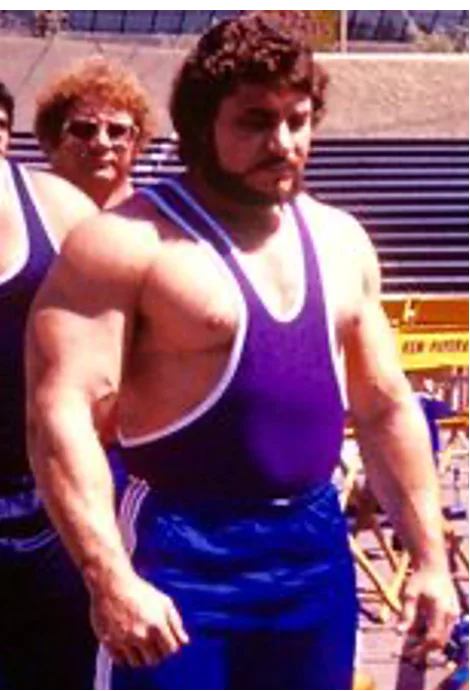
Jon Cole - Powerlifter: simply incredible
The Fast-Twitch Monster
Jon Cole, shown in the featured image, stood 5 feet 10 inches, weighed roughly 258 pounds in the photo, looked like Zeus come to life, and was married to Lynda Carter’s sister Pamela. Cole was a ball of fast-twitch muscle fiber. Weighing a few biscuits shy of 260, old strength accounts credit him with running a 9.8-to-9.9-second 100-yard dash. But that was just the tip of his athletic iceberg.
Born in 1943, Jon Cole was a sort of athletic Mozart, exhibiting from an early age an extraordinary gift for flinging and throwing things. Despite being only 5 feet 10 inches tall, brutally short for an elite track-and-field thrower, Cole set throwing marks that still boggle the mind. He was not merely strong. He was explosive in every direction.
The exact record trail for every Cole feat is not always clean. That is the nature of early strength-sport and old AAU-era history. Yet the larger truth is not in doubt: Jon Cole was one of the most multidimensional strength athletes America ever produced.
Early Throwing Talent and the Need for Strength
Cole entered high school in Arizona in 1959 and quickly became a discus phenomenon. He was named a high school All-American in the discus in 1961 and again in 1962. By the time he left high school, he was one of the top throwing prospects in the country.
At age 12, Cole began resistance training. He sought the size and strength lifting could provide. His lack of height was a definite throwing disadvantage, and to offset his shortness he compensated by using free-weight training to add thickness, muscle, and power, effectively turbocharging his inherent explosiveness.
Cole had a heavy bone structure that allowed him to add a considerable amount of bodyweight over the course of his athletic career. The body he built for throwing also became a body capable of world-class lifting.
Arizona State, Thorebeck’s Gym, and the Iron Pipeline
Jon went to Arizona State on a full-ride track scholarship. He began training at the famed Thorebeck’s Gym, one of the first truly hardcore training facilities in the nation. Members included powerlifting star John Kantor, pro-wrestling powerhouse Superstar Billy Graham — Wayne Coleman — ASU football players, scholarship sprinters and throwers. Everyone at Thorebeck’s sought the same things: muscle, power, size and strength.
Any athletic task Cole tried, he was good at. Old accounts credit him with throwing a baseball 435 feet, as measured by ASU head baseball coach Bob Winkles. He is also credited with kicking a 68-yard field goal measured and witnessed by ASU football coach Frank Kush. Within a month of first trying the javelin, Cole reportedly made one of the ten best javelin throws in the country for 1968. He also won the AAU discus title in 1969.
Those feats sound fictional. With Cole, the fictional became plausible.
Olympic Weightlifting by Brute Force
All the while he was throwing at the national and international level, Cole lifted and competed in Olympic weightlifting. He also competed in the newly formalized sport of powerlifting. The ASU community became the hotbed of lifting in the Southwest.
Jon Cole’s Olympic lifting technique was brutal. There was little finesse, little beauty, little polished international technique. Everything was bulled up, manhandled and gotten overhead somehow. Every lift looked different. Every lift looked awkward. And yet old Olympic-lifting accounts credit him with a 1,200-pound total: a 430-pound clean and press, a 340-pound snatch, and a 430-pound clean and jerk, the latter muscled and pushed to lockout in an awesome display of brute strength.
His powerlifting technique was similarly rough. His barbell squats were high by today’s IPF standards, and his deadlifts were herky-jerky, all back, and painful looking.
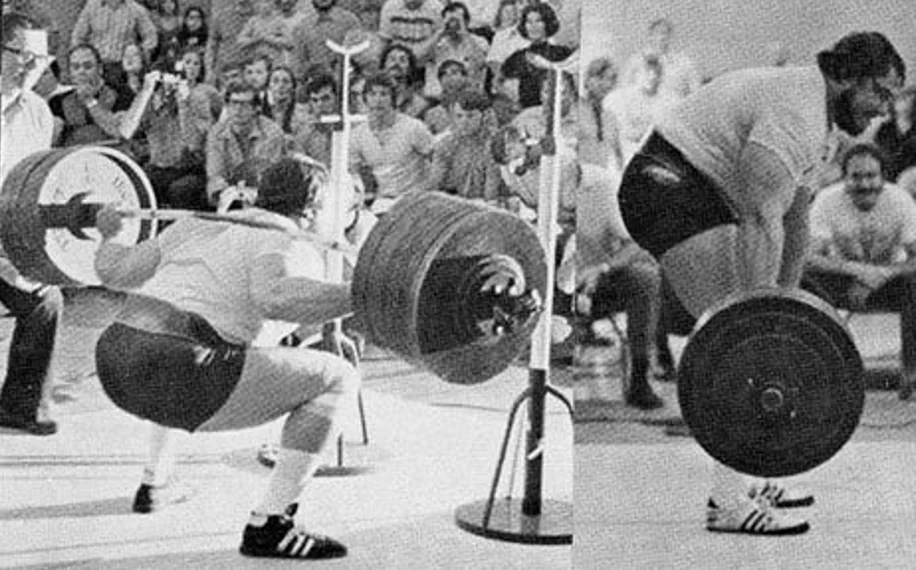
Powerlifter Jon Cole squatting in RAW with Marty Gallagher.
Cole Enters Powerlifting and Shocks the Nation
In 1968, Cole entered the AAU Senior Nationals in Los Angeles and came out of nowhere to capture the national title in the 242-pound class. The archived result lists him at 242.5 pounds bodyweight, squatting 710, bench pressing 465, and deadlifting 724 for a 1,899-pound total. He won the outstanding lifter award, given to the single best lifter of the entire competition.
In 1969, Jon skipped the AAU national powerlifting championships held in York, Pennsylvania. I sat in the front row with Hugh Cassidy as we watched George Frenn win the 242-pound title that year, breaking Cole’s squat and deadlift records in the process.
Cole came back with a vengeance in 1970. Once again, he won the national championships, this time in New Orleans, his second win as a 242-pound powerlifter. The archived line lists a 760.5 squat, 520 bench press and 779 deadlift for a 2,059.5 total. Hugh Cassidy was one of the lifters Jon decimated that day. It was then Hugh decided to move up to superheavyweight. Cassidy felt there was no way he could beat Cole in the 242-pound class.
Cole’s physique and rate of improvement were freaking the other lifters out.
In an Arizona competition, as a warm-up to the national championships, old accounts credit Cole with squatting around 800, bench pressing 525, and deadlifting 815. This was to be his last competition as a 242-pound-class lifter. As Jon got older, he found it increasingly difficult to make the 242-pound limit. He pushed his bodyweight upward and began attacking superheavyweight records.

Jon Cole’s controversial deadlift style leaned hard on brute back power and hip lockout.
Williams, Kuc, Cassidy, and the World-Championship What-If
It was announced that the first world powerlifting championships would be held in Pennsylvania in 1971. Photos of Cole breaking records appeared back East and his main competitors, the fearsome Big Jim Williams and Williams’ equally fearsome power protégé, young John Kuc, began to cast doubt — to put it nicely — on the legitimacy of Cole’s lifts.
His squats were “sky high,” according to Big Jim, and his deadlift style was “a circus trick.” Cole’s techniques would not pass muster, Williams and Kuc asserted, were he to come east and lift in the first world championships.
Cole indicated he would be there, and it shaped up as the power battle of the titans. Cole, Williams and the fast-rising Kuc would slug it out, Ali-Frazier style, at the first world championships. Jon Cole was a no-show. It was said that he tripped over a cord in an appliance store, fell and suffered an injury. As it turned out, both Williams and Kuc were bushwhacked by my mentor, Hugh “Huge” Cassidy, when Hugh pulled a clutch deadlift to win the world title.
At the 1972 national powerlifting championships, Cole competed as a superheavyweight. His lifts were subject to the same scrutiny as everyone else and he decimated the field. The archived meet line lists a massive 869-pound squat, 570-pound bench press, and 820-pound deadlift for a 2,259-pound total.
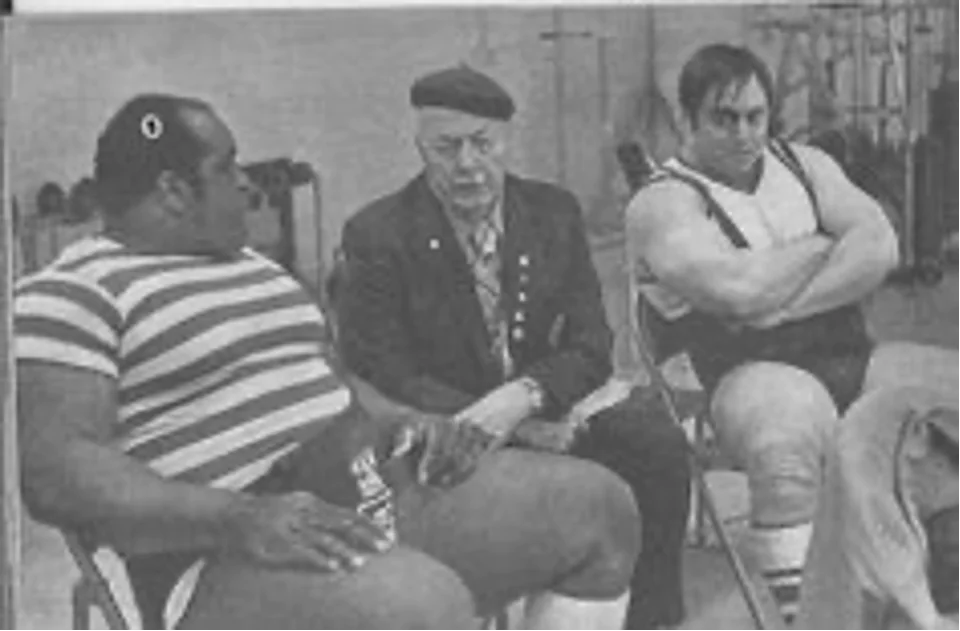
Jim Williams, Bob Hoffman and John Kuc: a snapshot of the giants Cole was measured against.
Coming off his incredible performance at the national championships, Cole was expected to lift at the 1972 world championship. Cole was again a no-show. John Kuc was on fire that year. Kuc squatted 905, bench pressed 600, and deadlifted 845 for a 2,350-pound total as he steamrolled to the world title.
Keep in mind that this was 1972 and this was Cole’s peak period for shot and discus. He was competing at a serious level in multiple sports. In addition to being world class in discus, shot and powerlifting, Cole was pushing his way up the American rankings as an Olympic weightlifter. Once again, Cole’s peak year as an Olympic weightlifter was 1972.
Jon Cole the Strength Coach
Cole became the head strength coach at ASU. He started cranking out amazing athletes on a routine basis. Hall-of-fame baseball player Reggie Jackson trained under Cole. Sack master Mark Gastineau of the Jets and Super Bowl MVP Danny White of the Dallas Cowboys trained under Jon. Old accounts also credit Cole with working with Len Dickie of the Green Bay Packers, Mike Haynes of the New England Patriots, John Jefferson of the Chargers, baseball pros Floyd Bannister, Rick Monday and Ernie Banks, plus Thomas “Hit Man” Hearns prior to a title defense.
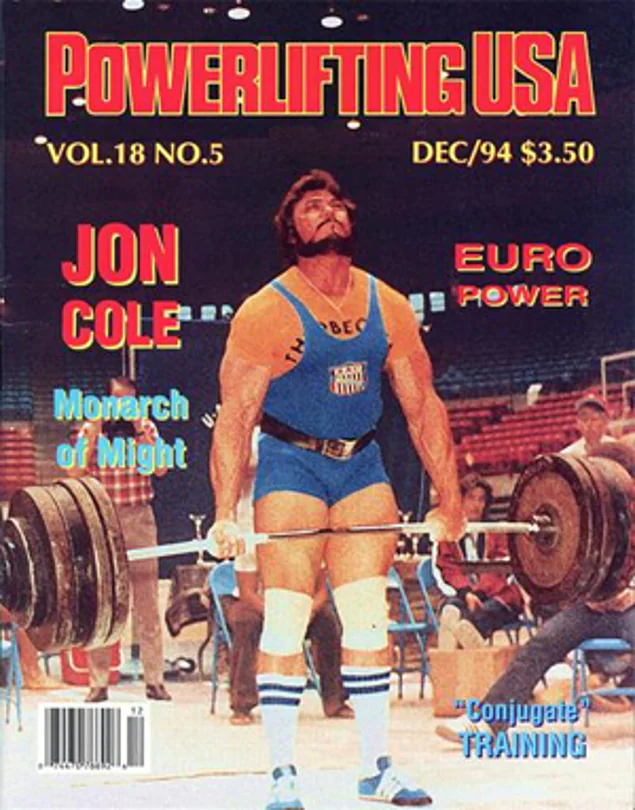
Jon Cole on the December 1994 Powerlifting USA cover.
Jon Cole was known for his savage training ethic. Having to train for discus and shot, powerlifting and Olympic lifting meant he had to cover a lot of training bases. He was also training a battalion of ASU athletes. Between training himself, training others, competition preparation and travel to compete in multiple sports, Cole virtually lived in the gym.
He was the epitome, perhaps the patron saint, of the volume-plus-intensity approach.
Cole’s Volume + Intensity Training Template
Here is a typical two-week training snapshot attributed to Powerlifting USA, February 1982. Cole would think nothing of taking three hours to work through a training session.
| Week / Day | Main Work | Assistance Work |
|---|---|---|
| Week 1 / Day 1 | Bench press: 10, 8, then 5 sets of 5 Full squat: 10, 8, 6, then 5 sets of 5 |
Upright rows: 5 x 8, adding weight each set Standing triceps press: 5 x 8, adding weight each set Standing barbell curls: 5 x 8, adding weight each set Toe raises: 6 x 20 |
| Week 1 / Day 2 | Power cleans: 5, 4, 3, 2, 1 Incline barbell press: 10, 8, then 5 sets of 3 |
Lying triceps presses: 5 x 8, adding weight each set Standing barbell curls: 5 x 8, adding weight each set |
| Week 1 / Day 3 | Bench press: 10, 8, then 5 sets of 5 Full squat: 10, 8, then 5 sets of 3 |
Standing triceps press: 5 x 8, adding weight each set Standing barbell curls: 5 x 8, adding weight each set Toe raises: 6 x 20 |
| Week 2 / Day 1 | Front squats: 10, 8, 6, then 5 sets of 3 Incline barbell press: 10, 8, then 5 sets of 5 |
Curls: 5 x 8, adding weight each set Lying triceps: 5 x 8, adding weight each set Toe raises: 6 x 20 |
| Week 2 / Day 2 | Deadlifts: 5, 4, 3, 2, 1 Bench press: 10, 8, then 5 sets of 3 |
Standing triceps: 5 x 8, adding weight each set Barbell curls: 5 x 8, adding weight each set |
| Week 2 / Day 3 | Full squats: 10, 8, 6, then 5 sets of 3 Incline barbell press: 10, 8, then 5 sets of 5 |
Barbell curls: 5 x 8, adding weight each set Upright rows: 5 x 8, adding weight each set Lying triceps: 5 x 8, adding weight each set Toe raises: 6 x 20 |
Note the astonishing amount of arm work and the relative absence of direct deltoid or lat work. Cole used the incline barbell press as his only training for the Olympic press. No jerks and no snatches were done in training.
I get exhausted just reading Cole’s workouts. It was a superhuman amount of work.
Why Jon Cole Still Matters
As he matured, Jon Cole found himself drawn out of the athletic universe and into the business universe. With his looks, brains, connections, athletic pedigree, and cutting-edge ideas, he and his methods were in high demand. He morphed into a successful businessman and strength coach.
Cole died in 2013. His athletic versatility was otherworldly. We have not seen his multidimensional equal for the past 50 years and I doubt we ever will.
He was a world-class thrower, national-championship powerlifter, credible Olympic lifter, strongman competitor, strength coach, businessman, and all-around explosive freak. In an era of specialization, Jon Cole was impossible to categorize.
Equipment Notes for Jon Cole-Style Strength Training
Jon Cole’s training universe was built around the basics: barbells, plates, straps, collars, mats, belts, and enough space to throw down hard work for hours at a time.
For powerlifting-focused training, lifters and facilities can review powerlifting equipment, Olympic weightlifting bars, weight plates, and weightlifting straps, wraps and sleeves.
The Iron Cowboy Powerlifting Bar is a relevant option for heavy squats, deadlifts, and bench pressing. IRON COMPANY premium rubber bumper plates, SnapClips barbell collars, IRON COMPANY leather weightlifting straps, Schiek 2006 wide weightlifting belt, and IRON COMPANY heavy-duty deadlifting mats all fit the broad training environment discussed here when they match the athlete, facility and intended use.
For storage in a serious barbell space, the IRON COMPANY wall-mounted Olympic bar holder can help keep bars off the floor and out of traffic.
The equipment does not create a Jon Cole. The man did that. The equipment simply gives the rest of us an honest place to try.
Safety Note for Extreme Volume and Heavy Lifting
Jon Cole’s training was extreme even by old-school standards. Do not copy his workload blindly. High-volume, high-intensity training across multiple sports requires unusual genetics, years of preparation, technical skill, food, sleep, recovery, coaching, and judgment.
Heavy squats, bench presses, deadlifts, power cleans, incline presses, and long sessions require secure collars, suitable bars, appropriate plates, proper flooring, stable racks or platforms, conservative warm-ups, and competent partners where needed.
Stop for sharp pain, dizziness, numbness, technical collapse, or abnormal movement. This article preserves Marty Gallagher’s historical powerlifting and strength-culture perspective; it is not individualized medical, rehabilitation, or programming advice.
Related Strength-History Reading
For more RAW strength-history context, read When Powerlifting Giants Walked the Earth, Larry Pacifico: The Great White Shark of Powerlifting, and Brad Gillingham Powerlifting Legend.
About the Author: Marty Gallagher
As an athlete Marty Gallagher is a national and world champion in Olympic lifting and powerlifting. He was a world champion team coach in 1991 and coached Black's Gym to five national team titles. He's also coached some of the strongest men on the planet including Kirk Karwoski when he completed his world record 1,003 lb. squat. Today he teaches the US Secret Service and Tier 1 Spec Ops on how to maximize their strength in minimal time. As a writer since 1978 he’s written for Powerlifting USA, Milo, Flex Magazine, Muscle & Fitness, Prime Fitness, Washington Post, Dragon Door and now IRON COMPANY. He’s also the author of multiple books including Purposeful Primitive, Strong Medicine, Ed Coan’s book Coan, The Man, the Myth, the Method and numerous others. Read the Marty Gallagher biography here.
Marty Gallagher is a champion strength athlete, coach, author, and RAW Podcast host known for powerlifting, Olympic lifting, and serious strength training.
