
 Call us today at 1-888-758-7527

When Powerlifting Giants Walked the Earth
A picture is worth 1,000 words. Remembrances of powerlifting days gone by.
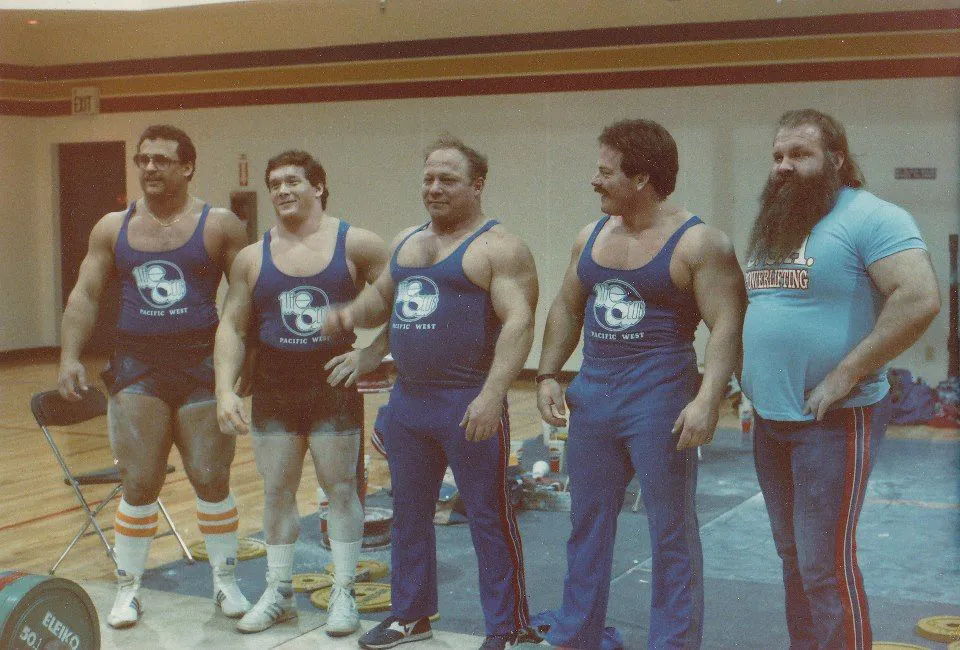
Sometimes one photograph can capture an entire powerlifting era. In this Marty Gallagher RAW remembrance, Doug Furnas, Ed Coan, Fred Hatfield, Jeff Magruder and Doyle Kenady stand as evidence of a time when the best powerlifters were brutally strong, massively muscled, and built by heavy barbell squats, paused bench presses, locked-out deadlifts, and old-school power training.
A Photo from Powerlifting Days Gone By
Sometimes a man’s mind plays tricks on him, particularly when recalling his powerlifting youth. One thing I have noticed about retired athletes, the older they get, the more inflated their accomplishments tend to become. I have a friend that once bench pressed a state record of 375-pounds in the 181-pound class, this in 1983. Currently, I believe that excellent bench press has swollen to 468-pounds and grown from a state record into a then-national record. I smile and keep my mouth shut when his retelling takes place in my presence. I am sure I am guilty of applying purple prose and amplification to some of my own memories. Some of my memories recently got reverification when, out of the blue, one of my old comrade-in-arms, GrillMan, had the presence of mind to forward me this incredible photo from yesteryear.
As soon as I saw it, I went, “So – my memories were correct! Those recollections were accurate – those guys were FREAKS!” Just as I remembered it. It has long been my contention that the powerlifting men of that era were larger and more muscular than the Olympia winners of that era. The elite powerlifters of the day were far more impressive and imposing than Frank Zane, Chris Dickerson or Samir Bannout, who between them captured seven Olympias. Dickerson had 16.5-inch arms when he won the Olympia, pathetic. Arnold once derisively described Zane as, “A chicken-body with 17-inch arms.” Starvation dieting was all the rage and bodybuilders of that time looked scrawny and emaciated. Not these guys. There are four hall-of-fame powerlifters in this one photo, and the other guy raw bench presses 600!
Why These Old-School Powerlifters Looked Different
The men in the picture were built the way they were because they “bore the weight.” Nothing was done to make powerlifting easier: no monolifts, no extra-length knee wraps, no groove briefs, no predator half-suits, no canvas suits, no double denim shirts. Barbell squats had to be below parallel and bench presses paused. Deadlifts had to be locked out and held, no stopping, no hitching, no deep lay backs and no weightlifting straps. Crisp lifts done with signature techniques. Most old timers lifted totally raw in the off-season and added “gear” in stages as the competition neared.
This type of power-training built muscle and strength in ways that were so profound and cutting-edge that bodybuilders adopted them; men like Dorian Yates kept the power training minimalistic essence while adding additional bodybuilding exercises to the training template. So who are these guys and why do they matter? From left to right...
Doug Furnas: The Greatest 275-Pound Powerlifter
Doug Furnas, on the far left, is the greatest 275-pound powerlifter of all time. Standing 5-10 and weighing a full 275-pounds, Furnas sported a 9% body fat percentile. He bench pressed 600 raw, technically he wore a size 60 bench shirt “to stay warm,” and squatted 986 like it was 135, grinning on the way up. Add to that an 826 deadlift on a lift he rarely practiced.
He had incredible legs, 33-inch thighs with a 36-inch waist, over 21-inch calves. Put a hand over his torso and gaze at his legs. Now put your hands over his legs and gaze at the torso: it looks like perfect parts from two different perfect bodies. Doug was long-legged with a short torso. At the Jerry Jones’ APF championships he became the first powerlifter in history, regardless of bodyweight, to total 2400 twice, Maui and Minnesota. He was a disciplined eater that neither smoked nor drank. Freaky impressive body, great athlete, star in rodeo, football and professional wrestling, he could do full Chinese splits and a standing backflip weighing 275.
Ed Coan: The Jim Brown of Powerlifting
Ed Coan is the Jim Brown of powerlifting. In this photo he appears to have grown into the 220-pound weight class, this after setting world records in the 181 and 198-pound classes. He is perfectly proportioned for power: long torso, short leg, wide back, huge hands and longish arms that helped his deadlift yet made his bench press push longer.
At 220-pounds sporting the body in the photo, his lifts were science fiction stuff: a 960-pound competition squat, more in training, a 550-pound raw double in the bench press and a 900-pound competition deadlift. Ed pulled 900 for 2 and 920 x 1 in training, where he didn’t have to squat 960 before being allowed to deadlift.
I find it instructive to compare and contrast Ed Coan’s physique to the physiques of the men he is standing with. Doug dwarfs him in every way; Fred and Jeff have bigger torsos and Doyle outweighs Ed by nearly 100-pounds, yet Coan outlifted all of them at their best. My theory is twofold: I suspect Coan’s tendons and ligaments are super-sized and have an off-the-chart tensile strength. I also suspect Coan was able to tap into a larger portion of his brain; his psyche was not over-the-top and demonstrative, yet it was fierce. His long-term adherence was a tribute to his tenacious mindset.
Fred Hatfield: Dr. Squat at Maximum Bodyweight
Fred Hatfield, Dr. Squat, is shown at his all-time top bodyweight of 255-260. He looks ready to burst. Fred is stuffed to the gills: he has a massive chest, and thick shoulders and arms. The distended gut comes from purposeful forced feedings. That was the era of the Hawaiian Budweiser Record Breaker competition and Fred fought for years to squat 1,000.
He essentially focused all his efforts on this quest and eventually succeeded, sort of. He squatted 1,000; however, they pulled the racks forward so he could avoid the walkout. He succeeded and birthed the Monolift. Fred stood 5-6 and during this period, while on the grand quest, he would eat often in order to forcibly grow more muscle and grow more waist to better handle 1,000. When not on the grand quest, Fred would walk around at 200-pounds. I thought he looked best when he squatted 880 weighing 220 at one of Larry’s national championships.
Fred was a bon vivant and proudly smoked and drank. Fred and British drug guru Tony Fitton and I had one memorable hotel room sit-down that lasted three hours during which two fifths of Black Bushmill were consumed. I had to crawl back to my hotel room. I wish to God I’d audio taped that bullshit session.
Jeff Magruder: Bench Press Superstar
Jeff Magruder was a bench press superstar. He is not the superstar, hall-of-fame, all-time great that the other four were. Having said that, Jeff was a bonafide bench press all-time great: he was, I believe, the 3rd man to raw bench 600, after Mike McDonald and Larry Pacifico. It was reported in Powerlifting USA that Jeff bench pressed 315-pounds for 52 reps. That’s no typo, Jack. I have never heard of another human, regardless their size, be able to handle this poundage for that staggering number of reps. Keep in mind that the NFL Combine all-time rep record with 225 is 51. 315 for 52?
Jeff was from Seattle and when I ran into him he was lifting as part of Doyle Kenady’s Pacific Northwest gang of power psycho-killers. Those boys rode into the Reno Open in 1980. I was there lifting and saw Jeff in action. Jeff was no dwarfish 242er. A lot of great benchers are great because they are thick and stocky with big chests and short arms. Jeff was like a muscled-up bodybuilder.
A big, good looking alpha male, Chaillet lovingly called him “Pumpkin Head.” A closer look at Jeff’s skull makes you do a double-take: he truly did have an outsized noggin. He was rumored to be super successful in the fitness business, perhaps on account of the extra room for brains. I suspect that the fact that four out of the five are wearing Pacific West T-shirts, excepting the counter-culture Doyle, leads me to think this was a Jeff-backed gathering.
Doyle Kenady: World Champion Lifter and Coach
Doyle Kenady was the personification of a free spirit. Quiet and bright, he had been a great Division I college athlete before turning to powerlifting. He was the second man in history to deadlift 900-pounds and a two-time IPF superheavyweight world champion. Doyle won multiple American national championships and was the greatest international powerlifting coach of all time: he was the head coach for team USA at the IPF world championships and during his tenure, Team USA won the world title six years in row, a record never equaled by any coach.
Doyle was the personification of an Old School power trainer. He stood 5-10 foot, weighed 315-pounds and mentored all the great lifters to come out of the Pacific Northwest. I fell in with his crew in 1980 when forty lifters rented two buses and drove from Portland to Reno for the Reno Open. Doyle helped me out when I was having a bad lifting day. He offered coaching and back spotted me on a critical 3rd attempt squat. He had great tactical advice that got excellent results: his fleet of Pacific Northwest lifters always were top competitors at the junior nationals and national championships. A great lifter and a greater coach. Known as Mountain Man or Grizzly Man, Doyle was a class act, steady and consistent. He was not only a world champion athlete, he was a world champion coach.
Old-School Powerlifting Equipment Takeaway
The lesson from this photograph is not nostalgia alone. These men were built by heavy, repeatable work with a powerlifting bar, serious plates, collars, belts, platforms, mats, and the kind of training culture that respected the squat, bench press and deadlift. Modern lifters, strength coaches, first responders, military fitness rooms, school weight rooms and commercial facilities can still take the useful part of the lesson: do the basics with intent and use equipment that supports real work.
For plate loading, lifters can compare urethane Olympic plates with grips, premium rubber bumper plates, and Lock-Jaw barbell collars when building a dependable barbell training setup. For support gear, options such as a leather powerlifting belt, Schiek 2006 wide weightlifting belt, and perforated neoprene knee sleeves can support different training preferences.
For deadlift-heavy training, heavy-duty deadlifting mats can help define a pulling area. For assistance work outside strict powerlifting competition, pulling accessories such as Pioneer leather weight lifting straps or Schiek power lifting straps can be useful when grip is not the target of the session. Bodybuilders and strength athletes adding accessory work can also use IRON COMPANY urethane dumbbells to build muscle around the foundational barbell lifts.
Powerlifting Giants FAQ
Who are the powerlifting giants in this article?
The article discusses Doug Furnas, Ed Coan, Fred Hatfield, Jeff Magruder and Doyle Kenady. Marty Gallagher uses one old photo to remember an era of powerlifting when the top lifters were massive, brutally strong and technically distinct.
Why does Marty Gallagher say these powerlifters “bore the weight”?
He means they handled the weight under stricter and more primitive conditions than many later lifters. Squats had to be below parallel, bench presses had to be paused, deadlifts had to be locked out and held, and supportive gear was far more limited.
Why does the article compare powerlifters to bodybuilders?
Marty argues that the elite powerlifters of that era were often more muscular and imposing than the top bodybuilders of the time. He connects that look to heavy power training, big barbell lifts and the physical demands of the squat, bench press and deadlift.
What made Ed Coan so special in this group?
According to Marty, Coan was smaller than several men in the photo yet outlifted them at their best. Marty credits Coan’s proportions, connective tissue, ferocious psyche and long-term adherence as part of what made him the Jim Brown of powerlifting.
What equipment supports old-school powerlifting training?
A practical setup starts with a powerlifting bar, Olympic plates, secure collars, a belt if the lifter uses one, and a safe area for squats, bench presses and deadlifts. Deadlifting mats, knee sleeves, straps for assistance work, and dumbbells can support related training.
Is this article a modern powerlifting program?
No. This is Marty Gallagher’s historical powerlifting commentary and personal remembrance. It is valuable for understanding the attitude, standards and training culture of the era, but modern lifters still need appropriate programming, technique and judgment.
About the Author
As an athlete Marty Gallagher is a national and world champion in Olympic lifting and powerlifting. He was a world champion team coach in 1991 and coached Black's Gym to five national team titles. He's also coached some of the strongest men on the planet including Kirk Karwoski when he completed his world record 1,003 lb. squat. Today he teaches the US Secret Service and Tier 1 Spec Ops on how to maximize their strength in minimal time. As a writer since 1978 he’s written for Powerlifting USA, Milo, Flex Magazine, Muscle & Fitness, Prime Fitness, Washington Post, Dragon Door and now IRON COMPANY. He’s also the author of numerous books including Purposeful Primitive, Strong Medicine, Ed Coan’s book “Coan, The Man, the Myth, the Method" and numerous others. Read the Marty Gallagher biography here.
Marty Gallagher is a champion strength athlete, coach, author, and RAW Podcast host known for powerlifting, Olympic lifting, and serious strength training.
