
 Call us today at 1-888-758-7527

Dave Jacoby: Powerlifting in the Competitive Foxhole
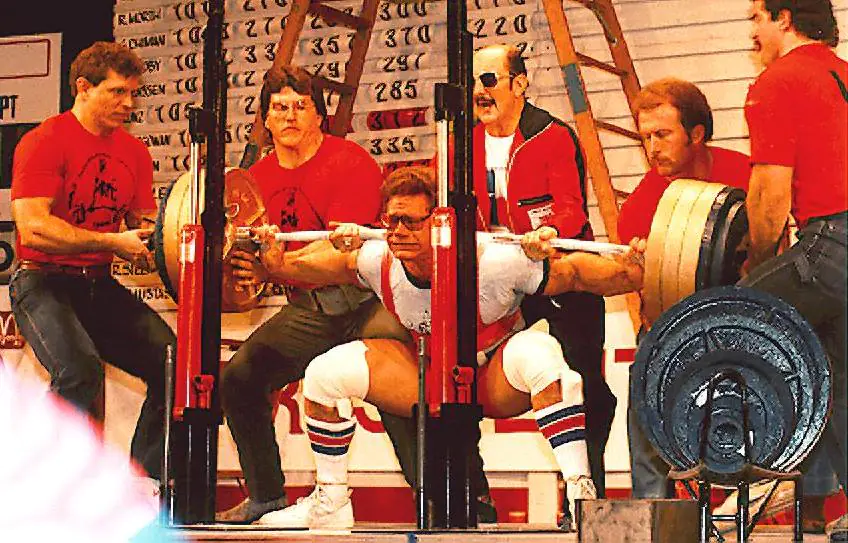
“Revenge is a dish best eaten cold.” Dave Jacoby sinks low with 844 at the 1992 Birmingham world championships. This was the “Paybacks are a bitch” final world championship win.
In elite powerlifting, the competitive foxhole is not a metaphor thrown around lightly. It is the place where the squat, bench press and deadlift are decided under lights, under pressure, and often under physical distress. This Marty Gallagher RAW article preserves a firsthand account of Dave Jacoby, a quiet family man who became a terrifyingly reliable world championship lifter when the barbell, the crowd and the moment demanded it.
American Powerlifting Dominance and Overseas World Championships
Back in the 1970s and 80s, American powerlifters usually put in subpar performances when winning the world championships. Winning the world championships was a veritable walk in the proverbial park compared to the competitive hell of winning the American nationals and securing a slot on the world championship team. While setting world records at the US nationals was rather commonplace, setting world records at the world championships was exceedingly rare.
A lot of times an American lifter needed a world record or world record performance to win at the nationals. At the world championships the American lifters were, more often than not, so far in front of their foreign counterparts that the Yank usually won the class simply by making his opening attempts. We were that good and that deep back then.
Few Americans set world records at world championships and there were numerous reasons: the hassle of overseas travel, cabs, buses, trains, boats, jets, layovers, customs coming and going, missed connections, jet lag, time differences and bad weather. Above all other impediments was eating strange food for protracted periods. It all combined to make it hard to set records.
The world championships were locked out of America for a decade over a series of lawsuits. Ergo, the world championships were always held overseas and usually somewhere in Europe. The collective US team would usually gather in New York to board a plane to travel to the world championships as a unit.
Travel sucks for oversized powerlifters and overseas travel doubly sucks. Imagine being massive and being wedged into a succession of tiny seats on planes, boats, buses, trains and cabs for hours on end, only to arrive at the final destination and find out the accommodations suck, the locals suck, the food sucks and everything is super expensive. The realization hits you and you realize you are stuck in this foreign hellhole for another seven days before you lift.
Indeed, the prevailing thinking of the day, the 70s through the 1990s, was that to maximize performance, an athlete needed to arrive and acclimatize to the time difference. This required showing up a full seven days before competing. The science on acclimatizing was convincing on paper, but the empirical reality proved to be quite different. What was overlooked was the negative impact on performance bad food and alcohol abuse had on performance. Most coped with being exiled in Bratislava, the Ukraine or Orebro by drinking with hard drinking teammates.
Dave Jacoby: Powerlifting Super Star
One lifter that never seemed to become aggravated by the travails of travel was Dave Jacoby. Dave stayed apart from it all and above it all; he had a lovely wife, quite attractive and smart. Older than Dave, she had an older daughter by a previous marriage. Dave and the two girls would make an annual pilgrimage to accompany him to the world championships. It was a massive family field trip and you would see them around town, sightseeing and doing classical touristy things while the rest of team USA were slumped on barstools.
The Jacobys travelled with an armada of expensive luggage, silver cases all on wheels; the Jacobys packed heavy when they traveled. They stayed separate from the team and apart from all the alpha male shenanigans. Outrageous boy behavior always occurs when male athletes go on long road trips.
Dave Jacoby lived in Ohio and was a bit of a mystery man. The word was that he was a long-haul trucker and was only able to train once a week. That in and of itself was amazing. Despite repeated enticements, he never lifted for either of Ohio’s other powerhouse power teams, Larry Pacifico’s Power Elite out of Dayton, or Black’s Gym out of Cleveland. All the top lifters and coaches admired Jacoby as a lifter and as a man.
Dave Jacoby was a good-looking dude, quiet, unassuming, soft spoken, and humble. Yet, when it was time to throw down, this is the man you wanted with you in your foxhole. He always came through; he always found a way to win.
Jacoby’s Signature Squat Technique
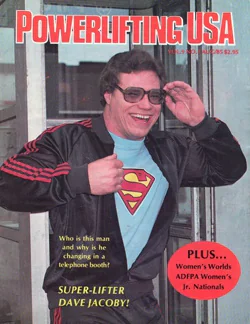
In competition Dave Jacoby morphed from Mr. responsible family man, a mild-mannered Clark Kent, Dave wore big goofy nerd glasses, into an insane-O Superman. Not a nice Superman, a scary bizzaro Superman. Dave had lots of muscles and used mind-blowing signature power techniques and super psych to complete his lifts. I once watched Dave from the wings at the nationals, standing next to power icon Doug Furnas. Doug was usually unemotional; cool to the point of icy. We watched together as Dave made a clutch 3rd attempt squat with 876.
We had a perfect side-view of his squat. Dave used a crazy, seam-splitting set-up: it took him six steps, to each side, wide, wider, wider yet, to attain his signature, wide-stance, upright, all-leg squat. After setting up, he released his knees, sat back and began a slow and precise descent. At parallel, he released his hips, free-fell for 2-3 inches, put on the brakes and caught the rebound as he stood erect with the barbell. As the three white lights came on, Furnas started uncharacteristically shaking his head while muttering, “Textbook! Textbook!”
The 1991 IPF World Powerlifting Championships
Entering into the 1991 IPF world powerlifting championships, Dave Jacoby was the multi-time defending world champion and favored to win the title and win it with great ease. At that point in time, Dave’s best competitive three-lift total was an insurmountable 100 pounds ahead of the world’s best foreign lifters. In those days making the US team was much harder than winning the world championships.
If you won the US national championships you won a slot on the world team, simple as that. The incredible depth of strength talent in this country in those days was astounding. Beating the best foreign lifters at the world championships was usually a comparative cakewalk compared to winning the US nationals.
While back home Jacoby might have to slug it out with Willie Bell, Thor Kritsky, Kirk Karwoski, Joe Ladnier or Steve Wilson, each man having held or set world records. Amongst foreign 242-pound class lifters, none of Dave’s competitors had held a world record in any lift. Jacoby was typical of the great lifters of that era in that he was built like a proverbial brick house.
I was thrilled when Jacoby asked for me to be his lifter coach. I respected and admired him as an athlete and had long been a real fan; he was a class act. At the worlds we had our first ever conversation when he arrived to lift. He seemed affable and quiet and shy. He spoke soft and I was flattered that he knew who I was. When it was time for the 242-pound class to commence warming up, numbers coach Sean Scully, Dave and I huddled up.
Warm-Ups, Music, and Platform Timing
He would open his squats with 771. Ergo, he would need seven warm-up sets. As a seasoned backstage coach, I wore my watch and used it to drive our warm-up system: every five minutes the lifter would take a warm-up lift. We would be through all seven warm-ups in exactly 30 minutes. The strategy was to start warming up exactly 30 minutes before the start of the 242-pound class.
Most US lifters would use music to try and relax, distract and distance themselves from the chaos that inflected the backstage area of any national or IPF world championships. Every three minutes I would attract Dave’s attention as he listened to his music. I would raise one finger, indicating that he should get ready to take a scheduled warm-up attempt. I would have two or three teammates at my disposal.
I breathed a sigh of relief when we got him through his warm-ups exactly as planned and exactly on time. They announced over the public address system that he would be the next lifter and he and I walked out onstage into glaring lights. As he appeared, the Europeans whistled and blew their weird little pink plastic air horns they bought at the meet from vendors, and cowbells, they banged cowbells and chanted.
It was startlingly bright as you walked onstage. Swedish TV was filming. The ancient hall was well-lighted, well-kept, ancient, wooden, a spotless auditorium packed to overflowing. Dave chalked his hands and leaned forward toward me, “DO IT!” He yelled. This was my cue to slap him across the face. He was the first and only lifter I’ve ever slapped. I am not a fan of the slap and in the past refused to administer or receive. This was different and I was indifferent and my pathetic little slap was worse than none.
The audience howled with delight when I slapped Dave like a ten-year old throwing a tantrum. I heard snickering and experienced mockery. Dave looked at me wide-eyed, wild eyed, with a crazed look of exasperation. He yelled, “C’MON MARTY! THIS IS FOR REAL!” With that, I drew back and blasted him so hard it left a hand print. He actually said, “Thank you!” He then wheeled and roared out onto the platform. His squat was picture perfect.
I slapped him several times that day. I slapped him so hard that the next day my hand was swollen. Dave saw me in the lobby a few days later and upon examining my still-swollen hand said with a wry, slightly manic grin, “Thanks for taking one for the team Marty!”
The Missed Squat and the Coach-Lifter Covenant
Dave had not had the best of training cycles leading up to the 1991 world championships. Still, on his worst day and on everyone else’s best, he wins easily. It was decided he would do enough to win, which should be an easy thing because he was that much better than the rest of the world. After a lovely second attempt success with 804, coach Sean Scully walked to our group and announced that he had put in Dave’s 3rd attempt squat at 832 pounds. Dave exploded, “DAMN SEAN! That’s a BIG jump!”
This outburst from the unflappable Dave Jacoby sent a cold chill down my spine. Sean was visibly shocked. When in top shape, Dave was consistently capable of an 850-870 squat. Here in Sweden, Dave was nursing a thigh injury. “That 804 felt heavier than it should have.” He said by way of explanation. The champ was off and maybe a little more than he’d let on.
Sean had worked with Dave before, and felt like even on a bad day, and based on his own visual impression of the 804, Sean felt that 832 was a conservative jump. The champ apparently felt different. And besides, he didn’t like not being consulted ahead of time. We told the lifters, “You make the first two attempts for the team. We pick for you on the first two lifts: you pick the 3rd attempt.”
By not consulting Dave prior to selecting the 3rd attempt squat, “Someone should have thought to ask me,” we had violated the coach-lifter covenant. Dave missed that 832-pound squat and I felt we had missed it for him. Had he made an 821-pound 3rd, he would have accumulated an unassailable lead. He would have won the world championship right then and there. Instead, we were in for high drama.
The King of the 242s had a “nice” lead and Dave was one of the world’s best bench pressers and one of the world’s best deadlifters. We collectively blew off the squats the instant they were over.
The Pec Tear and the Sharks in the Water
We got him warmed up for the bench presses. He was a complete professional and this was not his first rodeo. Dave warmed up in a relaxed, quiet, focused way. We opened his bench press with a piece of cake 458. He pressed it effortlessly and received three white lights. As I waited just off the weightlifting platform, I noticed that he was struggling a bit to get up off the bench. As he stood, turned and walked towards me, his left hand was supporting his right elbow. His face was contorted in pain. He looked me in the eye and said, “We got a problem…”
He had torn a section of his right lower pec; the fibers had ripped off the bone and he was already starting to discolor into purple, the color of blood pooling beneath the skin. Oh shit, I thought, something that had never occurred to me occurred to me: Does the defending world champion have to pull out of the competition?
A bleeding Dave Jacoby, literally and figuratively, was suddenly thrown into a swimming pool full of sharks. It seemed as if every lifter in the 242-pound class smelled blood and was immediately reenergized. They had all worked out their final competitive placings; however, if the King unexpectedly suffers a serious injury and if he is out, or if his bench/deadlift poundage is dramatically reduced, then the world title was up for grabs.
The crowd and the other lifters became animated at our misfortune. Frantic foreign conversations, rapid fire, loud, aggressive, guttural Germanic, harsh Finn, Russian Slav slang, Chinese, Japanese. At a full-blown IPF world championships, invariably held abroad, English is a minority language. Our Dave entourage made its way back to the corner of the warm-up area. All of the team was there as our stars, Kirk and Dave, were lifting that evening.
A circle of four assembled. Everyone else was kept at arm’s length and out of earshot. The four included Dr. Richard Herrick, MD, team doctor; coach Sean Scully, me and Dave. Sean spoke as I scanned the faces of the crowd; a considerable number of people had gathered and stood watching us. Foreign coaches and their underlings were watching us intently, waiting for us to come to our decision. They would then run back to their teams and finalize their various assassination plots.
There was no question that Dave was done bench pressing. The only real question was: could he continue? Could he deadlift? If so, how much? Dave grimaced as he clutched the ice pack to his purple pec. Sean asked point blank. “Yes or no Dave? Can you go? Can you pull one deadlift? In competition with no warm-up deadlifts? If so, if you can pull, how much?” Dave pondered and said, “Put me in at 704.”
Trench Warfare in the Deadlift
The five-time world champion was in deep trouble. Dave’s closest competition was a Norwegian, a good lifter, never a great lifter, a man that consistently placed in the top five in the world. Sean had to lower Dave’s 340 kilo opening deadlift to 320 kilos and the instant Sean lowered Jacoby’s deadlift, coaches were scrambling with notepads and pencils.
Whatever Dave deadlifted, the Norwegian lifter would have to deadlift 10 additional kilos, 22 more pounds. Dave was the heavier of the two lifters and in powerlifting, ties are decided in favor of the lighter man. Thus, the lighter man need not defeat his opponent, just tie him in the three-lift total, and be awarded the higher placing by virtue of being lighter.
Dave stood when he was about ten minutes out and began to pace in an attempt to limber up. He was a ball of pain and simply straightening his arm made him yelp. No warm-ups: we didn’t want to risk it. He was fine with the idea. He would take his pain medicine where it counted, on the platform, at the world championships fighting it out, trench warfare style, for the world title. If something was going to rip or tear, let it be on the platform during battle, not in the warm-up room. It was time.
I led the way for the Team USA posse as we made our way from backstage up the narrow stairs and onto the stage. We walked out into the hot bright TV spotlights and he chalked up. His name was called. You would have thought they had just announced Satan. Whistles, horns, boos, a totally negative vibe, palpable and real, hung thick in the hall. I pulled his lifting belt for him as Sean found the hole for the belt tongue. He chalked his hands and leaned into me, “C’mon Marty – DO IT!” He didn’t have to ask twice: I walloped the injured champion’s face with every ounce of strength I had.
Dave looked maniacal as he spun and strode to the lifting platform. The crowd volume crested as he set up and then with surprising ease pulled 704 to lock out. Was it my imagination or did the Bulgarian head judge make him hold the bar at lockout for an extra-long time? Dave dropped to one knee in agony as he replaced the barbell; he got up holding his bad arm with his good arm. He was making his injury worse.
The Norwegian countered with an easy 722 to tie and take the lead by tying in the total and being lighter. Our foursome reconvened and Dick Herrick stepped in and made a strong case for Dave bagging it right then and there. Dick was sensible and reasoned and responsible, yet after hearing Dick out, Sean blew right on past all the sane and reasonable talk and confronted Dave, “One more deadlift – yes or no??? Right now answer the question.” Dave said, “Yeah! One more!”
We put in 722 for Dave’s second deadlift. This proved to be a repeat of the first attempt. Dave was a wide-stance sumo deadlifter who relied on his incredible leg power to routinely pull 770 to 800 pounds in competition. He pulled the weight but this pull was shaky from start to finish. Once again he went to one knee after replacing the barbell. It was another three white light success and he retook the lead.
Now his injury was starting to freeze up. He moved awkwardly. We made our way backstage and we were quiet. Jacoby sat, miserable, clutching fresh ice. What was there to say? “Hey Dave, you can do it!” or “Hey Dave win this one for the USA!” or my favorite, “USA! USA! USA!” That lame-o stuff might happen in movies, but it doesn’t happen in Real World.
I made my way out front to watch the Norwegian handle his 744. I took a good look at him: he was lean and athletic looking with a dark beard. Like Dave, he was tall for the class. He looked like a good deadlifter. He pulled 744 quite easily. He and his mates were fired up: they smelled blood. Their man had tied Dave and was forcing him to do more or lose. He was looking to be the ultimate benefactor of Jacoby’s injury.
After he replaced the tying second attempt deadlift to the platform, he leapt skyward three feet and punched the air with his fist. When three white lights came on, the audience began soccer-chanting.
I returned backstage to the American contingent. I didn’t have to verbally tell anyone that the Norwegian had smoked the weight. It didn’t matter. Dave sat on the folding chair and waved his good hand. He said this without looking at anyone. “There is no strategy here - the most I could realistically handle is 733 – so go put that in.” We did.
It would be nice to say that Dave Jacoby successfully pulled his third attempt deadlift and the Norwegian failed his final deadlift and Dave won – but that didn’t happen. The 733 seemed glued to the floor. It was anticlimactic. The crowd cheered his failure; the Norway posse went wild, leaping about and tossing the new world champion high into the air, much to the crowd’s delight.
Dave was ignored in the celebration. He stood and walked off the platform. I walked next to him and said, “You were incredible.” I had no idea if he would be devastated or shattered by this unexpected loss. He looked at me with a blank expression. He was hardly shattered. In fact, he appeared pissed off. Still hurting, he glanced over at the jubilant Norse dudes that were whooping it up at his expense. Their celebrations would go on far into the night. Dave clutched his arm tight, he thanked me and walked off with his wife.
The Revenge Year: Jacoby’s Final National and World Championship Wins
The next year a vengeful and merciless Dave Jacoby put on a one-man blitzkrieg as he mowed down friend and foe alike to win his final national championship and then his final world championship. He steamrolled the best in the nation and then decimated the best in the world. He then hung up his lifting belt and rode on off into the sunset, like Shane after mowing down Jack Palance. Dave Jacoby administered a can of whoop-ass and then drove off in his diesel truck, never to be seen again.
Training Note: Competitive Psyche Is Not a Safety Recommendation
This article preserves Marty Gallagher’s firsthand powerlifting account and the hard-edged competitive culture of the era. The face slapping, lifting through serious injury, and battlefield language are historical storytelling, not a recommendation for modern lifters. Today’s powerlifters, strength coaches, first responders, military athletes, bodybuilders, and weightlifters should use judgment, competent coaching, appropriate spotting, safe equipment, and medical guidance when injury is suspected.
Powerlifting Equipment Takeaway
Dave Jacoby’s story is about competitive nerve, not equipment shopping, but elite powerlifting still depends on serious basics. A lifter training the squat, bench press and deadlift needs dependable free weights, a stable rack or platform setup, a strong bar, and a belt that supports the way the lifter trains.
For home gyms, commercial strength rooms, school weight rooms, first responder facilities and military fitness spaces, IRON COMPANY customers can compare power racks, cages and platforms, the Alpha 11 Power Rack, and the Body-Solid Commercial Power Rack when building a barbell training area. For serious pullers and squatters, the Iron Cowboy Powerlifting Bar is one option to consider for heavy powerlifting-style training.
Support gear should match the athlete, the lift and the training environment. Lifters looking for a powerlifting belt or weightlifting belt can compare the Schiek L6010 Competition Powerlifting Belt and the Forged Passion Leather Weightlifting Belt based on fit, feel, training style, and personal preference.
Dave Jacoby Powerlifting FAQ
Who was Dave Jacoby?
Dave Jacoby was a world-class American powerlifter in the 242-pound class, described by Marty Gallagher as quiet, humble, and unassuming outside competition, yet ferocious and dependable when it was time to lift.
What happened to Dave Jacoby at the 1991 IPF world championships?
According to Marty Gallagher’s account, Jacoby entered as the defending world champion, missed a key squat, tore part of his right lower pec during the bench press, and still attempted to win the world title through the deadlift while badly injured.
Why was overseas travel such a problem for American powerlifters?
Marty explains that overseas world championships involved long travel, bad timing, unfamiliar food, time changes, jet lag and difficult logistics. For oversized powerlifters trying to peak, those conditions made world-record performances much harder.
What made Dave Jacoby’s squat technique distinctive?
Jacoby used an extremely wide stance, an upright torso, a slow precise descent, and an all-leg style that impressed even elite powerlifters. Marty recalls Doug Furnas watching Jacoby’s 876-pound squat and calling it “Textbook.”
Did Dave Jacoby come back after the 1991 loss?
Yes. Marty writes that Jacoby returned the next year with a vengeful, merciless performance, winning his final national championship and then his final world championship before disappearing from the sport.
What equipment supports powerlifting-style training?
A practical powerlifting setup includes a dependable barbell, free weights, a power rack or platform area, a benching station, and a lifting belt if the athlete uses one. The exact setup depends on the lifter, facility, training goals and available space.
About the Author
As an athlete Marty Gallagher is a national and world champion in Olympic lifting and powerlifting. He was a world champion team coach in 1991 and coached Black's Gym to five national team titles. He's also coached some of the strongest men on the planet including Kirk Karwoski when he completed his world record 1,003 lb. squat. Today he teaches the US Secret Service and Tier 1 Spec Ops on how to maximize their strength in minimal time. As a writer since 1978 he’s written for Powerlifting USA, Milo, Flex Magazine, Muscle & Fitness, Prime Fitness, Washington Post, Dragon Door and now IRON COMPANY. He’s also the author of numerous books including Purposeful Primitive, Strong Medicine, Ed Coan’s book “Coan, The Man, the Myth, the Method" and numerous others. Read the Marty Gallagher biography here.
Marty Gallagher is a champion strength athlete, coach, author, and RAW Podcast host known for powerlifting, Olympic lifting, and serious strength training.
