
 Call us today at 1-888-758-7527

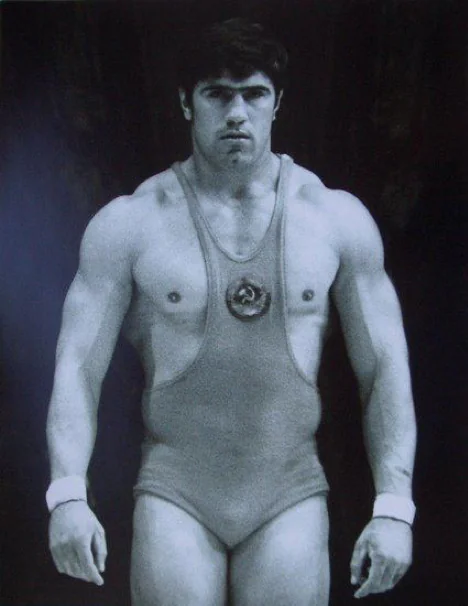
David Rigert: Rock-Star Olympic Weightlifter
Bad to the Bone David Rigert: pissed off at the world and for good reason
David Rigert was as close to a rock star as there ever was in Olympic weightlifting. First and foremost were his feats: his mystique was founded on his otherworldly accomplishments. Rigert set 63 world records, second only to the greatest Olympic lifter of all time, Vasiliy Alexeev. Rigert eventually pressed 437, snatched 407 and clean and jerked 507, all world records and all made while he weighed between 195 and 205-pounds. For lifters studying weightlifting, barbell power, explosive strength, and old-school resistance training, David Rigert remains one of the most charismatic athletes the iron world has ever produced.
David Rigert, the Rock-Star Olympic Weightlifter
Atop otherworldly accomplishments add good looks, swagger, lots of anti-establishment attitude, repeated excessive drinking, fighting, arrest, deportation, suspensions, and ultimately, utter and complete triumph. No, I am not describing Kirk Karwoski or Keith Richards, I am describing David Rigert, born a pissed-off rebel, and for a lot of good reasons.
Why Rigert Was Pissed Off at the World
In June of 1941 Hitler launched operation Barbarossa. Four million German soldiers invaded the Soviet Union across a 900-mile front in a war of annihilation and extermination. Stalin was shocked, caught totally unawares. One of the consequences was the immediate exile and forced migration of Russians of German extraction. Russia had attracted tens of thousands of German immigrants starting in the 1700s. There were huge enclaves of Russians with German roots in the Ukraine, the Baltic states and those areas abutting Poland and East Prussia.
Stalin’s solution was forced mass migration: he did not want Russians with deep German roots throwing in with the invading Nazis. He ordered the forced migration of 650,000 German Ukrainians. He ordered 500,000 Germanics in the Baltic States into exile, sending them 800-miles eastward to Siberia. Able-bodied boys and men were sent to gulag work camps, munitions factories, mines or steel mills. Slave labor laid 20,000 miles of Soviet railroad track from 1941 thru 1944. These men were worked seven days a week and lived on starvation rations. The enslaved workers had a 70% mortality rate.
Speaking of mortality rates: 88% of all German war deaths in World War II occurred on the Eastern Front. Though the Germans killed four Russians for every one of their losses, the Red Army didn’t care as they had an endless supply of replacements. The Red Army mobilized eight million men and their motto was “Not one step back!” Stalin’s secret police machine gunned any Red Army soldiers caught retreating. Field Marshall Zhukov, the greatest general of World War II quipped, “It takes a brave man to be a coward in the Red Army.”
David Rigert’s father was sent to the Ural Mountains to work as a slave laborer. His mother and the children were sent by railcar to barren and desolate North Kazakhstan. David grew up in Muslim Kuban territory near the Caucasus. The treatment of his parents and his extended family was the genesis of his hatred of Soviet authority.
Self-Taught Strength and Master of Sport
After the war, David’s family were allowed to return home, or what was left of it. Young David was short yet perfectly proportioned. He was naturally athletic and explosive. Later in life he would develop a 40-inch vertical leap. David came to Olympic weightlifting late in life: he was 19-years old before he touched a barbell. He trained himself using Arkady Vorobyrov’s textbook. He joined the army and after two years of self-instruction he won the coveted Master of Sport certification in Olympic weightlifting. This was unheard of for an individual without any formal coaching.
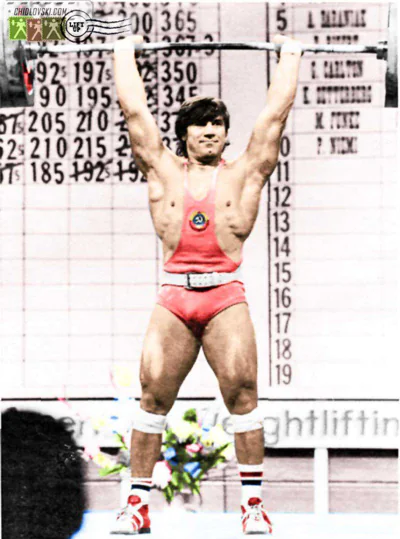
Weightlifter David Rigert toys with 220 kilos, 484-pounds, weighing 195.
Rudolf Plyukfelder and the Trud Voluntary Sports Society
After he left the army, David lived and trained in Armavir. In 1969 he met the famous weightlifting coach Michael Rudolf Plyukfelder. As a lifter, Rudolf Plyukfelder won world championships in 1959 and 1961. He won the Olympic gold medal in 1964. As a coach, Rudolf created an unrivaled stable of world and Olympic champions starting with Soviet mega-star Yuri Vlasov. Rudolf trained the greatest weightlifter of all time, Vasiliy Alexeev. Rudolf created Olympic champions Aleksey Vakhonin, Nikolay Kolesnikov, Aleksandr Voronin, Viktor Tregubov, and David Rigert.
Rudolf Plyukfelder was an Olympic-lift genius; arguably the greatest Olympic weightlifting coach of all time. Plyukfelder was born in the Ukraine to a family with deep German roots. The Plyukfelder’s lived in an enclave of Germanic Russians. When Germany invaded the Soviet Union in 1941, Rudolf’s father and older brother were executed by the Russian secret police, shot in the head while the family watched. The rest of the family was sent to a labor camp in Siberia. At age 14 Rudolf was working 15 hours a day seven days a week in a Siberian coalmine in sub-zero temperatures wearing rags.
After the war, what was left of his family were allowed to return to what remained of their war-ravaged homes. As a pissed-off wrestler with coal miner strength, Rudolf won the regional wrestling championships in 1948 and 1949, overpowering opponents, brutalizing them. He began weightlifting at the advanced age of 22. He trained on his own as there was no weightlifting coach in his area. It was during this period he formulated his unique training approach that would enable him to win world championships, to win the Olympics, to set world records and then use these selfsame methods to create an army of world and Olympic champions.
As a lifter Rudolf set eight official world records, one in the press, five in the snatch and two in the total, the sum total of the three lifts. While still competing Plyukfelder coached some of his teammates. Aleksey Vakhonin was a future Olympic champion created by Rudolf from scratch. Years later, when Rudolf saw young David Rigert in action for the first time, he liked what he saw, a raw, lightning-fast, fearless powerhouse…a cocky bastard with an obvious chip on his shoulder. Rudolf understood the origin of that chip and he saw a lot of himself in the incredibly talented self-taught boy who had already attained the coveted Master of Sport, all on his own.
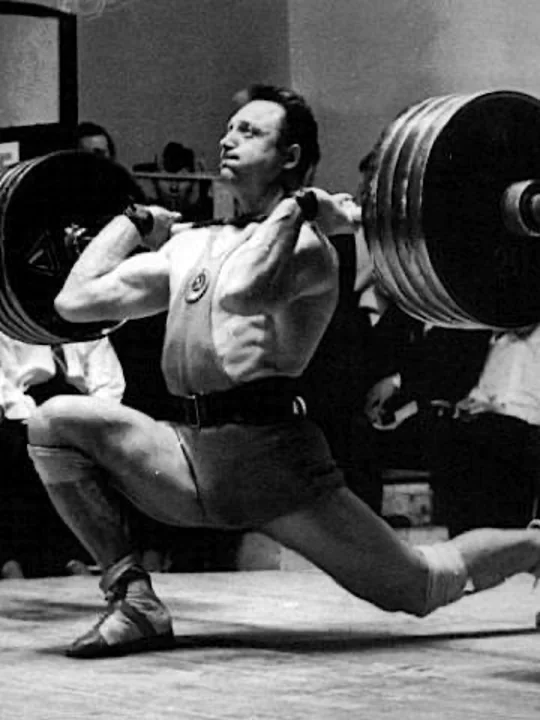
Rudolf Plyukfelder would become the world's greatest coach coaching the world's greatest Olympic weightlifter David Rigert.
Rudolf invited David to relocate to Shakhyy, where Rudolf taught weightlifting at the ominously named Trud Voluntary Sports Society, as opposed, I suppose, to a KGB-sponsored involuntary sport society. Rudolf didn’t have to ask David twice. David took to the new approach: after eleven short months using the Master’s system, David Rigert made the USSR national team in the 181-pound class. At the 1970 world championships the 24-year old 175-pound lifter, with only five years of training, won the bronze medal at the world championships.
The 1971 World Championship Breakthrough
Plyukfelder decided it was time to move David up a weight class, from 181 to 198. The twenty additional pounds of muscle turned David Rigert into a weightlifting terminator. He won his first world championship in 1971 in Lima, Peru where he steamrollered the best in the world with a 391-pound press, backed up with a world record 358-pound snatch and a world record clean and jerk: 441-pounds, making David the first middle-heavyweight in history to break the 200-kilo barrier.
The 1972 Olympic Debacle
At the 1972 Olympic Games David suffered the most humiliating loss of his career. He built a solid lead in the press before inexplicably opening with 363-pounds in the snatch. At the time he held the world record at 374-pounds. Why he insisted on starting so high, and why the Soviet coaches allowed it, remains clouded in mystery. He missed three snatches in a row and the surefire winner was out of a competition he could have easily won, disgraced and embarrassed.
In 1972 the press was dropped as one of the three competitive lifts. An entire segment of athletes was disenfranchised, put out to pasture. Like the Plyukfelder-trained superstar, Alexeev, David and Vasiliy were different; they set world records in all three lifts so dropping one lift just meant they could get better by concentrating on the remaining two. Before the press was banned, Rigert ended up setting the all-time 198-pound record in the press when he rammed overhead a staggering 437-pounds. Remember that just four years prior he was setting world records in the clean and jerk with 440, now he was pressing it.
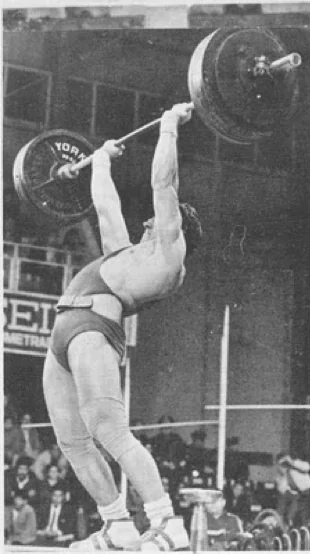
David Rigert 198-pound overhead barbell press record.
World Records, World Titles, and Gaming the System
After the 1972 Olympic debacle, Rigert pulled himself together: he won four consecutive world championships in the 198-pound class and finished his career with a world championship win in the 220-pound class weighing a light 204-pounds. He was balance personified, setting 21 world records in the snatch and 21 world records in the clean and jerk. He set 14 “total” world records, the combined poundage of the snatch and the clean & jerk. His world record balance made him unbeatable: no one came close to beating the USSR terminator for nearly a decade.
He was a conflicted man gaming the system: each time he set a world record he got a cash bonus; his record breaking was making bank for himself and his people. Yet the money came from the same killers that had terrorized his parents and killed Rudolf’s father and brother. It is doubtful that he ever showed us his true potential. The soviet system was set up to provide cash awards for national, big, and world records, much bigger. All of which was blatantly illegal by the “amateur” standards the free world athletes had to adhere to.
If you are being paid 1,000 extra rubles every time you break a world record, and you are breaking your own world record, the smart move is to barely break your own current world record, though you might be capable of crushing it by 10-kilos. The smart move is to inch the record up a tiny bit at a time, milk it for all it is worth. Alexeev and Rigert were the masters at gaming the system; the downside was that we missed them going all out when they were at their all-time best. It would have been financially detrimental.
The Weightlifting Rock Star
Rigert was a superstar and knew it. Real superstars have latitude that mere mortals do not. David knew he could stretch and bend and break rules other team members would not dare. He was David-freaking-Rigert, the most popular and charismatic weightlifter in the world. He kicked ass for the USSR with yawning regularity. He was difficult and aggressive and he hated authority. He smoked cigarettes, drank vodka by the gallon, leapt off 15-foot balconies, got in bar fights, chased beautiful women, and threw up on KGB handlers. Then the next day he’d break four world records.
He routinely violated curfew and when inebriated scuffled with KGB security guards on overseas trips. He snuck groupies into his hotel room and was suspended for drinking and fighting. He spoke his mind. This man had no love for the government that exiled and enslaved his parents. On the other hand, weightlifting had been a way out of the ghetto and a dead-end life. And he was unnaturally good at it. He had the right body type, the right nervous system and the right combination of raw strength and explosive power.
His best snatch at 198 was 396-pounds; his best clean and jerk was 487. At the end of career, he forayed into the newly created 100-kilo, 220-pound class. Weighing a light 204-pounds, barely over the middle-heavyweight class limit, he snatched 407 and clean and jerked 507. There is no doubt that had he exerted the slightest bit of diet discipline, he could have posted these lifts as a 198-pound lifter.
His physique was incredible and he backed up the swagger and attitude and world record after world record and world title after world title. He was a charismatic weightlifting rock star – and deservedly so. We miss him and we miss his type and kind. I prefer rock stars before they get cleaned up at the Betty Ford Center.
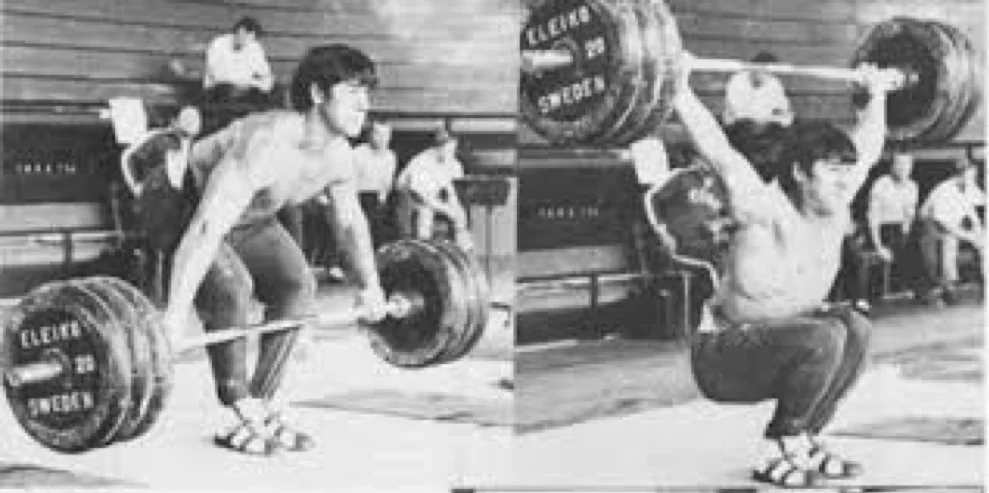
Weightlifter David Rigert snatching barbell. Rigert is shown snatching 308 while keeping his heels pinned together: atop his own naturally iconic training inclinations, his main influence was his mentor Rudolf Plyukfelder, the most innovative Olympic trainer of all-time.
Equipment Lessons from David Rigert-Style Weightlifting
David Rigert’s greatness was not created by equipment alone; it was created by genetics, rage, speed, coaching, practice, and fearless barbell execution. Still, Olympic weightlifting and serious strength training require the right basics. A home gym, school weight room, commercial strength room, first responder gym, or military fitness area built around serious lifting should start with dependable free weights, an appropriate Olympic bar, accurate plates, and enough room to train with control.
For lifters focused on barbell work, compare barbells, Olympic weightlifting bars, the Body-Solid Black Oxide Olympic Weightlifting Bar, and the Iron Grip OB-7 Industrial Chrome Olympic Weightlifting Bar when selecting equipment for snatches, cleans, jerks, pulls, overhead press work, squats, and broader weight training.
For loading options, weight plates and American Barbell urethane Olympic grip plates can support progressive loading across Olympic lifting, resistance training, and general strength work. For accessory training, fixed barbell work or controlled supplemental lifting, the IRON COMPANY urethane barbell set and dumbbells can support assistance exercises that do not replace the Olympic lifts but can round out a facility’s free weight area.
For rack-based work, presses, squats and general strength training support, facilities can compare power cages, platforms, and power racks or the Alpha 7 Power Rack. The equipment should serve the training: precise bar path, repeatable loading, safe setup, and enough durability to support hard use.
Training Note
This article is historical strength training commentary, not medical advice or a beginner Olympic lifting prescription. Snatches, cleans, jerks, heavy overhead pressing, squats, pulls and advanced weightlifting technique require proper coaching, appropriate loading, adequate space, recovery, and sound equipment. The useful lesson from David Rigert is not reckless imitation; the useful lesson is the blend of speed, strength, technique, fearless intent, and hard-won mastery under the bar.
David Rigert FAQ
Who was David Rigert?
David Rigert was a Soviet Olympic weightlifter and world record holder known for his extraordinary snatch, clean and jerk, overhead press, physique, rebellious persona, and rock-star charisma. Marty Gallagher presents him as one of the most magnetic figures in Olympic weightlifting history.
How many world records did David Rigert set?
In this article, Marty states that David Rigert set 63 world records, second only to Vasiliy Alexeev. The article also notes his balance across the snatch, clean and jerk, and total records.
What were David Rigert’s best lifts?
Marty lists Rigert’s top lifts as a 437-pound press, 407-pound snatch and 507-pound clean and jerk. He also notes that Rigert’s best 198-pound class lifts included a 396-pound snatch and 487-pound clean and jerk.
Who coached David Rigert?
David Rigert’s key coach was Michael Rudolf Plyukfelder, an Olympic champion, world champion and one of the most innovative Olympic weightlifting coaches of all time. Marty credits Plyukfelder with helping turn Rigert into a world-class force.
What happened to David Rigert at the 1972 Olympics?
Rigert built a solid lead in the press, then opened high in the snatch and missed three attempts in a row. Marty describes it as the most humiliating loss of Rigert’s career because he was considered a surefire winner.
What equipment supports Olympic weightlifting training today?
A practical Olympic weightlifting setup includes a quality Olympic weightlifting bar, appropriate weight plates, free weights, room to lift safely, and rack or platform support where needed. Dumbbells and fixed barbells can support accessory work, but the primary skill work still centers on the barbell.
About the Author
As an athlete Marty Gallagher is a national and world champion in Olympic lifting and powerlifting. He was a world champion team coach in 1991 and coached Black's Gym to five national team titles. He's also coached some of the strongest men on the planet including Kirk Karwoski when he completed his world record 1,003 lb. squat. Today he teaches the US Secret Service and Tier 1 Spec Ops on how to maximize their strength in minimal time. As a writer since 1978 he’s written for Powerlifting USA, Milo, Flex Magazine, Muscle & Fitness, Prime Fitness, Washington Post, Dragon Door and now IRON COMPANY. He’s also the author of numerous books including Purposeful Primitive, Strong Medicine, Ed Coan’s book “Coan, The Man, the Myth, the Method" and numerous others. Read the Marty Gallagher biography here.

Marty Gallagher is a champion strength athlete, coach, author, and RAW Podcast host known for powerlifting, Olympic lifting, and serious strength training.
