
 Call us today at 1-888-758-7527

Chasing Ken Patera: Olympic Weightlifting Part 2
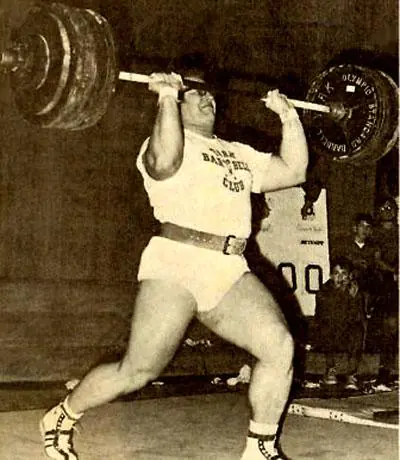
Here is how close Olympic weightlifter Ken Patera came to being the first man in history to lift a 500-pound barbell overhead. This lift was done at a local competition in Portland, a full six months before Alexeev completed the feat. As a consolation prize, Ken Patera became the first man to clean and stand erect with a 500-pound barbell.
Portland, 1970: I had missed Olympic weightlifter Ken Patera by mere weeks. I was now living three blocks from the gym Ken trained at, or had trained at until he was excommunicated. Ken Patera, the hottest young lifter in America, had been unceremoniously booted out of the gym he trained at. His offense? Repeatedly dropping barbells weighing between 350 to 500 pounds from nine feet in the air.
Ken Patera, Sam Loprenzi, and the Barbell Bombs
This was before the invention of rubber bumper plates and Patera was dropping giant barbells onto wooden weightlifting platforms and hard iron edges were splintering carefully constructed plywood lifting platforms. This did not endear him to management. In Ken’s defense, his drops were not purposeful; these were close misses in the clean and the snatch.
Sam Loprenzi was the gym owner and lived in an apartment atop the gym. Sam was in his late 50s and single. He was a cool dude, an ex-Mr. America contender and no sissy. He related that Patera’s misses sounded like a stick of dynamite had been set off under his living room. Sam later said, “Ken’s misses were always at the worst times for me. I would be just drifting off to sleep or sipping wine when a Patera atomic bomb would go off. If he was having a bad night, Ken might miss five times over a three-hour period.” Ken Patera had to stop Olympic weightlifting or be gone.
Ken was gone; I knew not where, but in his Jaws-like wake I heard plenty of “Ken stories” from Portlanders that had witnessed him training. One local monster man told me how he and a buddy had shown up to train at Sam’s gym and the counterman said, “Ken’s here.” My guy continued. “So, my buddy and I walk into the main room and sure enough, Ken is sitting on a weight bench. He has 365 pounds sitting on the squat rack. This was gonna be GREAT! We’d get to see Ken squat; maybe on his heavy set with 800 he’ll ask US to spot! So, Ken stands up from the bench for his set of squats with 365. He goes to the Olympic bar, un-racks the barbell, steps back, sets up to squat, takes a deep breath, and then does three perfect reps in the press-behind-the-neck! We lost our shit!”
Ken Patera: Genetic Wonder and Multi-Sport Power Athlete
Olympic weightlifter Ken Patera was the very definition of a genetic wonder. He was from a clan of genetic wonders: his older brother Jack Patera had a long NFL career as a middle linebacker. Jack became truly famous as the longtime head coach for the Seattle Seahawks. Another of the Patera brothers, Dennis, played for the San Francisco 49ers. Ken was a star football player, wrestler, basketball player and track and field athlete. In high school he broke an ankle playing basketball and from that point forward he focused on shot put and discus.
Ken Patera won a track scholarship to Brigham Young University and became one of best shot putters in the country. He took 3rd at the collegiate nationals and eventually tossed the 16-pound ball 64-7 when the world record was 69-2. Leading up to the 1968 Olympic tryouts he decided to peak his power and up his bodyweight. He pushed his bodyweight up to 300 pounds, Ken is 6’1”, and his raw power soared: he smoked an 820-pound ass-on-heels raw barbell squat and pulled a 725-pound deadlift in a lift he did not practice. He made a 520-pound paused bench press. Not bad for a guy who normally only did incline bench presses.
When he didn’t make the 1968 Olympic Team in the shot put, he turned all his time and attention towards weightlifting. His progress was astounding. The Olympic Trials for track and field were in May of 1968. By December of 1969, seventeen months later, he became the first man to clean and stand erect with 500 pounds. He missed the jerk portion of the lift. A few months later, at the 1970 world championships in Columbus, Ohio, Alexeev became the first man to clean and jerk 500 pounds.
Ken Patera’s Overhead Barbell Press and Olympic Weightlifting Power
Ken Patera began his competitive weightlifting career at an advanced age. Like Paul Anderson before him, Ken overcompensated for his raw, inefficient technique, a symptom of his late-in-life start, with ungodly pure power. He “gooned” the weights, technique be damned. It was no coincidence that his best lift, the overhead press, was the least technical. Even here he gave away pounds to the overhead press technical tricksters: Ken’s presses were models of strictness.
On the national level, Ken simply took over. At one time he held all the American records simultaneously: press, snatch and clean and jerk. He eventually pushed his three-lift total to just a few biscuits shy of 1,400 when he posted a 1,397-pound total. This awesome display consisted of a 505-pound press, a 387-pound snatch and a 507-pound clean and jerk. Internationally it was a different story.
Serge Redding and the West German wunderkind, Rudolph Mang, were both excellent lifters; however, neither was remotely capable of handling Vassily Alexeev. Ken Patera was capable of beating the Soviet superman. Ken had the power, Ken was stronger than Alexeev. The thinking was, if Ken, late to the game, could refine his techniques he could beat the unbeatable King. He was that strong. His presence pushed Alexeev to incredible levels.
Dropping the press in 1972 allowed Alexeev to concentrate on the snatch and the clean and jerk. Four years of concentrated effort, and an ever-escalating 350-pound bodyweight, propelled him to unimagined heights: in 1976 Alexeev clean and jerked an otherworldly 564 pounds. This lift has only been exceeded by 24 pounds in 43 years. Alexeev also pressed the most weight ever, 521 pounds, using a much looser style and far more advanced technique than Ken’s super-strict 505. When Ken took the barbell out of the squat racks for the overhead press, avoiding the clean, he could ram 550 overhead.
Ken bombed out of the 1972 Olympics; he missed three consecutive snatches and was out of the competition. That same week the press was dropped as one of the three competitive lifts by the IOC. Now only snatch and clean and jerk would be contested. Ken bid Olympic weightlifting adieu. He headed into a lucrative, high-profile career as a big time WWF wrestler. Again, because of his innate athletic abilities, because of his raw power, his transition was effortless. How did he train at his peak? Here is Ken Patera in his own words.
Ken Patera’s 1972 Olympic Weightlifting Training Template
Here is a typical workout schedule, one I am using as I am preparing for the 1972 Olympic Games. With these exercises, I strengthen every position and every movement in Olympic lifting.
Monday, July 3rd 1972
- Overhead squats: 135 x 3, 205 x 3, 255 x 3, 295 x 2, 325 x 2
- Front squat: 225 x 3, 315 x 3, 405 x 3, 455 x 2, 520 x 1
- Snatch-grip hi-pulls off blocks: 225 x 3, 315 x 3, 365 x 3, 405 x 3
- Press behind neck: 135 x 3, 205 x 3, 255 x 3, 305 x 3, 345 x 1
Wednesday, July 5th
- Front press off the racks: 225 x 3, 295 x 2, 355 x 2, 405 x 1, 440 x 1, 480 x 1, 325 x 5
- Clean-grip hi-pulls: 255 x 3, 305 x 2, 355 x 2, 405 x 2, 455 x 2, 505 x 2, 555 x 2
- Hyper-extensions: no weight, 3 x 10, rise up as high as possible on each rep
Friday, July 7th
- Snatch: 135 x 3, 205 x 3, 255 x 2, 295 x 1, 315 x 1, 340 x 1, 360 x 1
- 45-degree incline press on bench: 225 x 5, 295 x 5, 345 x 3, 405 x 3, 430 x 1
- Good mornings: 135 x 5, 205 x 5, 255 x 5, 305
At the time of the workout, July, 1972, Ken weighed a tight 320. At his peak he posted these lifts: clean and press 505; press with bar taken out of the squat rack, avoiding the clean, 550; 45-degree incline 465; standing press behind neck 375; power clean 440; front squat 615; back squat 820; overhead squats with snatch grip 405 x 5. Had Ken gotten into Olympic lifting as a youngster and been drilled on technique by a topflight coach, he would have ruled the world.
His training template is minimalism personified: we get dazzled and distracted by the poundage he used. Strip away the fascination with his feats and he was a minimalist. At his peak he trained three times a week performing four exercises in session 1 and three exercises in sessions 2 and 3. Ken performed a grand total of ten exercises per week and he never repeated an exercise during the course of the training week. This is the epitome of doing fewer things better.
He was athletically talented and perhaps saddled with the curse of too many choices. Olympic weightlifting is the absolute worst, in terms of financial compensation or recognition. For Ken Patera, becoming one of the best weightlifters in the world was just another athletic bus stop. When the elite banned the power lift, the overhead press, Ken’s forte, that was the last straw. Besides, he was going broke as a lifter. Pro wrestling beckoned. Needless to say, he thrived.
Meeting Ken Patera Years Later
I had the good fortune to meet and party with Ken in a surreal, Hunter S. Thompson-esque Fear and Loathing setting. For some bizarre reason, for several years in a row the most prestigious powerlifting competition in America was held at a working-class casino in a godforsaken corner of West-by-God Virginia. This was a race track and casino set in the middle of a seriously ravaged section of West Virginia. The best rooms available were really rough. Having said that, I had some incredible times: I rubbed shoulders with giants.
Power God Ed Coan would lift at these meets. Doug Furnas would attend to coach Ed and on one memorable occasion I got Doug to come to the shabby suite I was sharing with Kirk Karwoski to do a taped interview for Muscle & Fitness magazine. Doug showed up in a great mood, which was good. I had seen Doug in not-so-good moods and that was frightening. He could have a terminator vibe about him that would make an interview difficult if not impossible.
Some serious lifters got wind that power God Doug would be coming to Kirk and Marty’s room at 1 PM on Friday. By the time I turned on the tape recorder, Doug and I were sitting in a room with eight beefy lifters, men that had come to sit and listen, all with bowed heads, listening hard, ultimate respect for the uber-alpha male that was Doug.
I am a good interviewer. I have a lot of practice. When I worked for Muscle & Fitness, my job was to interview the world’s best bodybuilders on how they trained and ate. I go by the truism my Irish dad often related, “I never learned a goddamned thing listening to myself talk.” I ask good questions and shut up. Then I ask good follow-up questions and shut up. Furnas was really relaxed and appreciated my serious philosophic training questions. We ebbed and flowed for two hours. We parted company. The boys in the room actually applauded after their alpha leader left.
The next night I partied hard with Ken-freaking-Patera.
The Silver God in West Virginia
The same weekend as the powerlifting competition, the casino was hosting a UFC-style, steel cage octagon event. The headliner was, then still active, UFC hall of fame fighter Dan Severn. Dan was going to fight some highly touted local in the main event. I had interviewed Severn for Muscle & Fitness and knew him. We got on really well. He was smart and savvy. Randy Strossen, the Major Domo of MILO magazine, was at the event and told me Patera was there for the fight. I was instantly intrigued: I had been just missing Ken for decades. I tried to interview him for M&F and we had never connected. I’d heard he didn’t do interviews.
Dan Severn toyed with the local before submitting him in the second round. Afterwards, there was also some sort of ridiculous bench-shirt competition: a bunch of guys that would be hard-put to bench press 550 pounds raw, with a pause and no shirt, were trying to bench press 800 pounds. They were wearing bench shirts that increased their un-shirted pushing power by 40%.
The bench shirts were so tight and so restrictive that seven out of eleven bench contestants bombed out, missed three consecutive bench presses and were out of the competition, because, despite pulling downward with all their might on barbells loaded with 700-plus pounds, they could not get the barbell to touch the chest. It was ludicrous.
Randy Strossen kept buying rounds of beer at both the fight and the bench press contest. I was drinking three beers to every one of his; I was getting pretty loose. After the fight and the bench press extravaganza, everyone effortlessly gravitated to the casino bar. It was then I spotted my white whale: Ken was here.
I saw him with my first glance around the bar, he was unmistakable: he wore a massive silver pompadour atop his massive head atop his massive body. He stood out in this smoke-filled bar like a lighthouse. He glowed. He was a comic book hero come to life. I was magnetized and moved towards him. He was standing at the bar talking to some lifters and fighters as Ken had a foot in both worlds.
I introduced myself and past that I did not know what to expect. We shook hands and he said, “I know who you are! Drink with us!” He didn’t have to ask me twice. For whatever reason he locked in on me and we proceeded to commence drinking, talking and laughing. We hit it off. Outwardly I was cool, inwardly, I was losing my shit. I was partying with the ghost, the man I had been just missing for decades.
The Silver God was here in the flesh and he’d taken a shine to me. We clicked. He was not introspective or demur, he was looking to have some drinks with some serious athletes and talk about a wide-ranging series of inter-related training topics. Patera was a smart dude. He was open and gregarious and reminded me of some of my hardcore Irish relatives, particularly my vicious cousins in the strip-mined coal town of Wilkes Barre.
We talked alone, we talked with small groups, we talked in large groups, we laughed our asses off. We drank man drinks: whiskey and stout beer. Round after round after round after round after round. It was a surreal setting: a hillbilly casino in Appalachia stuffed with out-of-shape chain-smoking locals. To make the absurd more surreal, I was sitting in a small bar stuffed to the gills with cage fighters, world-level powerlifters and the Silver God, Ken Freaking Patera, getting hammered and laughing till my guts were ready to explode.
And why not! No one was driving, we were all staying at the hotel, so overindulgence was assumed and expected. No wives or girlfriends in this crowd. I observed through my haze that herculean men tend to have herculean appetites and herculean capacities. I would love to relate some of Ken’s priceless strength bon mots. He was funnier than Rodney Dangerfield on a good night or, alternately, a profound sage when the topic turned to strength training. But relating his profundities is an impossibility since I blacked out.
Somehow, someway I ended up back in my hotel bed. My first awareness was putrid taste; it was as if a red-assed baboon had shit in my mouth. I awoke. I was then horrified to learn that I had amnesia: had I insulted Ken and had he power drilled me into the barroom floor? Was I concussed? I could not remember or recall a single wisdom-nugget that Ken had related. It was if that segment of my mind had been scrubbed, bleached, surgically wiped clean or perhaps more accurately, drowned in a sea of Irish whiskey and an ocean of Irish beer.
It was a night of utter and complete self-destruction: too much fun, too many shots of powerful booze, one toke over the line sweet Jesus. No clear memories other than that I had participated in some sort of strength Mardi Gras: powerlifting, cage fighting, a bench press carnival, culminating in my audience with the Silver God.
And all interspersed with enthusiastic substance over-indulgence and passionate gluttony. Actually, upon reflection, it was more of a strength Valhalla experience: it was the perfect day for the true alpha male: elite strength competition, elite cage fighting, athletics all day long and then at night eating and drinking and partying with the boys, hard and long and loud till they closed down the bar or everyone passed out. And not a woman in sight.
I was later told that Patera was a bit of recluse and public outings were a rarity. It sure didn’t seem so that night. I told Stacy this and called Patera “a gregarious recluse.” She smiled, “That phrase could be applied to you, Dumbo. Maybe that’s why you two got on so well.” I don’t know, I can’t remember.
Back to Chasing Ken Patera Part 1 here.
Equipment Notes for Olympic Weightlifting and Powerlifting Training
The Ken Patera story is not an equipment review, but the training details are a reminder that elite Olympic weightlifting and powerlifting are built around serious basics: a dependable Olympic barbell, appropriate weight plates, strong racks, a usable bench, and a training surface that can handle real work.
For modern strength rooms, garage gyms, school weight rooms, first responder training spaces and military fitness facilities, rack-based work can be built around a Body-Solid Commercial Squat Stand, a Body-Solid Commercial Power Rack, broader power cages, platforms and power racks, or a Defiant Strength Half Rack depending on available space and training goals.
For bench work, incline pressing and assistance work, options include a Defiant Strength flat utility bench, the Alpha multi adjustable bench, and the Defiant Strength Olympic bench press with plate storage. For dumbbell assistance work, facilities can compare dumbbells, American Barbell Series 1 urethane dumbbells, and rubber hex dumbbell sets.
For barbell loading, the CAP Barbell 7' Black Olympic Weight Bar, IRON COMPANY premium rubber bumper plates, and TKO solid rubber bumper plate sets can support different training environments when selected for the right user, room, and lifting style.
Training and Editorial Note
This article preserves Marty Gallagher’s firsthand voice, old-school powerlifting culture, and road-warrior strength writing. Olympic weightlifting, heavy overhead work, missed attempts, high pulls, front squats, snatches, bench pressing, and powerlifting-style training require proper coaching, suitable equipment, safe loading practices, and enough room to train. The barroom and overindulgence scenes are historical storytelling, not a recommendation for recovery, performance, or lifestyle.
Ken Patera FAQ
Who was Ken Patera?
Ken Patera was an elite American Olympic weightlifter, national record holder, multi-sport athlete, and later professional wrestler. Marty Gallagher presents him as one of the greatest overhead barbell pressers in history and one of the strongest American lifters of his era.
How close did Ken Patera come to lifting 500 pounds overhead?
According to Marty’s account, Patera became the first man to clean and stand erect with a 500-pound barbell in December 1969, but he missed the jerk portion of the lift. Alexeev later became the first man to clean and jerk 500 pounds.
What made Ken Patera’s overhead press so famous?
Patera’s overhead press was famous for its strictness and raw power. Marty cites an official 505-pound competition press and a 550-pound press from the racks, making Patera’s overhead barbell press one of the defining lifts of his era.
What was Ken Patera’s training template like?
Marty describes Patera’s peak template as minimalist. In the 1972 Olympic preparation example, Patera trained three days per week, used ten total exercises across the week, and did not repeat an exercise during the training week.
Why did Ken Patera leave Olympic weightlifting?
After bombing out of the 1972 Olympics and after the press was dropped as a contested lift, Patera left Olympic weightlifting and moved into a lucrative professional wrestling career.
What equipment supports Olympic weightlifting-style training today?
A practical setup includes an Olympic barbell, weight plates or bumper plates, a weightlifting platform, a squat stand or power rack, a stable bench, and dumbbells for assistance work. The exact setup should match the facility, coaching, lifter experience, and training goal.
About the Author
As an athlete Marty Gallagher is a national and world champion in Olympic lifting and powerlifting. He was a world champion team coach in 1991 and coached Black's Gym to five national team titles. He's also coached some of the strongest men on the planet including Kirk Karwoski when he completed his world record 1,003 lb. squat. Today he teaches the US Secret Service and Tier 1 Spec Ops on how to maximize their strength in minimal time. As a writer since 1978 he’s written for Powerlifting USA, Milo, Flex Magazine, Muscle & Fitness, Prime Fitness, Washington Post, Dragon Door and now IRON COMPANY. He’s also the author of numerous books including Purposeful Primitive, Strong Medicine, Ed Coan’s book “Coan, The Man, the Myth, the Method" and numerous others. Read the Marty Gallagher biography here.
Marty Gallagher is a champion strength athlete, coach, author, and RAW Podcast host known for powerlifting, Olympic lifting, and serious strength training.

Regards,
Steve James