
 Call us today at 1-888-758-7527

The Power Savant - Ultra-Minimal Power Training
Limit Training, Maximize Intensity, Create the Rested Effort
Limit training, maximize intensity, create the rested effort.
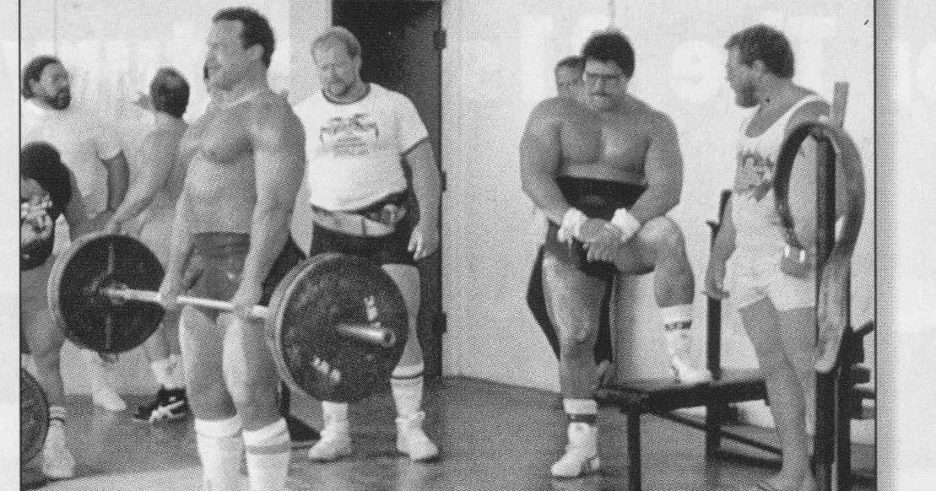
Mark Chaillet stands with one leg on the weight bench talking with me between warm-up attempts with Doug Furnas at the 1986 APF World Championships in Maui. The surviving meet sheet lists Doug Furnas at 985 squat, 600 bench, 815 deadlift and 2,400 total. It lists Mark Chaillet at 900 squat, 520 bench, 840 deadlift, and 2,260 total. Those numbers do not diminish the larger point: both men were monsters, and Chaillet was already proving that ultra-minimal power training could build world-class strength.
Mark Chaillet: Tunnel-Visioned Radical
Mark Chaillet was a tunnel-visioned radical, a true iconoclast who at an early age happened upon a unique style of training that suited him and suited his personality. He stayed with this rigid regimen without variation for the entirety of his career. That he got results was indisputable. Physically, Mark morphed himself into a gargantuan freak, a muscular monster, and one of the most formidable deadlifters of his era.
Mark stood 5 feet 9 inches and weighed around 275 pounds at his peak, carrying a thick, hard, powerful physique. Old strength accounts and my firsthand memory credit him with an 880-pound deadlift and a below-parallel 1,000-pound squat in training. The surviving powerlifting databases do not capture every gym lift, federation record, or old strength-history claim, but they do confirm the central truth: Mark Chaillet was a world-class lifter with a huge squat, huge deadlift, and tiny exercise menu.
His training was always the same. Young Mark fell in love with the competitive powerlifting experience and sought to replicate that atmosphere in every training session. Chaillet training sessions were mini-powerlifting competitions. Training sessions were twice weekly, Monday and Thursday, at Mark’s pristine power gym in Temple Hills, Maryland.
Temple Hills: Mini Powerlifting Competitions Twice a Week
The men that gathered at 4 p.m. were not a bunch of individuals who happened to be training in the same room at the same time, each pursuing an individualized resistance-training program. This was a ritualistic group training session. At 4 p.m. on Monday, everyone in the room started squatting. Then they bench pressed. At 4 p.m. on Thursday, everyone in the room started deadlifting.
There would be four separate lifting platforms going simultaneously, each geared to a different strength level. On each platform, each man in turn stepped up and performed, working upward in poundage. As one man lifted, the others in his group watched, spotted, exhorted, and critiqued.
Mark Chaillet was ferocious. Because he took it so seriously, life-or-death stuff, everyone else did likewise. There was no grab-assing or stupid boy stuff occurring. This was a roomful of scary dudes screaming and snorting ammonia while repping 800 on the barbell. There was a collective warrior / war vibe that took everyone’s game to the next level.
Why Heavy Singles Made Sense to Chaillet
Asked why he did nothing but single-rep top sets and why he did so few of them, Mark spoke with Zen clarity.
“I am a powerlifter. We are judged by our best single rep in each lift, this done in competition. I train for what we are judged on. If you are judged by your single rep strength, why would you avoid single reps in training? That makes no sense. Why avoid what you are to be judged on?”
When every training session is a power competition, competing in powerlifting competitions becomes second nature.
Psyche, Rage, and the Top Set
Before a top set, Mark would chalk his massive bearpaw hands and have me or his brother Ray tighten his lifting belt. Mark would lean forward and snap an ammonia capsule under his nose. He would take three deep snorts and let loose with an inhuman bellow. He was summoning up the gods of rage, psychosis, and chaos. He would then turn and hurl himself at the barbell.
Up close he was freaking scary. With his monstrous hands, gorilla leverages, insane temperament, and body loaded with gobs of low-end torque, he looked like he could tear a man apart. He was able to generate this degree of manufactured psychological fury on every top set of every squat, bench press, and deadlift. Mark was a psyche master.
He showed me, without words, what a real psych was: a real psyche is a scary psyche, not a faux WWE psyche. Chaillet boosted his performance dramatically with his summoned-from-hell mindset. I always felt it gave him an enormous edge. He skillfully controlled, channeled, and redirected his rage toward an inanimate object: a barbell.
The Rested Effort Before It Had a Name
In addition to Chaillet’s unshakable loyalty to his lifting menu of nothing but singles — and no other lifting of any kind — Mark had equally strong ideas about recovery. Mark was fanatical in his insistence that lifters trained too often, did too much and therefore always lifted in a fatigued state. At the time, Mark was accused of being lazy.
He was not lazy. He was early.
Mark was championing the same sophisticated rested-effort strategy that sprint guru Charlie Francis later codified in Speed Trap. Francis’s sprint revelations included these core ideas:
- Train all out: only by working up to and past current limits does a sprinter get faster.
- Train all out less often: if an athlete is never fully recovered, the athlete cannot express true top-end speed.
- Consider the central nervous system: optimal top speed requires a fresh CNS and longer rest between reps and sessions.
- Train at capacity when rested: to become faster or stronger, the athlete must train at a capacity-equaling or capacity-exceeding effort while fully recovered.
Francis’s sprint revelations mirrored Chaillet’s strength-training approach. Mark sought to exceed current 100% capacities, but only when 100% rested and recovered. How best do you rest and recover? Mark insisted you limit your exercise menu. Any exercises other than the three lifts “just wear you down.” In addition to training as little as possible, train as hard as possible. Then take a full seven days of rest before repeating that lift.
A Typical Chaillet Training Split
| Day | Lift | Work Performed |
|---|---|---|
| Monday | Squat and bench press | Work up to one planned single in each lift |
| Thursday | Deadlift | Work up to one planned single |
A 12-Week Ultra-Minimal Power Cycle
| Week | Squat | Deadlift | Bodyweight |
|---|---|---|---|
| 1 | 685 | 700 | 258 |
| 2 | 705 | 715 | 260 |
| 3 | 725 | 730 | 262 |
| 4 | 745 | 745 | 264 |
| 5 | 765 | 760 | 266 |
| 6 | 785 | 775 | 268 |
| 7 | 805 | 790 | 270 |
| 8 | 825 | 805 | 272 |
| 9 | 845 | 820 | 274 |
| 10 | 865 | 835 | 276 |
| 11 | 885 | 850 | 278 |
| 12 | 905 | 865 | 280 |
Mark would start a 12-week periodized training cycle underweight, weighing around 255 pounds, doughy, essentially untrained — or perhaps more accurately, detrained. Mark had the thick bone structure of a silverback gorilla. Even completely out of shape he was still capable of a 700-pound squat and deadlift.
Mark was a relatively light eater. When the cycle started, he would buckle down and get consistent about his food intake. Every week he would make a 20-pound jump in the squat and a 15-pound increase in the deadlift. He would push his bodyweight upward. He never got fat. The deeper into the cycle we got, the bigger, harder, more muscled-up, and leaner he became.
What Made the Power Savant Work
Mark Chaillet was the unconscious iconoclast. Stubborn and steadfast beyond comprehension, Mark had an unshakable belief in how best to weight train. He eventually squatted a below-parallel 1,000 in training and 940 in competition. Mark deadlifted 880 weighing around 270. He set numerous deadlift records across his competitive era. I was his training partner and competition coach for six years.
Mark was a powerlifting savant. He asked for no one’s opinion about training. He had one way of training: period. Thank God.
Mark staked out the uber-extreme of ultra-minimalism. He trained minimally within each session: three lifts and three lifts only, each done once a week for a single periodized rep. He trained infrequently and he championed the rested effort. Mark showed us how little was needed, in terms of training volume, to become massive and strong beyond comprehension.
Never has a man done less and gone further. Incredible.
Equipment Notes for Ultra-Minimal Power Training
Ultra-minimal power training makes equipment quality more important, not less. If the entire week turns on a few heavy singles, the bar, plates, bench, platform, and belt must be dependable.
For a Chaillet-style heavy-singles environment, lifters, and facilities can compare Olympic weightlifting bars, weight plates, weight benches, weightlifting platforms, and weightlifting belts.
A minimalist setup might include a platform such as the Legend Fitness 3131 basic weightlifting platform, a bench such as the Body-Solid SFID425 full commercial adjustable bench, a belt such as the IRON COMPANY all-leather powerlifting belt, loading such as American Barbell urethane Olympic grip plates, and a bar such as the CAP Barbell 7-foot black Olympic weight bar, when those tools match the lifter, room, load, and stated specifications.
The equipment does not create Chaillet’s strength. The equipment merely gives a trained lifter a safer, more stable place to express strength.
Safety Note for Heavy Singles and Minimalist Powerlifting
Mark Chaillet’s system was an elite powerlifting case study, not a beginner template. Heavy singles require technical consistency, progressive warm-ups, realistic planned targets, secure collars, suitable rack or platform setup, competent spotters where appropriate, and the discipline to stop after the prescribed lift.
Beginners, older trainees, injured lifters, deconditioned athletes and anyone without coaching should not copy maximal singles casually. Build technique with submaximal work first. Use safeties. Load progressively. Do not attempt a personal record when sleep, warm-ups, pain, balance, bar path, or bar speed tells you the day is wrong.
Ammonia, extreme psyche and heavy singles are not party tricks. They belong only in the hands of trained lifters who understand attempt selection, missed-rep risk, and recovery. Ultra-minimalism works only when the few sets performed are technically excellent, recoverable and safe enough to repeat.
This article preserves Marty Gallagher’s RAW firsthand historical coaching perspective. It is not individualized medical, rehabilitation, or programming advice.
Related Ultra-Minimal Training Reading
For more Marty Gallagher minimalism context, read Once-a-Week Strength Training Minimalism, The Undisputed King of Weight Training Minimalism, and Strength Training Minimalism Part III.
RAW with Marty Gallagher, J.P. Brice, and Jim Steel Podcast.
About the Author: Marty Gallagher
As an athlete Marty Gallagher is a national and world champion in Olympic lifting and powerlifting. He was a world champion team coach in 1991 and coached Black's Gym to five national team titles. He's also coached some of the strongest men on the planet including Kirk Karwoski when he completed his world record 1,003 lb. squat. Today he teaches the US Secret Service and Tier 1 Spec Ops on how to maximize their strength in minimal time. As a writer since 1978 he’s written for Powerlifting USA, Milo, Flex Magazine, Muscle & Fitness, Prime Fitness, Washington Post, Dragon Door and now IRON COMPANY. He’s also the author of multiple books including Purposeful Primitive, Strong Medicine, Ed Coan’s book Coan, The Man, the Myth, the Method and numerous others. Read the Marty Gallagher biography here.
Marty Gallagher is a champion strength athlete, coach, author, and RAW Podcast host known for powerlifting, Olympic lifting, and serious strength training.

Since first and now repeatedly having read 'The Purposeful Primitive' it's always the writing about Chaillet that reignites dwindling embers and that only serves to as a base to stockpile was inevitably comes from reading the books cover to cover.
Not really someone that comments on my posts however credit where it's due.
I thoroughly enjoy your style of writing and also the Podcast as well with J.P and Jim.
Thanks for taking the time to share all the info you've shared.